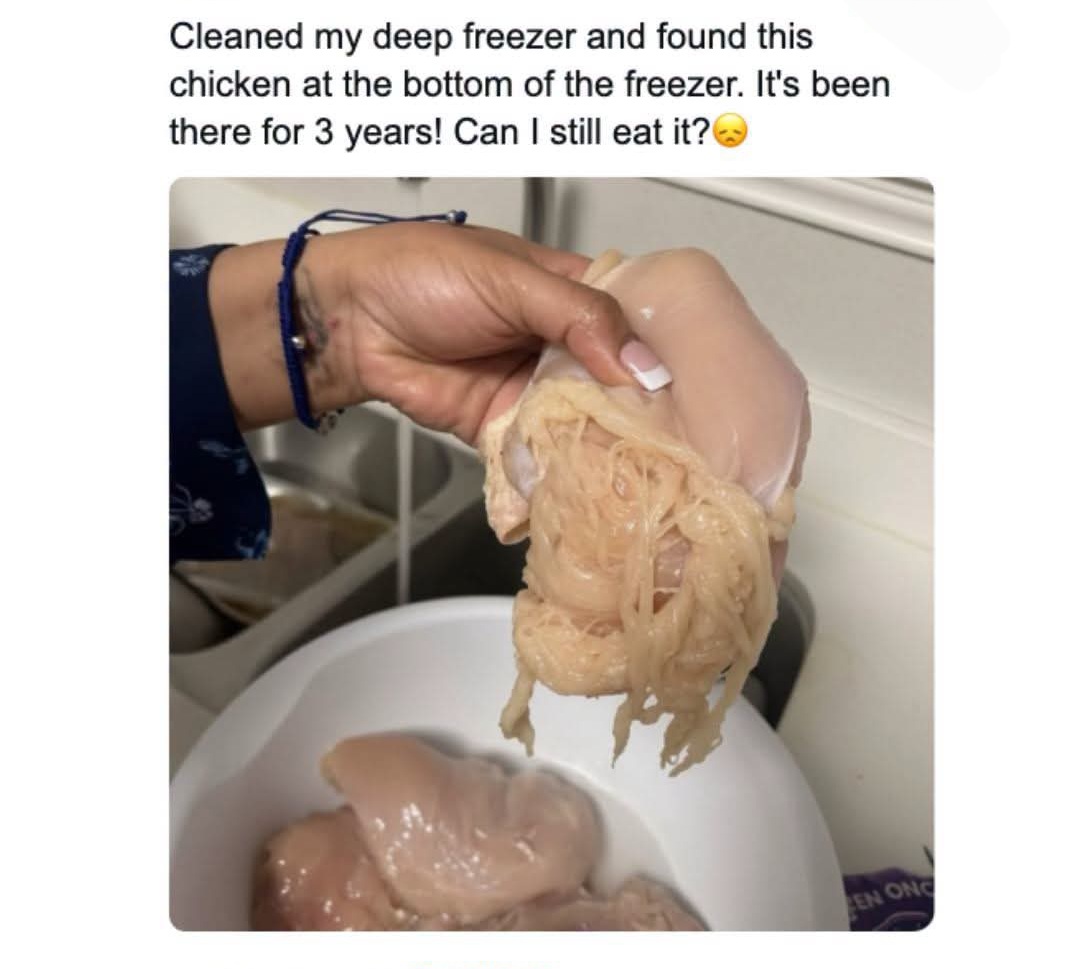
3-Year-Old Frozen Chicken: Would You Eat It? 👀🍗
“I cleaned my deep freezer and found this chicken at the bottom. It’s been there for 3 years! Can I still eat it?”
That is one freezer discovery that would make almost anyone stop and think twice. 😳
The chicken in the picture may look perfectly recognizable, but when something has been sitting in the freezer for three years, the real question isn’t simply whether it looks okay.
So, would you cook it—or throw it away?
🍗 Three Years in the Freezer: Is It Automatically Unsafe?
Here’s where freezer storage can be confusing.
Food that remains continuously frozen at 0°F (-18°C) or below can remain safe for a very long time. Federal food-safety guidance explains that freezing keeps food safe indefinitely, while recommended freezer-storage times are primarily about quality, not necessarily safety. (U.S. Food and Drug Administration)
However, that does not mean every three-year-old package of chicken is automatically a good idea to eat.
The important question is whether the chicken remained continuously frozen and was handled properly.
❄️ Safety vs. Quality
These are two different things.
Safety
If raw chicken has stayed continuously frozen at 0°F or below, freezing prevents microorganisms from multiplying. Simply being three years old does not automatically make continuously frozen chicken unsafe.
Quality
Quality is another story.
Chicken that has spent years in a freezer may suffer from:
- Freezer burn
- Dry, tough areas
- Loss of moisture
- Changes in texture
- Off-quality flavor
- Damage from poor packaging
USDA guidance notes that proper packaging helps maintain quality and prevent freezer burn, and that packaging can allow air to affect quality during prolonged storage. (Ask USDA)
So a three-year-old chicken might technically still be safe if it stayed properly frozen—but it could be a very unpleasant meal.
🚨 The Biggest Question: Did the Freezer Stay Frozen?
This is more important than the calendar.
If the freezer lost power, malfunctioned, or allowed the chicken to thaw substantially at some point, the situation changes.
If you don’t know whether the chicken remained safely frozen, don’t rely on its appearance or smell to decide whether it’s safe. USDA specifically warns that you cannot rely on appearance or odor to determine food safety, and you should never taste questionable food as a test. (Ask USDA)
When in doubt, throwing it away is the safer choice.
👀 What About the Chicken in the Picture?
The photo shows raw chicken that appears to have been frozen for an extremely long time.
But a photograph cannot establish whether the chicken is safe to eat.
You can’t determine from a picture:
- Whether it stayed at 0°F or below
- Whether the freezer ever lost power
- Whether it partially thawed
- How it was packaged
- Whether it was contaminated before freezing
- How it was handled before it went into the freezer
That’s why “It looks fine” isn’t enough.
🧊 Don’t Thaw It on the Counter
If you decide the chicken has been continuously frozen and you are going to use it, thaw it safely.
The FDA recommends three safe methods:
1. Refrigerator
Place the chicken in the refrigerator and allow it to thaw gradually.
2. Cold water
Keep the chicken in a leak-proof package and thaw it in cold water, changing the water every 30 minutes.
3. Microwave
Use the microwave only when you will cook the chicken immediately afterward. (U.S. Food and Drug Administration)
Never leave raw chicken sitting on the kitchen counter to thaw.
🌡️ Cook Chicken Thoroughly
If you do cook the chicken, poultry should reach an internal temperature of 165°F (74°C). Use a food thermometer rather than judging doneness by color alone. (U.S. Food and Drug Administration)
Check the thickest part of the chicken with the thermometer and make sure the safe temperature is reached.
🤔 Would You Eat It?
This is where the debate gets interesting.
Some people would say:
“If it stayed frozen the entire time, it’s safe.”
Others would say:
“Three years? Absolutely not!” 😂
And both reactions are understandable.
From a food-safety perspective, the length of time in the freezer alone doesn’t automatically make continuously frozen food unsafe. But from a quality perspective, three years is a very long time for chicken to sit in a home freezer.
And if you don’t know what happened to it during those three years, there is another very simple option:
🗑️ When in doubt, throw it out.
The cost of replacing a package of chicken is much smaller than the potential consequences of eating food that was not safely stored.
🍗 The Freezer Lesson
This is also a great reminder to occasionally clean out the deep freezer.
Label packages with the date you freeze them, keep your freezer at 0°F (-18°C) or below, and use older foods before newer ones whenever possible. The USDA recommends keeping freezers at or near zero degrees Fahrenheit. (Ask USDA)
A simple date written on the package can prevent the next great freezer mystery:
“When exactly did I put this in here?” 😂
👀 So… What’s Your Answer?
Imagine opening your freezer and finding this chicken at the bottom.
Three years old.
It stayed frozen the entire time.
The package isn’t clearly dated.
Would you:
A. Cook it 🍗
B. Throw it away 🗑️
C. Only use it if it passes a careful inspection 👀
D. Absolutely NOT take the chance! 😳
There may not be a universal answer to the “Would you?” question, but one thing is certain:
A freezer can hide some serious surprises! 😂❄️🍗
Final Takeaway
Three years in the freezer does not, by itself, prove that chicken is unsafe if it remained continuously frozen at 0°F or below. However, prolonged storage can seriously reduce quality, and if there is any uncertainty about whether the chicken thawed or was improperly stored, it is safest to discard it. (U.S. Food and Drug Administration)
Now be honest… would you eat this 3-year-old chicken? 👀🍗
