🥄
A, B, C, D… or E? The answer might be easier than you think!
There are some kitchen tools that seem to become part of the family. A favorite wooden spoon can stir hundreds of pots of soup, sauce, gravy, oatmeal, and stew. It gets darker with age, develops little marks from years of cooking, and somehow feels better in your hand than a brand-new utensil ever could.
But eventually, every wooden spoon reaches a point where you have to ask:
Is this a well-loved kitchen tool… or is it time to let it go? 😅
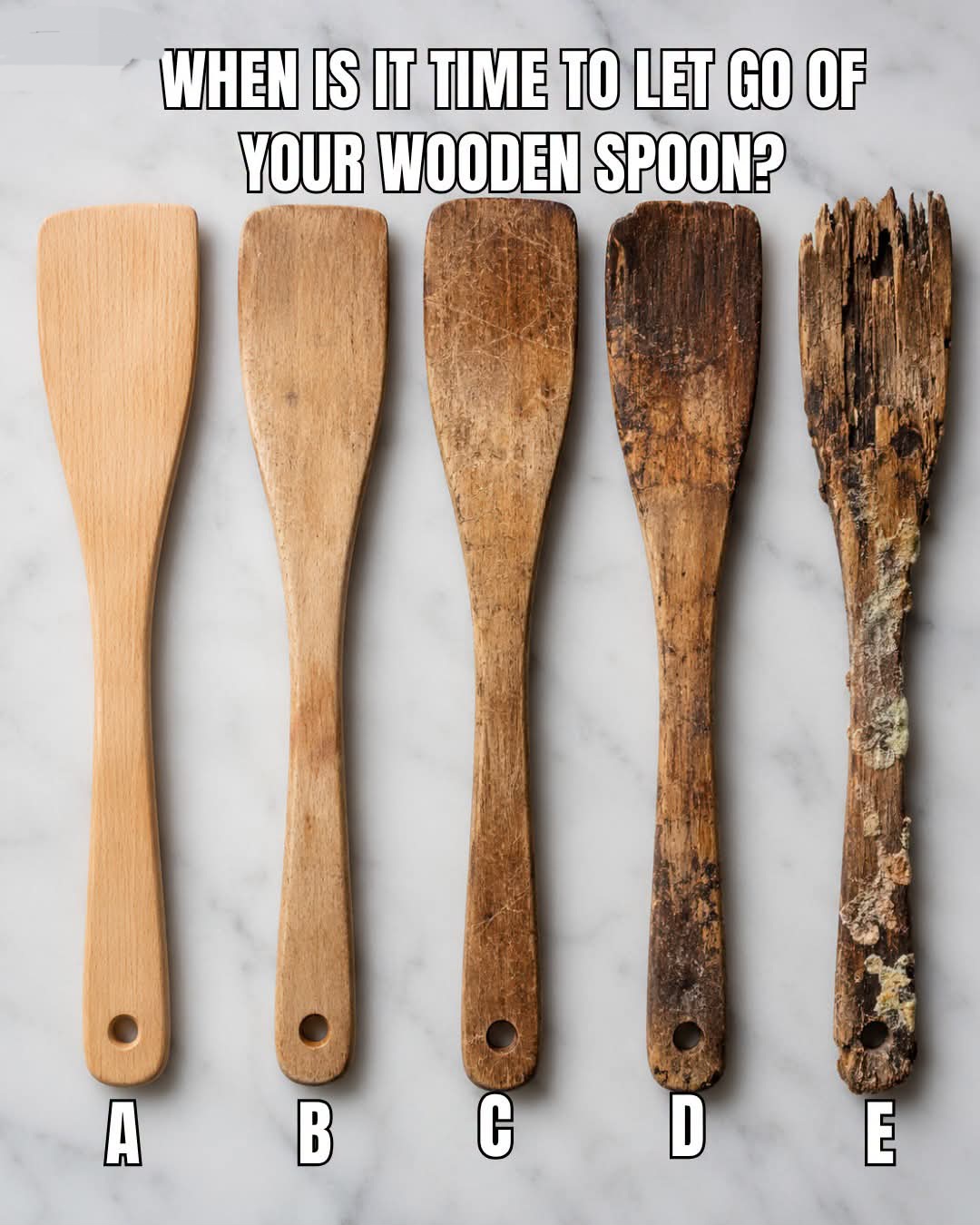
The picture above gives us five stages, from a beautiful new spoon to one that is clearly past its useful life.
So which one would make you throw it away?
🥄 A — Practically Brand New
This spoon is in excellent condition.
The wood is smooth, intact, and free from obvious cracks, splinters, deep grooves, or damaged areas. There’s no reason to replace a spoon simply because you’ve owned it for a long time.
A good-quality wooden utensil can last for years when properly cared for.
Verdict: Keep it!
🥄 B — Well Used, But Still Good
This spoon has clearly seen some cooking.
It may be darker than when it was purchased, and there are some scratches and signs of use, but the surface still appears intact.
That’s not necessarily a problem.
Wooden utensils naturally change appearance as they are exposed to food, heat, washing, and regular use. Age alone isn’t a reason to throw one away.
If the spoon remains smooth, structurally sound, and easy to clean, it can continue doing its job.
Verdict: Keep cooking!
🥄 C — Getting Pretty Worn
Now we’re entering the gray area.
This spoon has obvious discoloration, scratches, and wear. It looks like it has been through years of cooking—which isn’t automatically unsafe.
The important question isn’t:
“How old is it?”
It’s:
“Can I still properly clean and use it?”
If the surface is simply stained but remains solid and smooth, the spoon may still be perfectly serviceable. But if those scratches are becoming deep grooves, or the wood is beginning to split, it’s time to pay closer attention.
Verdict: Inspect it carefully.
🥄 D — Time to Start Saying Goodbye
This is where things become more concerning.
Deep cracks, splits, severe roughness, warping, or damaged areas can make a wooden utensil difficult to clean properly. Food residue and moisture can become trapped in damaged areas.
Food-safety guidance emphasizes that food-contact surfaces should be durable, smooth, and easily cleanable. (FSIS)
Experts similarly recommend replacing wooden utensils when they develop deep cracks, significant splintering, persistent odors, or other damage that makes them difficult to clean. (Which?)
Verdict: Probably replace it.
🥄 E — Absolutely Time to Let It Go!
Let’s be honest…
This spoon has retired. 😂
The final spoon in the picture is heavily deteriorated, with major splitting, rough fibers, darkened areas, and what appears to be significant surface deterioration.
That’s no longer simply “character.”
Once a wooden utensil becomes cracked, splintered, badly deteriorated, or impossible to clean properly, there’s little reason to keep risking it.
Verdict: Toss it and buy a new spoon.
🚨 The Biggest Warning Sign: Cracks
One of the clearest reasons to replace a wooden spoon is deep cracking or splitting.
Small surface marks aren’t necessarily a problem. But once a crack becomes deep enough to trap food particles or moisture, cleaning becomes much more difficult.
Cracks and splits are specifically identified as signs that a wooden utensil may need replacing. (Which?)
And you don’t need to wait until the spoon looks like the one labeled E.
If you notice a serious crack developing, that’s the time to act.
What About Stains?
This is where people sometimes throw away perfectly good wooden spoons.
A wooden spoon doesn’t have to remain the same pale color it was when you bought it.
Tomato sauce, curry, turmeric, coffee, caramel, and countless other foods can stain wood.
Staining by itself doesn’t automatically mean the spoon is unsafe.
The bigger concern is whether the wood is damaged, cracked, splintering, deeply grooved, or developing an odor that remains after proper washing and drying.
What About That “Old Wooden Spoon Smell”?
If a wooden spoon develops a persistent unpleasant or musty odor that doesn’t disappear after proper cleaning and drying, that’s another reason to consider replacing it.
Wood is porous, and damaged surfaces can make cleaning more difficult.
A spoon shouldn’t smell like last Tuesday’s dinner every time you pull it out of the drawer. 😂
🧽 How to Make Wooden Spoons Last Longer
A little care can dramatically extend the life of wooden utensils.
1. Wash Them by Hand
Wash wooden spoons with warm, soapy water after use and rinse them thoroughly.
USDA guidance recommends cleaning utensils with warm, soapy water and allowing them to air-dry or drying them with a clean towel. (FSIS)
2. Don’t Leave Them Soaking
Leaving wooden utensils sitting in water for long periods can contribute to swelling, drying, cracking, and warping.
Wash them, rinse them, and let them dry.
3. Avoid the Dishwasher Unless the Manufacturer Says It’s Safe
Wood can be damaged by the combination of heat, water, and prolonged washing. Repeated exposure can contribute to cracking and warping. (Allrecipes)
4. Let Them Dry Completely
Don’t immediately throw a wet wooden spoon into a closed drawer.
Give it plenty of air circulation so it can dry thoroughly.
5. Consider Food-Grade Mineral Oil
When wooden utensils become dry, food-grade mineral oil can help condition the wood and reduce the tendency toward drying and cracking. (Which?)
Don’t use ordinary household oils that can become rancid or leave the utensil sticky.
🥄 Can You Sand an Old Wooden Spoon?
Sometimes, yes.
If a spoon is merely rough or has minor surface wear, sanding can potentially restore a smoother surface. But sanding isn’t a magic fix for everything.
A spoon with deep structural cracks, major splitting, severe deterioration, or extensive damage should be replaced rather than rescued.
If you’re constantly wondering whether you’ve sanded it enough to make it safe again, buying a new spoon is probably the simpler—and safer—choice.
❌ What If There’s Mold?
That’s a different situation.
If you see obvious mold on a wooden utensil, don’t simply scrape off the visible patch and assume everything underneath is fine.
Mold can have microscopic growth below the visible surface, and damaged porous materials can be difficult to clean thoroughly. USDA guidance notes that mold can penetrate foods and that visible mold is only part of the growth. (FSIS)
For a heavily deteriorated wooden utensil with visible mold, replacement is the sensible choice.
❤️ But What About Grandma’s 30-Year-Old Wooden Spoon?
Here’s the interesting part.
A wooden spoon doesn’t have an expiration date stamped on the handle.
You might have one that’s 20 or 30 years old and still in excellent condition.
Another spoon might become unusable after only a couple of years because it was repeatedly soaked, overheated, poorly dried, or simply made from lower-quality wood.
Condition matters more than age.
A beautifully maintained old spoon can be perfectly useful, while a relatively new spoon with deep cracks and splinters may need to go.
🏆 So Which One Would You Throw Away?
Looking at the five spoons:
A — Keep
B — Keep
C — Inspect carefully
D — Replace soon
E — Definitely replace
And that’s the real lesson behind this picture:
Don’t throw away a wooden spoon just because it looks old. Throw it away when it becomes damaged enough that you can no longer clean or use it properly.
That beloved wooden spoon might have years of life left in it.
But when it starts cracking, splitting, splintering, or becoming impossible to clean…
it’s time to let go. 🥄❤️
👇 Now Be Honest…
Which one would make you finally throw your wooden spoon away?
🅰️ A — It’s practically new
🅱️ B — Still plenty of life left
🅲 C — I’d keep using it
🅳 D — That’s my limit
🅴 E — NOPE! Straight into the trash! 😂
And if you have a wooden spoon you’ve been using for 20 years… tell us! How old is the oldest one in your kitchen?
