🍋 ? This Tricky Counting Puzzle Is Harder Than It Looks!
Take a good look at the picture before you answer! 👀🍋
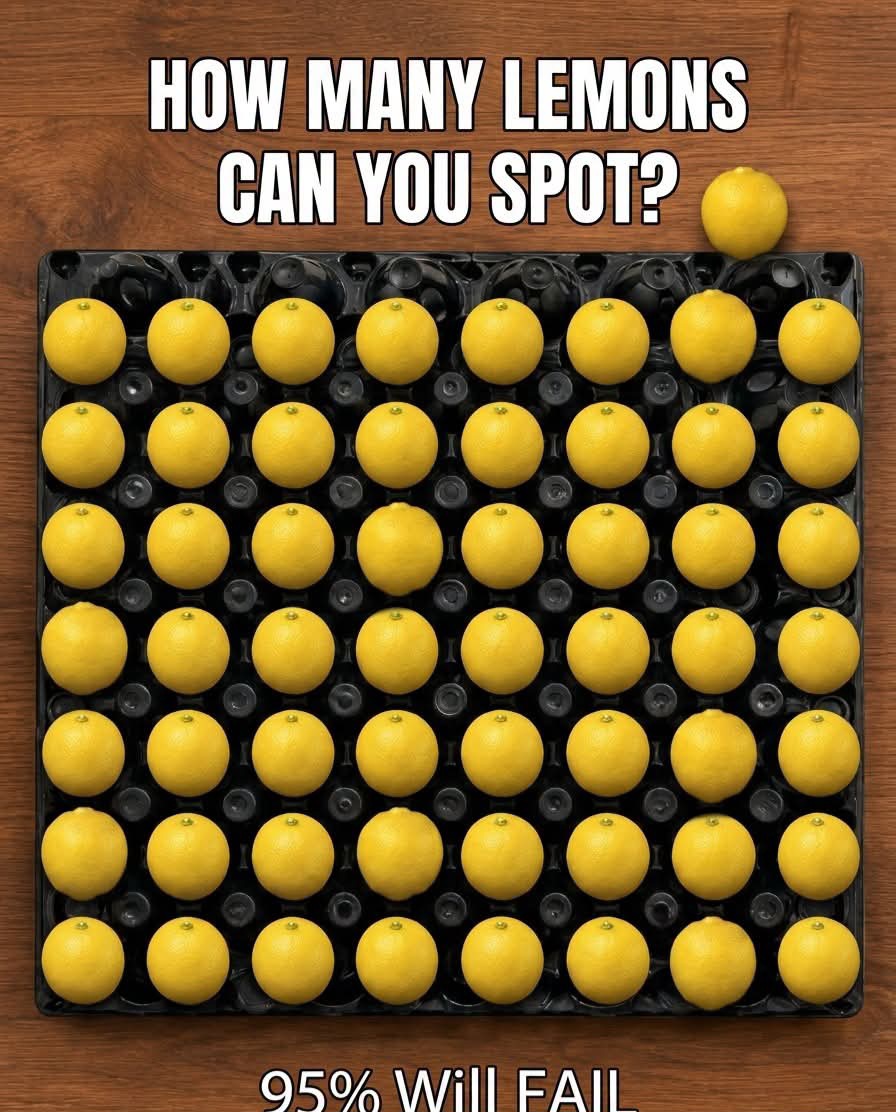
At first glance, this looks like one of those easy counting challenges. There are lemons arranged neatly in rows, so surely counting them should take only a few seconds, right?
Not so fast!
The image asks:
HOW MANY LEMONS CAN YOU SPOT? 🍋
And the small lemon sitting outside the tray makes the puzzle just a little more interesting.
If you counted quickly, you may have missed one—or simply lost track of where you were.
🧠 Why Is This Lemon Puzzle So Tricky?
Counting a large number of similar objects requires more than simply looking at the entire picture and estimating.
Research on visual enumeration shows that once there are more than just a few objects, people generally need focused attention and an item-by-item strategy to count accurately. (PubMed Central (PMC))
That’s exactly what makes this picture challenging.
The lemons are:
- Very similar in size
- The same bright yellow color
- Packed closely together
- Arranged in multiple rows
- Surrounded by a dark tray that makes them stand out
Your eyes naturally try to recognize the overall pattern instead of carefully counting every individual lemon.
🍋 Before You Look at the Answer…
Stop right here!
Take another look at the picture.
Try counting one row at a time.
Don’t count by simply estimating the number you think you see.
A good strategy is to start at the top-left corner of the tray and move from left to right. Once you finish one row, move down to the next.
And don’t forget to look outside the tray!
Did you get:
50?
55?
56?
57?
Or something completely different? 🤔
🔎 The Trick: Don’t Forget the Lemon Outside the Tray!
This is where the puzzle gets sneaky.
Most of the lemons are arranged in a very regular pattern inside the black tray. Because the arrangement is so uniform, it’s easy to focus exclusively on the tray and forget to check the surrounding area.
But there’s one additional lemon sitting above the tray.
That lemon counts if the question is asking how many lemons you can spot in the entire image.
🏆 THE ANSWER: 57 LEMONS! 🍋
If you count the visible lemons carefully, there are:
56 lemons in the tray
The tray contains 7 rows of 8 lemons:
7 × 8 = 56
And then there’s:
+ 1 lemon outside the tray
So:
🍋 56 + 1 = 57 LEMONS
🎉 Final Answer: 57
Did you get it on your first try?
👀 Why People Miss the Extra Lemon
The loose lemon at the top is easy to overlook because the majority of the image is dominated by the tray.
When we’re focused on a specific counting area, we can unintentionally ignore objects that fall just outside the area we’re mentally scanning.
That’s one reason structured counting works so much better than simply looking at the entire picture and guessing.
Studies of visual counting have found that counting places substantial demands on attention, and visual complexity or overlapping/random arrangements can make enumeration more difficult. (PubMed Central (PMC))
In this picture, the regular grid actually gives you a helpful shortcut: count the rows and columns instead of counting every lemon individually.
🧮 The Easy Way to Solve It
Instead of counting all 56 lemons individually, look at the arrangement.
Inside the tray:
8 lemons across
×
7 rows
=
56 lemons
Then look around the tray.
There’s one more:
🍋 + 1
57 total lemons!
This is a great example of why grouping can make a counting puzzle easier.
🤯 Did You Fall for the “95% Will Fail” Claim?
The image says “95% will fail.”
That’s catchy, but there’s no evidence in the image establishing that 95% of people actually get the puzzle wrong.
It’s better to treat that statement as viral-puzzle wording designed to make the challenge more tempting, rather than as a verified statistic.
The real challenge is simply whether you can get the correct answer.
And honestly, that’s much more fun anyway! 😂
🍋 Why Counting Puzzles Are So Addictive
There’s something satisfying about a puzzle that looks incredibly simple but forces you to slow down.
You look at the picture and think:
“They’re just lemons. I can count those!”
Then you start counting.
You get one number.
You count again.
You get another.
Suddenly you’re staring at the picture wondering how you managed to lose track of a bunch of lemons. 😂
Visual counting puzzles are popular because they test observation, attention, and accuracy rather than requiring complicated mathematics. Puzzle collections commonly use counting challenges specifically as visual-observation tests. (funwithpuzzles.com)
🍋 A Simple Trick for Solving Similar Puzzles
The next time you see a picture filled with objects, try this method:
1. Start in one corner
Choose a clear starting point.
2. Count in rows
Move consistently from left to right.
3. Keep a running total
Don’t restart from zero every time you lose your place.
4. Look outside the main group
The creator may intentionally place an extra object somewhere unexpected.
5. Use multiplication when possible
If there are 8 objects in each of 7 identical rows, calculate 8 × 7 instead of counting all 56 individually.
6. Do one final scan
Check the edges and surrounding area before announcing your answer.
🍋 Final Answer
After carefully counting the lemons in the tray and remembering the one lemon sitting outside the tray, the answer is:
🍋🍋🍋 57 LEMONS! 🍋🍋🍋
56 lemons in the tray + 1 lemon outside = 57.
So…
Did you get 57 on your first try? 👀
Or did you count them twice before noticing the extra lemon?
💬 YOUR TURN!
How many lemons did YOU see before reading the answer?
🍋 55
🍋 56
🍋 57
🍋 Another number
👇 Drop your answer in the comments!
And tag someone who always says:
