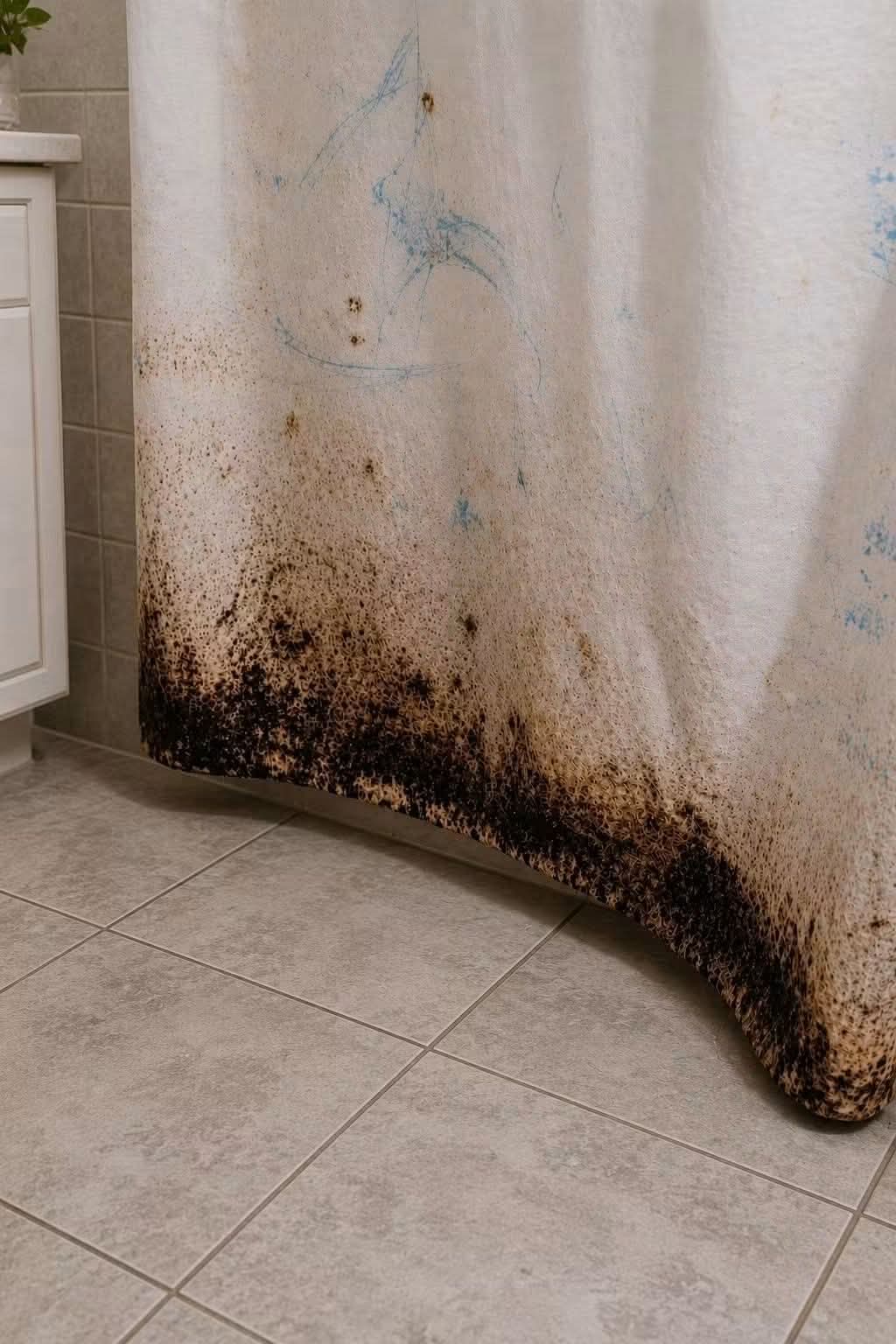
🚿 How to Get Rid of Mold, Mildew & Grime on the Bottom of a Shower Curtain
If you’ve ever pulled your shower curtain back and noticed that the bottom edge is covered in dark mildew, brownish grime, or mysterious spots, you’re definitely not alone. 😅
The bottom of a shower curtain is one of the easiest places for moisture, soap residue, and grime to collect. And when that area stays damp after every shower, mold and mildew can become a stubborn problem.
The good news? If the curtain is washable and the fabric is still in good condition, you may be able to clean it instead of throwing it away.
Here’s a practical way to tackle it.
🦠 Why Does the Bottom of the Shower Curtain Get So Dirty?
The bottom of the curtain is constantly exposed to moisture.
After a shower, water runs down the curtain and collects along the lower edge. If the curtain hangs against a wet floor or doesn’t dry completely between showers, that moisture can stick around.
Add:
- Soap and shampoo residue
- Body oils
- Dust and dirt
- Poor bathroom ventilation
- Humidity
- A curtain that stays bunched together
…and you’ve created an ideal environment for mildew and mold to grow.
The EPA emphasizes that moisture control is the key to controlling mold. (US EPA)
🧤 Before You Start Cleaning
Because the curtain in the photo has substantial visible growth, don’t jump straight into scrubbing it while it’s hanging in the bathroom.
Put on:
- Rubber or nitrile gloves
- Eye protection if you’re going to be scrubbing
- An N95 respirator if you’re doing significant mold cleanup
- Old clothing that can be washed afterward
Open a window or run the bathroom exhaust fan to improve ventilation.
The CDC recommends protecting your eyes, skin, nose, and mouth when cleaning mold and keeping the area well ventilated. (CDC)
If you have asthma, significant allergies, a chronic lung condition, or a weakened immune system, it’s better not to do mold cleanup yourself. (CDC)
🧺 First Choice: Wash the Curtain
If the care label says the shower curtain is machine washable, washing it is usually the first thing I’d try.
Step 1: Remove the curtain
Take it down carefully.
Try not to shake it around unnecessarily, especially if there’s a lot of visible mold.
Step 2: Check the care label
This is important.
Different shower curtains are made from different materials, including:
- Cotton
- Polyester
- Vinyl
- PEVA
- Other synthetic fabrics
Follow the manufacturer’s washing instructions.
Step 3: Wash with detergent
For a washable fabric curtain, place it in the washing machine with your normal laundry detergent and use the warmest cycle permitted by the care label.
You can add a couple of old towels if the manufacturer’s instructions allow it. They can help with gentle agitation during the wash.
For stubborn mildew, a laundry product specifically labeled for mold/mildew or an oxygen-based laundry whitener, when compatible with the curtain’s material, may help with staining.
Always follow the product label and the curtain’s care instructions.
🧽 What About Heavy Grime Along the Bottom?
If the bottom looks more like the photograph—with a thick buildup of grime and staining—you may want to pre-treat it before washing.
Lay the curtain flat somewhere appropriate for cleaning.
Use warm water and a mild detergent and gently work the dirty areas with a soft brush or cloth.
Don’t aggressively dry-scrub mold, because unnecessary disturbance can send particles into the air.
The EPA recommends removing mold from appropriate surfaces with detergent and water and then drying them completely. (US EPA)
Afterward, wash the curtain according to its care instructions.
🧴 What About Bleach?
Bleach is sometimes suggested for mold and mildew, but it isn’t automatically the best choice for every shower curtain.
The EPA says routine mold cleanup generally does not require biocides such as chlorine bleach, and emphasizes physical removal and moisture control. (US EPA)
The CDC does note that bleach can be used for certain household mold cleanup situations, but stresses following the product instructions and proper ventilation. (CDC)
Most importantly:
🚨 NEVER MIX BLEACH WITH VINEGAR, AMMONIA, OR OTHER CLEANERS.
Mixing bleach with ammonia or other cleaning products can produce dangerous toxic fumes. (CDC)
So don’t create a homemade “super cleaner” by combining different products.
🍋 What About Vinegar?
You’ll find plenty of homemade shower-curtain cleaning recipes online using vinegar.
While vinegar is commonly used as a household cleaner, you don’t need to rely on a complicated mixture of vinegar, bleach, baking soda, and other products.
In particular, never combine vinegar with bleach.
For visible mold, the important steps are:
Remove the growth → clean appropriately → rinse if required → dry completely → control the moisture that caused it.
That’s much more important than finding a magical homemade mixture.
🧺 Don’t Put a Moldy Curtain Straight Into the Dryer
After washing, inspect the curtain.
If visible mold or heavy staining remains, don’t automatically put it into a hot dryer.
Heat can set some stains, and the care label may prohibit machine drying.
Instead, follow the manufacturer’s drying instructions and make sure the curtain is completely dry before putting it back in the bathroom.
The EPA specifically stresses drying materials thoroughly because moisture is what allows mold to continue growing. (US EPA)
🗑️ When Should You Just Throw the Curtain Away?
Sometimes, the answer is simply:
It’s time for a new shower curtain.
If mold has heavily penetrated a porous or absorbent curtain material, cleaning may not completely remove it.
The EPA notes that mold can grow into porous materials and may be difficult or impossible to remove completely. Some mold-contaminated porous materials may need to be discarded. (US EPA)
Consider replacing the curtain if:
- Mold covers a large portion of it
- The material remains stained and musty after cleaning
- Mold returns almost immediately
- The fabric is deteriorating
- The curtain cannot be properly washed
- The care label doesn’t allow the cleaning method needed
- The bottom has become permanently discolored or damaged
Sometimes spending a few dollars on a new curtain is easier—and more hygienic—than spending hours trying to rescue one that’s badly deteriorated.
🚿 The Best Way to Keep It From Coming Back
Cleaning the curtain is only half the battle.
You have to help it dry.
After every shower:
1. Spread the curtain out
Don’t leave it bunched together.
A fully extended curtain has more opportunity to dry.
2. Run the bathroom exhaust fan
Use your bathroom ventilation during and after the shower.
The CDC recommends good airflow and exhaust fans that vent to the outside as part of mold prevention. (CDC)
3. Leave the bathroom door open when appropriate
Once you’re finished showering, allowing humid air to escape can help the room dry faster.
4. Keep the bottom from sitting in water
Make sure the curtain is positioned properly inside or outside the tub/shower according to your setup so water isn’t pooling against the bottom.
5. Don’t leave the curtain tightly bunched
This is one of the easiest changes you can make.
Let air reach as much of the curtain as possible.
6. Clean regularly
Don’t wait until the bottom turns black.
Regular cleaning makes it much easier to prevent buildup.
🧼 What About the Bathroom Floor?
If the bottom of the curtain is sitting against a dirty or damp bathroom floor, cleaning the curtain won’t solve the entire problem.
Clean the surrounding floor and tub/shower area as well.
Mold control ultimately comes down to removing moisture and cleaning affected areas, not simply killing mold with a chemical. (US EPA)
🚨 When Is the Problem Bigger Than the Curtain?
A dirty shower curtain is one thing.
But if you notice mold spreading across:
- Bathroom walls
- Ceiling
- Drywall
- Caulking
- Behind cabinets
- Under flooring
- Around plumbing
you may have a larger moisture problem.
Look for leaks, persistent condensation, poor ventilation, or water getting behind the shower.
If mold covers more than about 10 square feet, the CDC recommends considering professional remediation guidance. (CDC)
❤️ The Simple Shower-Curtain Cleaning Routine
If your curtain is washable, here’s the basic routine:
🧤 1. Protect yourself
Gloves, ventilation, and appropriate respiratory/eye protection for significant mold cleanup.
🚿 2. Take the curtain down
Handle heavily contaminated material carefully.
🧼 3. Pre-clean heavy grime
Use detergent and water and gently scrub stubborn areas.
🧺 4. Wash according to the care label
Use detergent and a compatible laundry treatment if needed.
🌬️ 5. Dry completely
Don’t put a damp curtain back into a humid bathroom.
🔍 6. Inspect it
If substantial mold remains or the material is deteriorating, replace it.
🚿 7. Prevent the moisture
Ventilate the bathroom and spread the curtain after every shower.
🏡 The Bottom Line
That nasty-looking black and brown buildup along the bottom of a shower curtain can be incredibly frustrating—but you don’t necessarily have to throw the curtain away at the first sign of mildew.
If it’s washable and the material is still in good shape, start with detergent, gentle cleaning, a proper wash, and thorough drying.
But if the mold is deeply embedded, the curtain is porous and deteriorating, or the growth keeps returning, replacing the curtain may be the better option.
And remember: the biggest secret isn’t a miracle cleaner.
It’s keeping the curtain and bathroom dry. 🚿✨
Because when you control the moisture, you make the bathroom much less welcoming to mold in the first place. (US EPA)
