! 🌶️🍋🧄
A bold, spicy, tangy homemade infusion made with apple cider vinegar, citrus, garlic, ginger, herbs and warming spices.
After making my first batch of fire cider, I knew I had to make it again. It was delicious, surprisingly easy to make, and became one of those homemade kitchen staples I actually looked forward to using.
I ended up drinking about 2 liters of my first batch over the last couple of months. I can’t say that it prevented illness or treated anything, but I personally felt that when I started noticing symptoms, having my fire cider was part of my routine—and I enjoyed it enough to make a second batch.
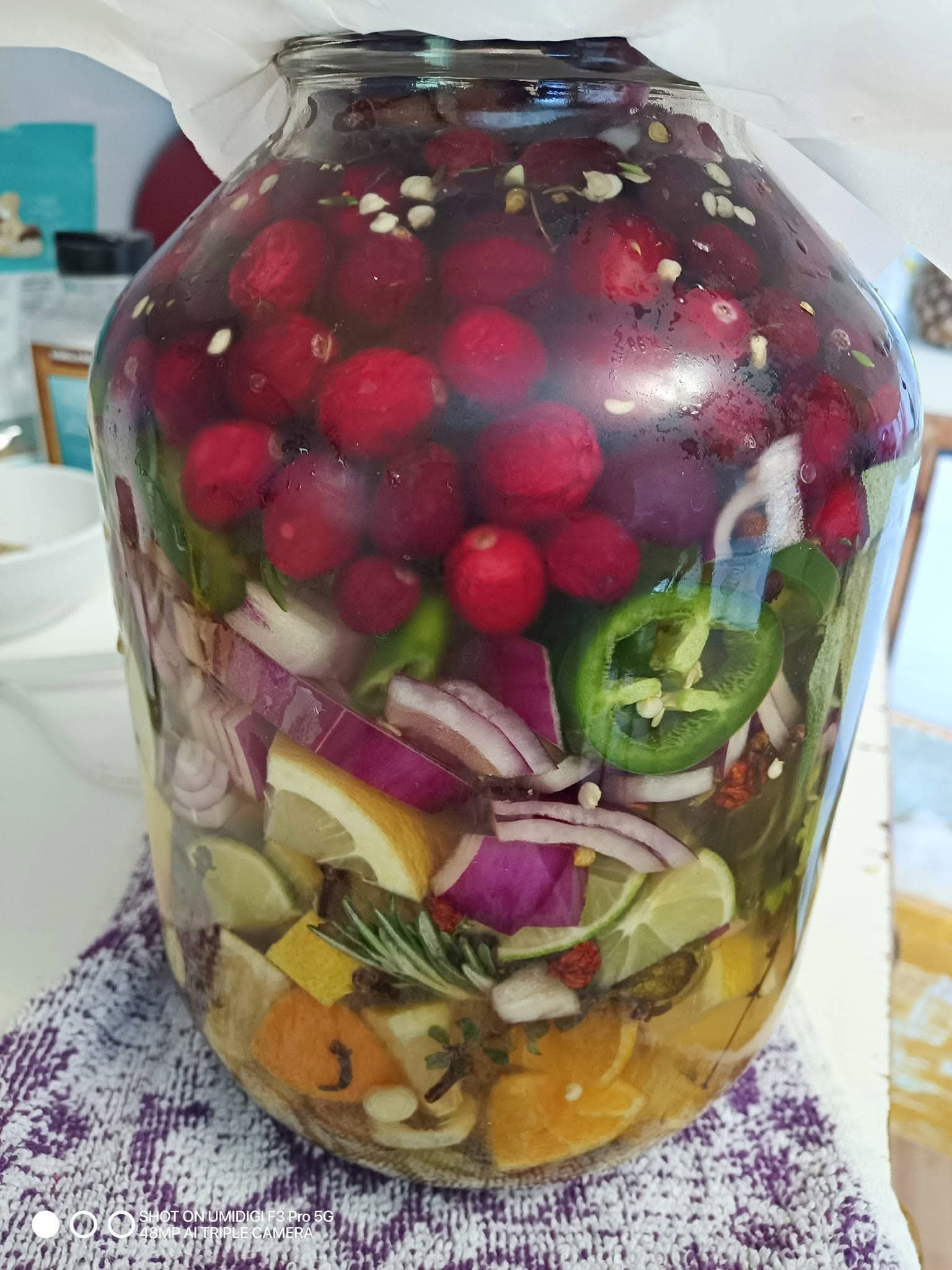
This time, I’m making a one-gallon jar packed with flavorful ingredients.
And just look at that ingredient list! 🔥
🌶️ What Is Fire Cider?
Fire cider is essentially a flavored apple cider vinegar infusion. Traditional versions commonly combine apple cider vinegar with ingredients such as onions, garlic, ginger and citrus, along with spicy peppers and herbs. (Extension de l’Université du Minnesota)
The result is intensely tangy, spicy, savory and aromatic.
It’s not a magic cure, and there’s limited evidence that fire cider itself prevents or treats colds. Even individual ingredients such as garlic haven’t been adequately shown to prevent or treat the common cold. (NCCIH)
For me, the appeal is much simpler: I love the flavor, I enjoy making it, and it gives me a way to use a whole collection of ingredients in one homemade infusion.
🔥 Homemade Fire Cider Recipe
Ingredients
For a 1-gallon glass jar, you’ll need enough apple cider vinegar to completely cover the ingredients.
- Apple cider vinegar, preferably pasteurized
- Fresh cranberries
- Jalapeño peppers
- Cayenne pepper
- Fresh ginger
- Fresh turmeric
- Fresh rosemary
- Fresh sage
- Whole cloves
- Whole allspice
- Fresh thyme
- Whole black peppercorns
- Oranges
- Lemons
- Red onion
- Fresh garlic
Optional
- Honey, added after straining, if you want to mellow the sharp flavor
Important note about quantities
Because a gallon jar can hold very different amounts depending on how tightly the ingredients are packed, I don’t recommend simply filling the entire jar with produce and then adding vinegar.
For safer preparation, the University of Minnesota Extension recommends approximately 1 cup of fruits and vegetables for every 2 cups of apple cider vinegar, rather than overpacking the jar. (Extension de l’Université du Minnesota)
🥣 How to Make Fire Cider
1. Clean everything well
Start with a clean work surface, clean cutting board, utensils and a thoroughly cleaned jar.
Wash the oranges, lemons, cranberries, peppers and fresh herbs under running water.
Food safety is especially important here because you’re combining vinegar with fresh fruits and vegetables. Adding fresh produce can change the acidity of the mixture and introduce microorganisms. (Extension de l’Université du Minnesota)
2. Prepare the ingredients
Thinly slice the oranges, lemons and red onion.
Slice the jalapeños.
Peel and slice the ginger and turmeric.
Peel the garlic cloves and gently crush them.
Leave the cloves, allspice and peppercorns whole.
You can leave the herbs whole or roughly chop them.
3. Add everything to the jar
Place the cranberries, jalapeños, ginger, turmeric, rosemary, sage, thyme, cloves, allspice, peppercorns, citrus, onion and garlic into the sanitized jar.
Don’t pack the ingredients down tightly.
4. Add the apple cider vinegar
Pour the apple cider vinegar over everything until the ingredients are completely submerged.
If the ingredients float, use a clean fermentation weight or another food-safe method to keep them beneath the liquid.
Don’t dilute the vinegar with water.
5. Cover and infuse
Secure the jar with a clean lid.
For a traditional home infusion, keep it in a cool, dark place and allow the flavors to develop for approximately 10–30 days, depending on how strong you want the finished vinegar. (Extension de l’Université du Minnesota)
Give the jar a gentle shake periodically if appropriate for your lid and setup.
Over time, the vinegar will take on the color, aroma and flavor of all those ingredients.
🍋 Strain the Fire Cider
When you’re happy with the flavor, strain the mixture through a fine-mesh strainer.
For a clearer finished product, a coffee filter can help remove small particles. The University of Minnesota Extension specifically recommends straining out the solid ingredients before bottling. (Extension de l’Université du Minnesota)
Press the solids gently to extract the flavorful vinegar, but don’t force every tiny particle through the strainer.
Discard the spent solids.
If you’d like a sweeter fire cider, add honey after straining, a little at a time, until it tastes the way you like.
🌶️ What Does It Taste Like?
This isn’t a mild vinegar!
The apple cider vinegar gives it a sharp tang, while the lemons and oranges add brightness.
The cranberries contribute a fruity note.
Then come the garlic, onion, ginger, turmeric and herbs.
And finally…
🔥 the heat.
The jalapeño, cayenne, black pepper and warming spices give this homemade fire cider its signature kick.
You can adjust the amount of jalapeño and cayenne in future batches depending on how spicy you like it.
🥄 How I Like to Use It
Fire cider can be enjoyed in different ways.
Some people take a small amount straight from a spoon or dilute it with water.
You can also use it as a flavorful ingredient in cooking.
Try it:
- Mixed into salad dressing
- Drizzled over roasted vegetables
- Added to marinades
- Mixed into a vinaigrette
- Added to soups
- Used to brighten beans or grains
- Diluted in water
- Mixed with honey for a sweeter flavor
The key is remembering that fire cider is a strongly flavored vinegar infusion, not a substitute for medical treatment.
❤️ Why I Made a Second Batch
My first batch was such a hit that I couldn’t resist making another.
I drank roughly 2 liters over the last couple of months, and I really enjoyed having it around.
I also noticed that when I started experiencing what felt like the beginning of an illness, I reached for my fire cider as part of my usual routine. I personally felt like it helped me get through those moments, but that’s my experience—not scientific proof that fire cider stopped an illness.
There simply isn’t enough evidence to claim that fire cider prevents or cures colds or other infections. Garlic, for example, has been studied for immune-related claims, but NCCIH notes that there isn’t enough evidence to establish that garlic prevents or treats the common cold. (NCCIH)
That’s an important distinction when sharing homemade remedies online.
It’s perfectly fine to enjoy a traditional homemade preparation without claiming that it cures disease.
🫙 How to Store Homemade Fire Cider
Storage deserves special attention because this isn’t simply plain vinegar anymore.
The University of Minnesota Extension recommends heating the vinegar during preparation as part of its food-safety guidance, then allowing the infusion to develop in a cool, dark place. After straining and bottling, the finished fire cider should be stored somewhere cool and dark, and refrigerated after opening. (Extension de l’Université du Minnesota)
If you notice mold, bubbling or unexpected cloudiness, discard the batch rather than trying to salvage it. (Extension de l’Université du Minnesota)
For the most conservative approach, especially when making a large one-gallon batch, follow a tested flavored-vinegar food-safety procedure rather than relying on vinegar’s acidity alone.
⚠️ A Few Important Safety Notes
Fire cider is acidic and spicy, so it isn’t necessarily comfortable for everyone.
It may cause heartburn, stomach irritation or digestive discomfort, particularly because of ingredients such as raw garlic and hot peppers.
Garlic can also interact with certain medications and may increase bleeding risk, especially with anticoagulants or aspirin. (NCCIH)
If you’re pregnant or breastfeeding, taking prescription medication, preparing for surgery, or have a medical condition that affects what you can safely consume, talk with your healthcare professional before making concentrated herbal preparations part of your routine.
And if you’re sick, have significant symptoms, or symptoms are getting worse, don’t rely on fire cider instead of appropriate medical care.
🔥 Second Batch, Bigger Jar!
There’s something really satisfying about seeing a gallon jar filled with cranberries, citrus, peppers, garlic, ginger, turmeric and fresh herbs, knowing that all those flavors are going to mingle together over the coming weeks.
It’s colorful.
It’s fragrant.
It’s spicy.
And after how much I enjoyed my first batch, I’m really looking forward to this one.
Have you ever made fire cider?
Would you make yours mild, medium or EXTRA HOT? 🌶️🔥
Pin this recipe, save it for later, and share your favorite fire cider ingredients in the comments!
