🍗 Do You Like Your Chicken Medium Rare? 👀
The picture makes for a great food debate.
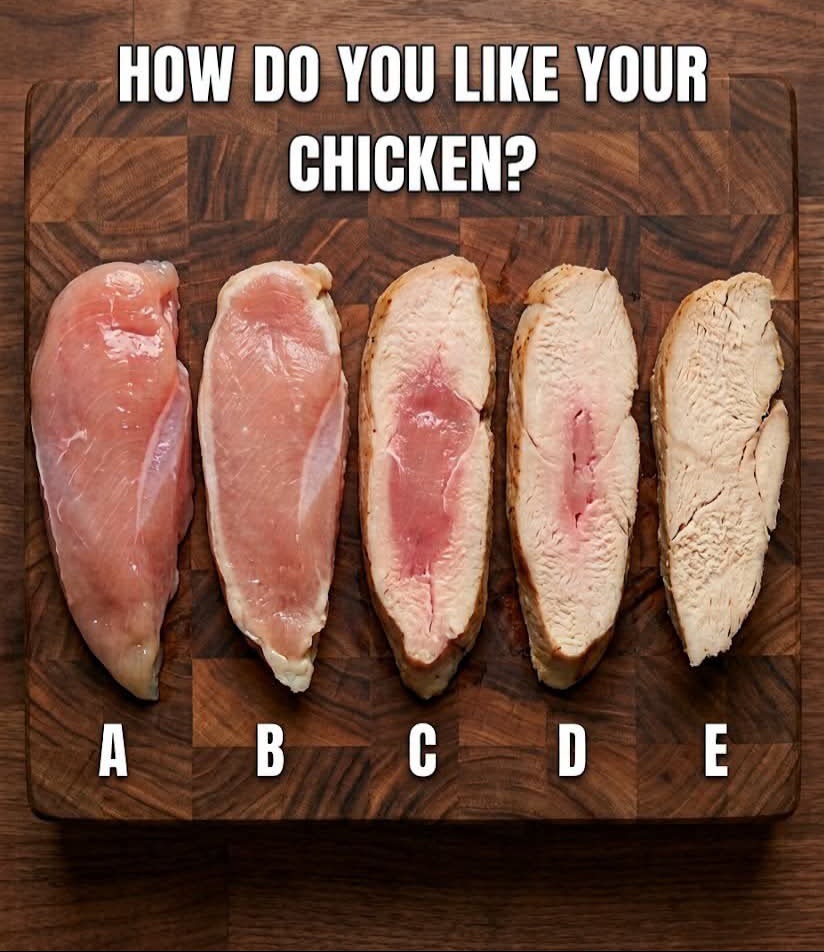
Five chicken breasts. Five different appearances. And one question:
How do you like your chicken?
Would you choose the juiciest-looking piece? The one with the most color? The one that is completely white inside?
Here’s the part that’s important:
Chicken isn’t like steak. Medium-rare chicken is not considered a safe level of doneness.
Unlike beef steak, poultry should be cooked to a safe internal temperature rather than judged by how pink or white the meat looks. The USDA recommends cooking all poultry to 165°F (73.9°C), measured with a food thermometer. (Ask USDA)
So before you pick A, B, C, D, or E based on the picture, let’s talk about what those appearances really mean.
🍗 Pink Chicken Doesn’t Always Mean Undercooked
This is where things get confusing.
People often assume:
Pink = raw
and
White = fully cooked.
But that’s not necessarily true.
USDA explains that safely cooked poultry can range in color from white to pink to tan. Color alone isn’t a reliable way to determine whether chicken is safely cooked. (Ask USDA)
Chicken can remain pink even after reaching a safe temperature because of chemical changes that occur during cooking. Younger birds can also show more pink because of their thinner tissues. (Ask USDA)
So that slightly pink section in a cooked chicken breast doesn’t automatically mean it’s dangerous.
But the opposite is also true:
A completely white chicken breast isn’t proof that it’s safe.
That’s why the thermometer matters.
🌡️ The Number You Need to Remember: 165°F
For home cooks, this is the number worth memorizing.
165°F (73.9°C).
That’s the USDA’s safe minimum internal temperature for poultry. (Ask USDA)
Insert the thermometer into the thickest part of the chicken breast, making sure the probe isn’t touching bone.
Once the thickest section reaches 165°F, you have a much more reliable indication that the chicken has reached the recommended safe temperature.
You don’t have to guess.
You don’t have to cut it open repeatedly.
And you don’t have to stare at the color wondering whether that pink spot is okay.
👀 So What About the Five Pieces in the Picture?
The photo appears to show a progression from very raw-looking chicken on the left to increasingly cooked chicken on the right.
But here’s an important point:
You cannot determine the safety of any of those pieces just from the photograph.
A photograph doesn’t tell us the internal temperature.
The piece that looks slightly pink could potentially have reached 165°F.
The piece that looks completely white could potentially have been removed too early.
The only reliable way to know is to use a properly positioned food thermometer. (Ask USDA)
That makes this picture a fun quiz—but not a reliable food-safety test.
🚫 Can You Eat Chicken Medium Rare?
Chicken should not be intentionally served medium rare.
USDA specifically advises against eating or tasting raw or undercooked poultry because poultry can contain harmful bacteria, and thorough cooking is important to destroy bacteria that may be present. (Ask USDA)
So while medium-rare steak may be a preference some people have, medium-rare chicken isn’t a recommended cooking preference.
You can absolutely aim for juicy chicken.
You can absolutely avoid dry chicken.
But the goal should be juicy chicken that has reached a safe internal temperature, not undercooked chicken.
💧 How Do You Keep Chicken Juicy?
A lot of people overcook chicken because they’re afraid of seeing any pink.
The answer isn’t to stop cooking before it’s safe.
Instead, focus on technique.
Don’t overcook it after it reaches a safe temperature.
Use a thermometer so you don’t keep cooking simply because you’re afraid the center isn’t done.
Pound very thick chicken breasts evenly.
When one end is much thicker than the other, the thin part can become dry before the thickest portion is ready.
Don’t cut into the chicken constantly.
Every time you cut into it, juices can escape.
Use a thermometer instead.
Let cooked chicken rest briefly.
Giving chicken a few minutes to rest before slicing can help it remain juicy.
🍳 Don’t Judge Chicken by Its Juices Either
Another old kitchen rule is:
“The juices must run completely clear.”
That’s not the best test.
Like meat color, juice color isn’t a reliable substitute for measuring the internal temperature.
USDA’s current guidance specifically emphasizes thermometer use because appearance isn’t a dependable indicator of safety. (Ask USDA)
🔥 What Temperature Should Your Oven Be?
When cooking chicken in the oven, USDA says the minimum oven temperature for cooking chicken is 325°F (162.8°C). (Ask USDA)
Of course, the cooking time will vary according to the size and thickness of the chicken, the cooking method, and the oven.
That’s another reason recipes shouldn’t rely on time alone.
A recipe might say:
“Bake for 25 minutes.”
But your chicken breast may be thicker or thinner than the one used to develop the recipe.
Temperature tells you much more than the clock does.
🧼 Don’t Forget the Raw Chicken Safety Rules
Safe cooking begins before the chicken even reaches the pan.
Keep raw poultry separate from ready-to-eat foods and be careful about cross-contamination.
Wash your hands after handling raw chicken, and clean cutting boards, utensils, counters, and other surfaces that have come into contact with it.
USDA emphasizes preventing cross-contamination along with cooking poultry to a safe internal temperature. (Ask USDA)
And remember:
Don’t wash raw chicken under the faucet.
Washing can splash contaminated juices around the sink and surrounding surfaces instead of making the chicken safer.
🤔 Which One Would You Pick?
Now back to the picture.
If this were simply a visual preference quiz, what would you choose?
A – Very pink and raw-looking
B – Still quite pink
C – Pink in the center
D – Mostly white with a little color
E – Completely white and well done
Most people probably have a strong preference.
Some people like chicken very juicy.
Others won’t touch it unless it looks completely white.
But the food-safety answer is different from the preference answer:
Choose the chicken that has reached 165°F, regardless of whether it looks slightly pink or completely white. (Ask USDA)
🍗 Juicy Doesn’t Have to Mean Undercooked
This is probably the biggest takeaway from the photo.
There’s a common idea that chicken has to be dry and tough to be safe.
It doesn’t.
You can have tender, juicy chicken and still cook it safely.
A thermometer takes the guesswork out of the equation.
Instead of slicing into the biggest piece and hoping it’s done, check the thickest portion.
Once it reaches 165°F, you know you’ve reached the USDA’s recommended safe minimum internal temperature. (Ask USDA)
❤️ Final Thoughts
The picture is definitely going to get people talking.
“I like mine juicy!”
“I want mine completely white!”
“That’s WAY too pink!”
“A little pink doesn’t bother me.”
And that’s exactly why it’s such a fun food question.
But when it comes to chicken, appearance and preference should never replace food safety.
Chicken isn’t steak.
Don’t aim for medium rare. Aim for 165°F. 🌡️🍗
And remember, a little pink doesn’t automatically mean chicken is undercooked—but a thermometer is far more trustworthy than your eyes. (Ask USDA)
🍗 So… How Do You Like Your Chicken?
A, B, C, D, or E?
Drop your answer below! 👇👀
