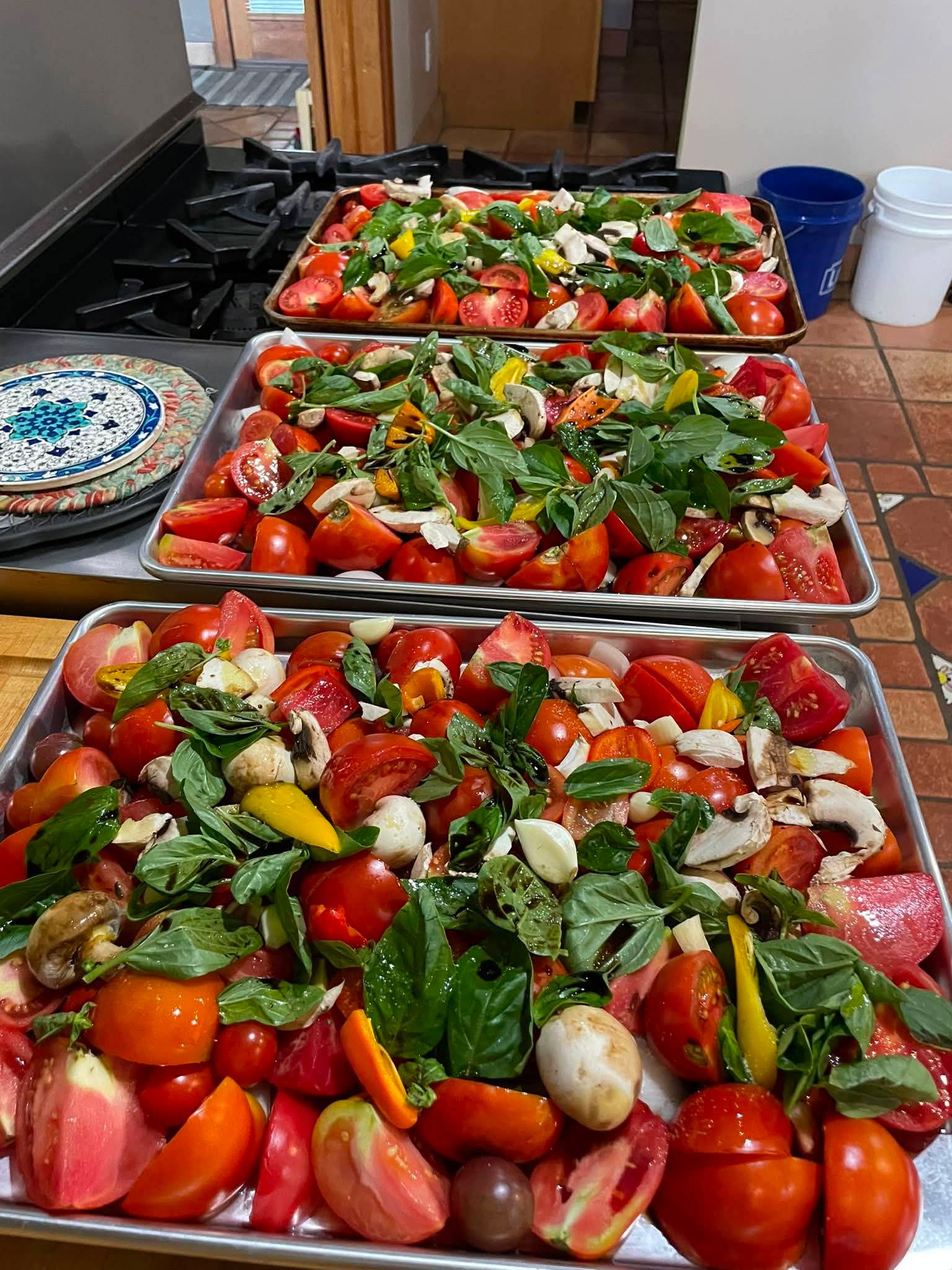
🍅 ?
Short answer: I would not water-bath the pasta sauce exactly as you currently make it.
Your sauce sounds absolutely delicious—roasted tomatoes, onions, basil, garlic, peppers, mushrooms, EVOO and balsamic vinegar—but that combination is not a tested boiling-water-bath canning recipe.
The issue isn’t that tomatoes are automatically unsafe to water-bath. It’s that once you add significant amounts of low-acid vegetables such as onions, peppers and mushrooms, plus oil, the acidity and density of the finished sauce can change. A splash of balsamic vinegar isn’t enough to know that the finished product is safely acidified. The National Center for Home Food Preservation specifically warns that homemade tomato/vegetable mixtures shouldn’t be canned by simply guessing at the amount of acid or processing time. (nchfp.uga.edu)
So your freezer method is actually a very good choice for your exact recipe. ❤️
However, there is a tested spaghetti sauce recipe containing tomatoes, onions, garlic, peppers and mushrooms that is designed for pressure canning. It specifically warns not to increase the proportions of the onions, peppers or mushrooms. (nchfp.uga.edu)
Here are the two ways I’d handle it.
🍝 Your Roasted Garden Pasta Sauce
The freezer-friendly version
This keeps the delicious method you already use: roast everything, blend it smooth, and freeze it in convenient portions.
Ingredients
- 8 pounds ripe tomatoes
- 2 medium onions, quartered
- 2–3 bell peppers, seeded and roughly chopped
- 1 whole head garlic
- 8 ounces fresh mushrooms, cleaned and sliced
- ½ cup fresh basil leaves
- 2–3 tablespoons extra-virgin olive oil
- 1–2 tablespoons balsamic vinegar
- 1½–2 teaspoons salt, or to taste
- ½ teaspoon black pepper
- 1 teaspoon Italian seasoning, optional
- ½ teaspoon red pepper flakes, optional
Optional additions
- 1–2 teaspoons dried oregano
- A pinch of red pepper flakes
- A little Parmesan when serving
- A spoonful of tomato paste if you want an especially thick sauce
👩🍳 How to Make It
1. Prepare the vegetables
Wash the tomatoes and remove any damaged areas.
Cut large tomatoes into halves or quarters.
Peel the onions and cut them into chunks.
Remove the stems and seeds from the peppers.
Clean and slice the mushrooms.
Separate the garlic cloves from the head, but leave the cloves in their skins if you’re roasting them.
2. Arrange everything on baking sheets
Spread the tomatoes, onions, peppers and mushrooms over large rimmed baking sheets.
Drizzle with the olive oil and sprinkle with salt and pepper.
Add the garlic.
Don’t worry if everything isn’t perfectly arranged.
This is a rustic sauce!
3. Roast
Roast at 400°F (200°C) for approximately 40–60 minutes, stirring or turning the vegetables once or twice.
You’re looking for:
- Tomatoes that have softened and started to caramelize
- Onions with browned edges
- Peppers that are tender
- Mushrooms that have cooked down
- Garlic that is soft and fragrant
The exact time will depend on how juicy your tomatoes are and how large you cut the vegetables.
🌿 4. Add the Basil
Once everything comes out of the oven, squeeze the roasted garlic from its skins.
Transfer the roasted vegetables and garlic to your Ninja blender.
Add the fresh basil.
Don’t add all the basil at once if you want a fresher flavor—save a little to stir in at the end.
🥣 5. Blend
Blend until you reach your preferred consistency.
You can make it:
Smooth
Blend thoroughly for a silky pasta sauce.
Rustic
Pulse several times so you still have little pieces of roasted vegetables.
Somewhere in between
This is my favorite—mostly smooth with just enough texture to remind you that it came from a garden full of vegetables.
🍅 6. Add the Balsamic Vinegar
Add the balsamic vinegar after blending.
Start with 1 tablespoon, taste, and add another tablespoon if desired.
The balsamic isn’t being added here as a canning preservative. It’s for flavor.
It gives the roasted tomatoes a beautiful sweet-tangy depth.
🔥 7. Simmer if Needed
If your tomatoes were particularly juicy, transfer the blended sauce to a large pot.
Simmer uncovered for 20–40 minutes, stirring occasionally, until it reaches the thickness you like.
This is especially helpful if you’re using the sauce for pasta, lasagna or pizza.
🫙 8. Cool Before Freezing
Let the sauce cool before transferring it to freezer containers.
Since you’re using jars, make sure they are specifically suitable for freezing and leave appropriate headspace so the sauce can expand as it freezes.
Don’t fill jars completely to the top.
And never put piping-hot sauce into a cold jar and immediately put it into the freezer.
❄️ Freezing Your Sauce
I actually think freezing is an excellent option for your particular recipe.
You can freeze it in:
- 1-cup portions
- 2-cup portions
- Family-size containers
- Freezer-safe jars
- Freezer bags laid flat
- Silicone freezer trays
I especially like freezing it in 1–2 cup portions because you can pull out exactly what you need for dinner.
Once frozen, transfer portions from freezer bags into a larger container if you want to save space.
🚨 Why I Wouldn’t Water-Bath Your Original Recipe
This is the important part if you’re thinking about putting those jars on the pantry shelf.
Your recipe contains:
🍅 Tomatoes
🧅 Onions
🫑 Peppers
🍄 Mushrooms
🧄 Garlic
🌿 Basil
🫒 EVOO
🍇 Balsamic vinegar
The tomatoes provide acidity, but the other vegetables can significantly change the overall acidity and consistency of the finished sauce.
And because you roast everything and then blend it, you aren’t following a tested canning process for that particular combination.
The National Center for Home Food Preservation explains that the safety of a tomato/vegetable mixture depends on the final acidity and other characteristics of the product. Simply knowing that tomatoes and vinegar are present doesn’t tell us whether a particular homemade recipe is safe for boiling-water canning. (nchfp.uga.edu)
That’s why I would not tell you to simply add “a little more balsamic” and water-bath it.
That’s not a safe way to develop a shelf-stable canning recipe.
🫙 But There IS a Tested Canning Option
If your goal is to have shelf-stable jars of spaghetti sauce, there is a tested recipe from the National Center for Home Food Preservation called Spaghetti Sauce Without Meat.
It contains:
- 30 pounds tomatoes
- 1 cup chopped onions
- 5 cloves garlic
- 1 cup celery or green pepper
- 1 pound fresh mushrooms, optional
- ¼ cup vegetable oil
- Salt and seasonings
The recipe specifically says not to increase the proportion of onions, peppers or mushrooms. Importantly, it is processed in a pressure canner, not a boiling-water bath. (nchfp.uga.edu)
For that tested recipe, the processing time is:
Pints: 20 minutes
Quarts: 25 minutes
The pressure depends on your altitude and the type of pressure canner you’re using. (nchfp.uga.edu)
See the complete tested NCHFP spaghetti sauce recipe
❗ What About the EVOO?
This is another reason I wouldn’t try to convert your personal recipe into a water-bath recipe.
The tested NCHFP spaghetti sauce recipe does include ¼ cup vegetable oil, but that’s part of a specific tested formulation with specific quantities of tomatoes and vegetables and a specific pressure-canning process. (nchfp.uga.edu)
That doesn’t mean you can take your own recipe, add olive oil, add some vinegar, and assume the same process applies.
Canning safety doesn’t work that way.
🍝 What I’d Do With YOUR Recipe
Honestly?
Keep making it exactly the way you love it—and freeze it.
Your roasted version sounds fantastic.
The roasting is actually a huge part of the flavor because the tomatoes, onions, peppers, mushrooms and garlic develop those wonderful browned, concentrated flavors before they ever hit the blender.
I’d make a huge batch when tomatoes are plentiful, blend it, portion it into freezer-safe containers, label everything with the date, and fill the freezer.
Then, in the middle of winter:
Pull out a container → thaw → heat → boil pasta → dinner.
That’s pretty close to having your own homemade pantry sauce without having to take a risk with an untested canning recipe.
❤️ My Favorite Way to Use It
For an incredible weeknight dinner:
- Thaw your roasted vegetable sauce.
- Warm it gently in a saucepan.
- Add a splash of pasta water.
- Stir in freshly grated Parmesan.
- Toss with hot pasta.
- Finish with fresh basil and a drizzle of EVOO.
You can also use it for:
🍕 Homemade pizza
🍝 Lasagna
🥖 Dipping sauce for garlic bread
🧀 Baked ziti
🍆 Eggplant Parmesan
🥩 Meatballs
🌶️ Stuffed peppers
🥘 Chicken or vegetable casseroles
🥫 If You Really Want a Water-Bath Version
I would not try to create one from your current recipe by simply increasing the balsamic vinegar.
There are tested tomato-based products that can safely be processed in a boiling-water canner when the recipe and acidification are followed exactly. For example, NCHFP’s tested tomato recipes specify precise amounts of bottled lemon juice, citric acid or 5% vinegar because tomato acidity can vary. (nchfp.uga.edu)
But once you start adding mushrooms, onions, peppers and other ingredients, the tested recipe needs to account for those proportions.
🍅 The Bottom Line
Your exact roasted pasta sauce?
❌ I would not water-bath can it as written.
❌ I wouldn’t rely on the balsamic vinegar to make it safe.
❌ I wouldn’t invent a processing time.
✅ Freeze it exactly as you’ve been doing.
✅ If you want shelf-stable jars, use a tested pressure-canning recipe and follow it without changing the vegetable proportions.
And honestly, your current freezer method isn’t a failure at all. You made a delicious garden sauce that freezes beautifully—and you already have a safe preservation method for the recipe you love. ❤️🍅
🍝 Roasted Tomato Pasta Sauce — Freezer Recipe at a Glance
Roast: tomatoes + onions + peppers + mushrooms + garlic + EVOO at 400°F for 40–60 minutes.
Blend: roasted vegetables + basil.
Season: salt, pepper and 1–2 tablespoons balsamic vinegar.
Thicken: simmer 20–40 minutes if needed.
Cool: completely.
Freeze: in freezer-safe containers, leaving room for expansion.
Enjoy: whenever you need a taste of summer! 🍅🌿❤️
