🥒
If you grew up with a kitchen full of vintage Tupperware, you may recognize this little green container immediately. But if you’ve never seen one before, its unusual insert can leave you wondering: What on earth was this made for?
The answer is pickles! 🥒
That’s right—this vintage container was designed as a pickle keeper, complete with a removable draining insert that made it much easier to grab pickles without fishing around in a jar full of brine.


🥒 The Mystery Container Is a Vintage Pickle Keeper
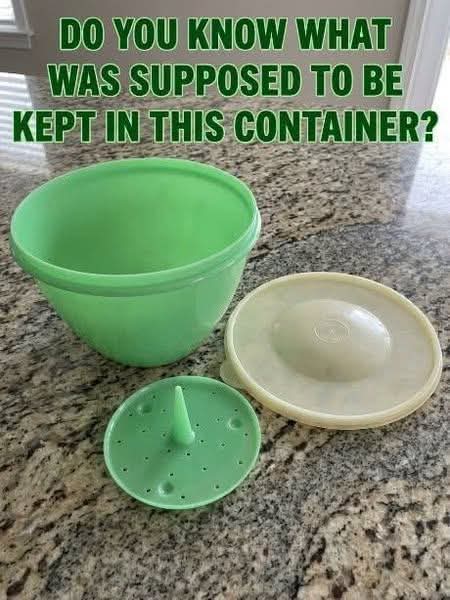
The piece shown is characteristic of the vintage Tupperware Pick-A-Deli/pickle keeper style. These containers came with a separate insert or strainer that allowed the pickles to sit above the liquid while remaining stored in the container.
Vintage examples are commonly identified as Tupperware pickle keepers, including avocado-green versions from the 1970s. (Etsy)
And once you understand how it works, the strange-looking pieces suddenly make perfect sense.
How did it work?
The basic idea was wonderfully simple:
- Place your pickles inside the container.
- Add the pickle brine.
- The perforated insert sits inside the container.
- When you wanted a pickle, you could lift the insert, allowing excess brine to drain away.
- Take your pickle and put the insert back down.
- Put the lid on and return it to the refrigerator.
Some vintage examples are specifically described as having a removable insert for storing and draining pickles or other foods. (Raising Hands Ministries International)
The Little Holes Were the Big Clue
Look at that green piece sitting beside the container.
Those little holes weren’t decoration.
They were designed to let the pickle juice drain through while the pickles stayed on the insert.
That meant you didn’t have to reach into a slippery jar with a fork and try to spear the pickle you wanted.
Lift the insert, grab a pickle, and put everything back.
It’s one of those old-fashioned kitchen inventions that makes you think:
“Wait… that’s actually pretty clever.”
Why Didn’t They Just Use a Regular Jar?
Today, most people simply keep pickles in the jar they came in.
But vintage kitchen products often had a specific purpose for making everyday foods easier to use and store.
The pickle keeper essentially transformed the contents of a jar into something more convenient to access. Vintage listings describe these containers as useful for pickles and olives because the food could be lifted out instead of having to dig around inside a jar. (Etsy)
And, of course, Tupperware was famous for creating specialized storage containers for all sorts of foods.
🫒 It Wasn’t Just for Pickles
Although pickles are the big answer, similar vintage keepers could also be used for other foods that benefit from draining.
Olives are another obvious possibility.
Some vintage listings specifically identify these containers as pickle/olive keepers, while others mention chopped vegetables and similar foods as possible uses. (Etsy)
So if Grandma had one of these in her refrigerator, there was a good chance it was holding something briny and delicious.
The Vintage Tupperware Colors Give It Away
That beautiful avocado, olive, or jade-like green is another reason these pieces are so recognizable.
Vintage Tupperware from the 1960s and 1970s is particularly loved today for its distinctive colors and specialized designs. Examples of these pickle keepers can still be found with green containers, contrasting lids, and removable inserts. (Marché d’Occasion)
Some surviving examples are even labeled with model numbers such as 1330-series pieces. (eBay)
🥒 Grandma’s Refrigerator Had a System
There is something charming about these old kitchen gadgets.
Today, we have refrigerator drawers, airtight glass containers, silicone organizers, and dozens of specialized storage solutions.
But Grandma had a container for the pickles.
A container for the butter.
A container for leftovers.
And probably another container inside another container that nobody was allowed to throw away. 😂
The goal was always the same: keep food organized, fresh, and easy to use.
Would You Still Use One Today?
Absolutely—provided an old plastic container is in good condition and appropriate for food storage.
If you find one at a thrift store, estate sale, or tucked away in a family kitchen, check it carefully for:
- Cracks
- Deep scratches
- Warping
- Brittle plastic
- Unusual odors
- Damage around the lid
- Signs that the plastic has deteriorated
And remember that vintage plastic can vary considerably in age and composition, so collectors may prefer keeping particularly old pieces for display rather than everyday food use.
The Answer to the Mystery
So, if you looked at the photo and guessed pickles, congratulations! 🥒
That strange green insert wasn’t a lid, a strainer for the sink, or some forgotten kitchen toy.
It was part of a vintage pickle keeper.
The container held the pickles and their brine, while the perforated insert allowed the liquid to drain when you lifted the pickles out.
It’s such a simple idea—but it’s also a wonderful example of how vintage kitchens were filled with clever little gadgets designed around the foods people actually ate.
And honestly, there’s something satisfying about discovering what an old kitchen gadget was really made for.
Did your grandmother or mother have one of these? What did she keep in it? 🥒💚
Pin This for Later
That mysterious green vintage container? It was a PICKLE KEEPER! 🥒 If you remember one of these from your childhood kitchen, you definitely aren’t alone.
