🐛🍂
Every fall, people start looking down at sidewalks, driveways, gardens, and roadsides hoping to spot one of nature’s most famous little weather forecasters—the woolly bear caterpillar.
They’re fuzzy, they’re easy to recognize, and according to generations of folklore, their stripes can supposedly tell us what kind of winter is coming. 👀❄️
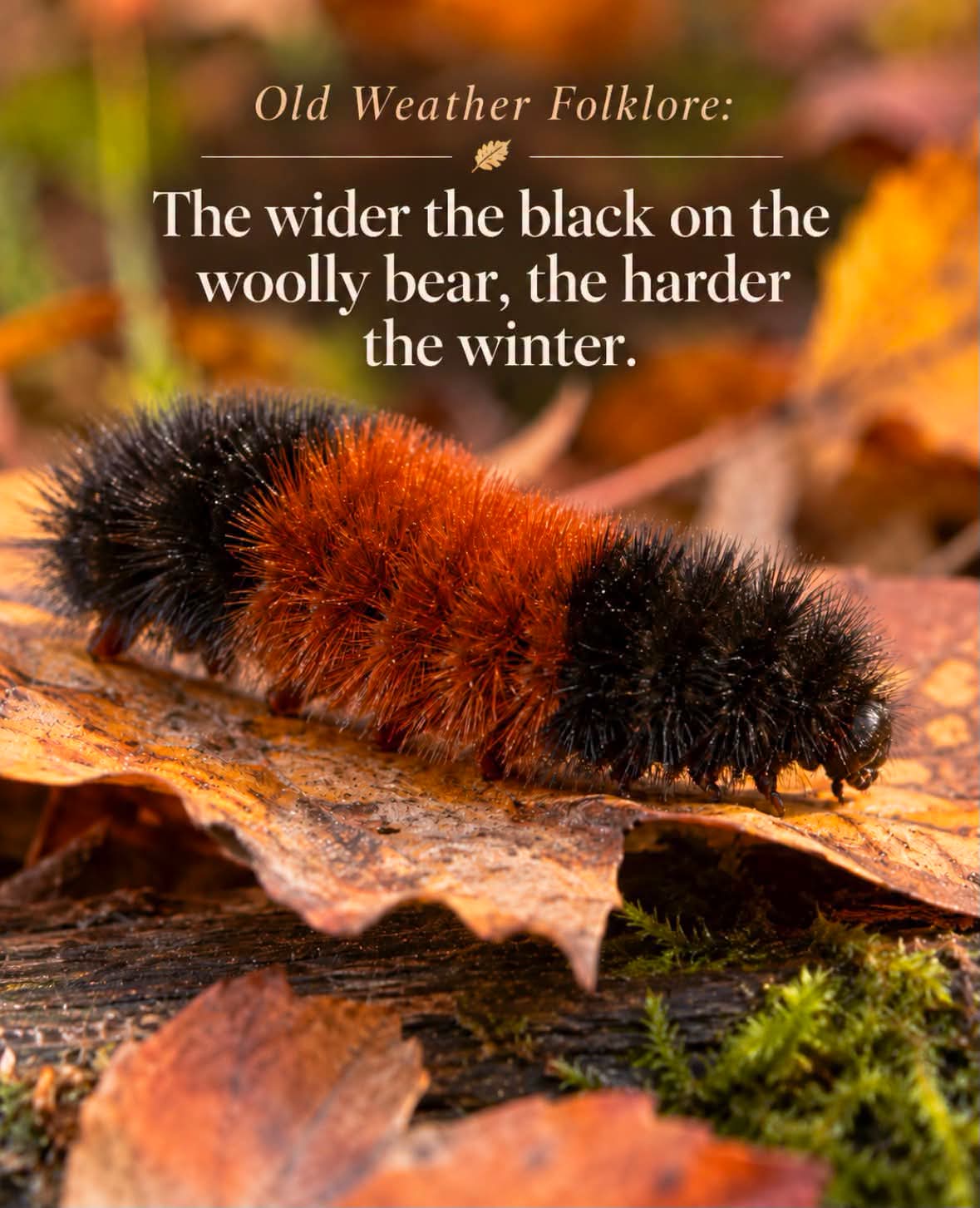
The old saying goes something like this:
The wider the black bands, the harder the winter.
And if the rusty-brown band in the middle is wider, folklore says we’re in for a milder winter.
It’s a charming tradition—but there’s much more to the story.
🐛 What Exactly Is a Woolly Bear?
The familiar banded woolly bear is the caterpillar stage of the Isabella tiger moth (Pyrrharctia isabella).
It’s typically covered in stiff, bristly hairs, with black coloring toward both ends and a rusty reddish-brown band through the middle.
In autumn, these caterpillars become especially noticeable because they’re often wandering across roads, sidewalks, gardens, and other open areas as they search for sheltered places to spend the winter. (Service Météo National)
And yes—they really do spend the winter as caterpillars.
That’s one of the coolest things about them.
🍂 The Old Woolly Bear Weather Prediction
According to the traditional folklore, you can examine a woolly bear in autumn and supposedly get a preview of the coming winter.
The basic prediction is:
🖤 More black = harsher winter
If the black bands are especially wide, folklore says the coming winter will be:
- Colder
- Longer
- Snowier
- More severe
🤎 More rusty brown = milder winter
If the rusty-brown band in the middle is wide, the traditional prediction is for a shorter or milder winter.
Some versions of the folklore go even further.
If the black band toward the head is longer, the beginning of winter is supposedly going to be the worst.
If the black band toward the tail is longer, the end of winter is supposedly going to be the harshest.
And another version claims the caterpillar’s 13 body segments represent the 13 weeks of winter, with the coloration of each section supposedly giving clues about the corresponding portion of the season. (Service Météo National)
That’s quite a forecasting system for one fuzzy little caterpillar! 😂
🔬 But Can Woolly Bears Really Predict Winter?
Here’s where the folklore and science part ways.
There is no reliable scientific evidence that a woolly bear’s stripe width can predict the severity of the upcoming winter.
Researchers and extension specialists have explained that the caterpillar’s coloration is influenced by factors such as age, growth, molting, and environmental conditions, rather than being a biological forecast of future weather. (Service Météo National)
In other words, a very black woolly bear isn’t carrying a tiny weather report inside its stripes.
It’s just being a woolly bear. 🐛❤️
🐛 So Why Do Their Bands Look Different?
This is actually pretty fascinating.
As woolly bears grow, they molt several times, and their coloration changes.
A caterpillar’s appearance can therefore tell us something about its development and growing conditions.
According to extension sources, better growing conditions can result in greater growth and a wider rusty-brown middle area, while younger caterpillars may have more black coloration. (Service Météo National)
So instead of being a crystal ball for next winter, a woolly bear’s appearance may tell us more about what the caterpillar has already experienced.
That’s almost just as interesting.
🌦️ The Weather Folklore Has Been Around for Generations
The woolly bear tradition is part of a much bigger history of people using nature as a seasonal calendar.
Before modern weather forecasting, people naturally paid close attention to animals, plants, clouds, insects, and other signs around them.
If certain patterns seemed to occur around the same time each year, those observations became sayings and traditions passed from one generation to the next.
The woolly bear became one of the most famous examples.
The folklore became particularly popular in North America, and communities have even built annual festivals around these fuzzy caterpillars. (Service Météo National)
🐛 Why Are They Wandering Around in the Fall?
If you’ve ever seen woolly bears crossing a driveway or road in autumn, you may have wondered where they’re going.
They’re generally searching for a protected place where they can spend the winter.
They may shelter beneath things such as:
- Fallen logs
- Bark
- Rocks
- Leaf litter
- Other protected debris
They’re not necessarily “running away from winter.”
They’re simply following their normal life cycle. (Service Météo National)
❄️ And These Little Caterpillars Are Tough!
Here’s the part that really deserves some appreciation.
Woolly bears are remarkably cold-tolerant.
They produce substances that function as natural cryoprotectants, helping protect their tissues during freezing conditions. Some sources report that woolly bears can survive extraordinarily low temperatures. (Service Météo National)
So while their stripes might not predict the winter, the caterpillar itself is exceptionally well adapted to surviving winter.
Nature gave it an incredible survival strategy—it just didn’t give it a degree in meteorology. 😂
🦋 What Does the Woolly Bear Become?
Eventually, the fuzzy caterpillar you’ve been spotting in autumn transforms into an Isabella tiger moth.
The caterpillar overwinters, resumes its development when conditions become favorable, and eventually forms a cocoon.
The adult moth emerges later in the season, completing the transformation from fuzzy caterpillar to moth. (Service Météo National)
It’s easy to overlook the adult moth because the caterpillar is much more recognizable.
🍁 Woolly Bear Festivals
The fascination with these caterpillars has become a genuine autumn tradition in some communities.
For example, Vermilion, Ohio, has held an annual Woolly Bear Festival since 1973, complete with a parade, woolly bear races, and a playful winter forecast.
There’s also a Woolly Worm Festival in Banner Elk, North Carolina. (Service Météo National)
So even though science doesn’t consider the caterpillar a legitimate weather forecasting tool, people have turned the folklore into a fun celebration of fall.
And honestly, that’s pretty wonderful.
🔎 What Should You Look for When You Find One?
If you come across a woolly bear this fall, take a closer look.
Notice:
🖤 How wide are the black sections?
🤎 How wide is the rusty-brown middle?
🐛 Is the caterpillar small or nearly full-grown?
🍂 Where did you find it?
🌡️ What has your local weather been like recently?
Instead of treating its stripes as a guaranteed forecast, you could keep a little nature journal.
Record what you see each fall and then compare your observations with the actual winter weather.
That turns an old folk tradition into a fun backyard science experiment!
❤️ The Best Part of the Woolly Bear Tradition
Even though science tells us that woolly bears cannot reliably forecast the coming winter, that doesn’t mean we have to stop enjoying the tradition.
There’s something wonderful about seeing people still looking for these little caterpillars every autumn.
It gets us outside.
It makes us pay attention to nature.
It gives grandparents something to tell grandchildren.
And it reminds us that long before weather apps and radar maps, people were constantly watching the natural world around them.
Maybe the woolly bear isn’t telling us what’s coming.
Maybe it’s simply giving us another reason to stop, look down, and appreciate fall. 🍂🐛❤️
🐛🍂 Have You Seen a Woolly Bear Yet?
Next time you spot one, take a picture and check out those bands!
Are the black bands wide? Is the rusty middle band wide?
According to folklore, you may have just found your neighborhood’s little winter forecaster. 😄❄️
Just remember: it’s a fun tradition—not an actual weather forecast.
And if you tell us where you live, we can compare what woolly bears are looking like in different parts of the country this fall! 👇🍂
