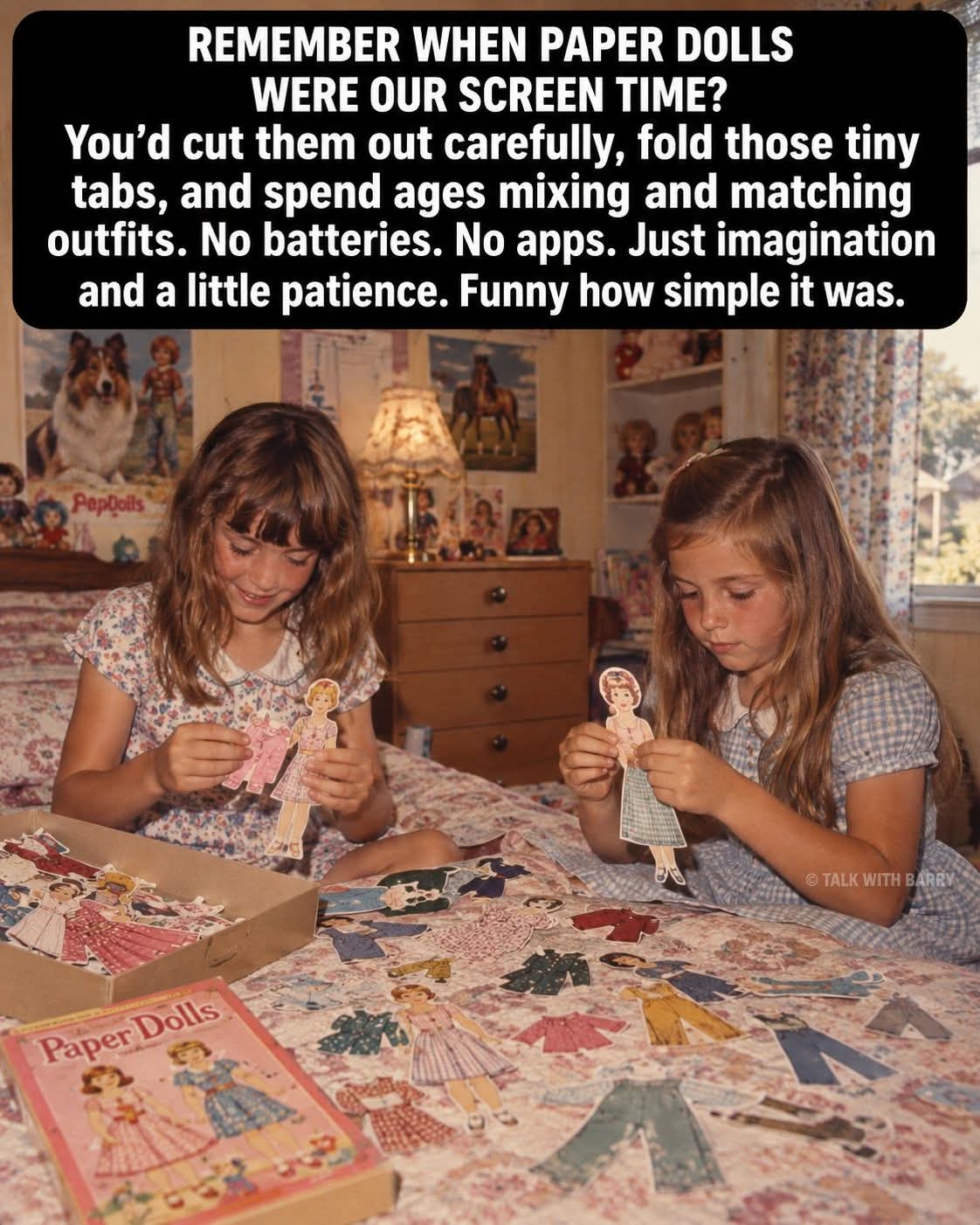
Paper dolls were our kind of screen time. ❤️
You’d sit there carefully cutting out each figure, trying not to snip the little tabs, then spend ages choosing which outfit went with which.
A bit of patience. A bit of imagination. And plenty of time to make up your own little world.
No batteries. No apps. No notifications.
Just a sheet of paper that could keep you happily occupied for hours.
Funny how something so simple could create such lasting memories. ❤️
Remember When Paper Dolls Were Our Screen Time? ❤️✂️
Before tablets, smartphones, video games, and endless streaming, there was something wonderfully simple that could keep a child entertained for hours:
Paper dolls.
A few sheets of paper, a pair of scissors, and an imagination were all it took to create an entire little world.
You would sit down with your paper doll and carefully cut around every tiny detail, concentrating especially hard around those little tabs. One wrong snip and an outfit might never stay on properly!
Then came the best part: choosing the clothes.
Would she wear the pretty dress or the skirt? The fancy hat or the casual one? Was she going to a party, going shopping, going to school, or simply spending the afternoon at home?
There were no rules.
There was just imagination.
✂️ The Joy Was in the Cutting
Paper dolls required patience.
You couldn’t simply tap a button and have an outfit appear. You had to physically cut each piece out.
The tiny tabs had to remain attached. The scissors had to follow the lines. Sometimes you had to turn the paper instead of the scissors to get around a difficult corner.
And if you accidentally cut off a tab?
Well… you learned to be more careful with the next one! 😄
That slow process was actually part of the fun.
Today we’re accustomed to entertainment happening instantly. Paper dolls made you work for the fun, and somehow that made the finished result feel even more special.
👗 A Whole Wardrobe on a Sheet of Paper
One little paper figure could have an enormous wardrobe.
There might be:
- Party dresses
- School outfits
- Pajamas
- Coats
- Hats
- Shoes
- Swimsuits
- Wedding dresses
- Work clothes
- Costumes
- Accessories
And every outfit could change the story.
A paper doll wasn’t simply a figure.
She could become whoever you imagined.
Historically, paper dolls were closely connected to fashion and popular culture. Commercial paper dolls became especially popular from the 19th century onward, and their clothing often reflected the fashions and social expectations of their era. (National Women’s History Museum)
🏠 We Created Entire Worlds
The best part wasn’t necessarily the doll itself.
It was the story you created around her.
Maybe she had a family.
Maybe she had a best friend.
Maybe she was a teacher, ballerina, movie star, mother, student, traveler, or fashion designer.
You could arrange the dolls around your bedroom floor and suddenly that little space became an entire town.
A box could become a house.
A book could become a building.
A blanket could become a stage.
And a handful of paper clothes could become an entire fashion collection.
No expensive accessories were required.
Your imagination supplied everything that was missing.
📰 Paper Dolls Were More Than Just Toys
Paper dolls actually have a fascinating history.
One of the earliest commercially manufactured examples was Little Fanny, published in England in 1810. In the United States, The History and Adventures of Little Henry appeared in 1812 with paper figures designed to help children act out scenes from the story. (National Women’s History Museum)
As printing became less expensive and more widespread, paper dolls appeared in books, newspapers, magazines, advertisements, and dedicated toy sets.
They became a way for children to interact with fashion, stories, and popular culture.
And those little outfits weren’t always just pretty decorations. Historians can look at paper-doll wardrobes to see what different periods considered fashionable, respectable, desirable, or appropriate. (National Women’s History Museum)
In other words, those tiny pieces of paper were little snapshots of history.
❤️ They Were Affordable Fun
Another reason paper dolls became so popular was their accessibility.
Unlike elaborate toys that could be expensive, paper dolls could be printed and sold relatively cheaply. The Metropolitan Museum of Art notes that inexpensive production helped make paper dolls available across a broad range of households. (The Metropolitan Museum of Art)
Sometimes they even appeared in newspapers and magazines.
You could find a doll, cut her out, and start playing.
For children who didn’t have shelves full of toys, that was enough.
Actually, sometimes it was more than enough.
🧒 The Kind of Play That Required Imagination
Paper dolls didn’t tell you exactly what to do.
There wasn’t a flashing screen saying:
LEVEL 1: GET DRESSED.
There wasn’t a timer.
There wasn’t a score.
There wasn’t an advertisement waiting for you after the next round.
You decided what happened.
You could change the story whenever you wanted.
If you didn’t like the ending, you simply invented a new one.
That kind of open-ended play gave children enormous freedom to create their own stories and characters.
📱 Before “Screen Time” Was a Phrase
Think about how different childhood entertainment was.
Instead of:
“Put the phone down.”
It might have been:
“Put the scissors away before you cut yourself!” 😂
Instead of worrying about how many hours a child had spent looking at a screen, parents might have found them sitting on the floor surrounded by tiny pieces of paper.
Instead of charging a device overnight, you simply put the paper dolls back in their box.
And instead of needing Wi-Fi?
You needed imagination.
👭 And Often, We Played Together
Paper dolls weren’t necessarily a solitary activity.
Sisters, cousins, friends, and neighbors could sit together and trade outfits, compare collections, invent stories, and decide which doll got which dress.
One person might be the designer.
Another might create the storyline.
Someone else might carefully organize all the outfits.
And inevitably, somebody would lose the most important dress.
“Who has the wedding dress?!” 😂
Those little moments became memories.
🎨 Some Children Became Designers
Paper dolls also encouraged creativity beyond simply dressing the figures.
Children could draw their own clothes.
They could color outfits differently.
They could create hairstyles, accessories, furniture, pets, houses, and entire families.
The collections at Te Papa include examples of children designing their own paper-doll clothing and creating elaborate stories around their dolls. (Te Papa Collections)
That was one of the beautiful things about paper dolls:
There was always room to add something.
You weren’t limited to what came in the box.
⏳ Where Did They Go?
Paper dolls didn’t disappear completely, but their popularity declined as new toys and forms of entertainment competed for children’s attention.
The National Women’s History Museum notes that paper dolls declined in popularity during the 1960s and 1970s, while other fashion-oriented toys offered similar imaginative play. (National Women’s History Museum)
Today, traditional paper dolls still have collectors and enthusiasts.
Vintage sets can be valuable not only because of their rarity, but because they preserve the fashions, illustrations, advertising, and cultural attitudes of the period in which they were created.
Museums including the Smithsonian and the Metropolitan Museum of Art maintain paper-doll collections that span generations. (The Metropolitan Museum of Art)
💭 Why We Still Remember Them
Maybe it’s because paper dolls were never really about the paper.
They were about time.
Time spent sitting on the floor.
Time spent carefully cutting.
Time spent deciding.
Time spent making up stories.
Time spent with a sister or friend.
Time when boredom wasn’t immediately solved by reaching for a phone.
And perhaps that’s why an old box of paper dolls can bring back so many memories decades later.
You remember the colors.
You remember the little tabs.
You remember the outfits.
You remember where you sat.
You remember who you played with.
And sometimes, you can almost remember exactly how it felt to be that child again.
❤️ A Little Paper, A Lot of Imagination
There’s something almost magical about how much entertainment could come from something so simple.
No batteries.
No charging cable.
No internet connection.
No notifications.
No subscriptions.
Just paper, scissors, patience, and imagination.
And somehow, that was enough to fill an entire afternoon.
Maybe that’s the lesson worth remembering.
Children don’t always need more complicated entertainment.
Sometimes they just need the opportunity to create their own.
Because when the toy doesn’t provide the entire story, the child gets to write it.
And those are often the stories we remember longest. ❤️
🥰 Did you play with paper dolls growing up?
A. ✂️ Yes! I had a whole collection
B. 👗 I mostly loved changing their outfits
C. 👭 I played with them with my sisters or friends
D. 🎨 I used to make my own clothes for them
E. ❤️ I never had them, but I remember seeing them
What was your favorite paper doll memory?
