⚖️ One Child’s Disruption Shouldn’t Outweigh 29 Children’s Right to Learn
Every classroom has challenges. Children have different personalities, different needs, different emotions, and different ways of expressing frustration. Sometimes a student may become disruptive, upset, restless, or unable to follow the lesson.
But the image above raises an important question:
How should a classroom balance the needs of one struggling student with the learning needs of everyone else? 📚⚖️
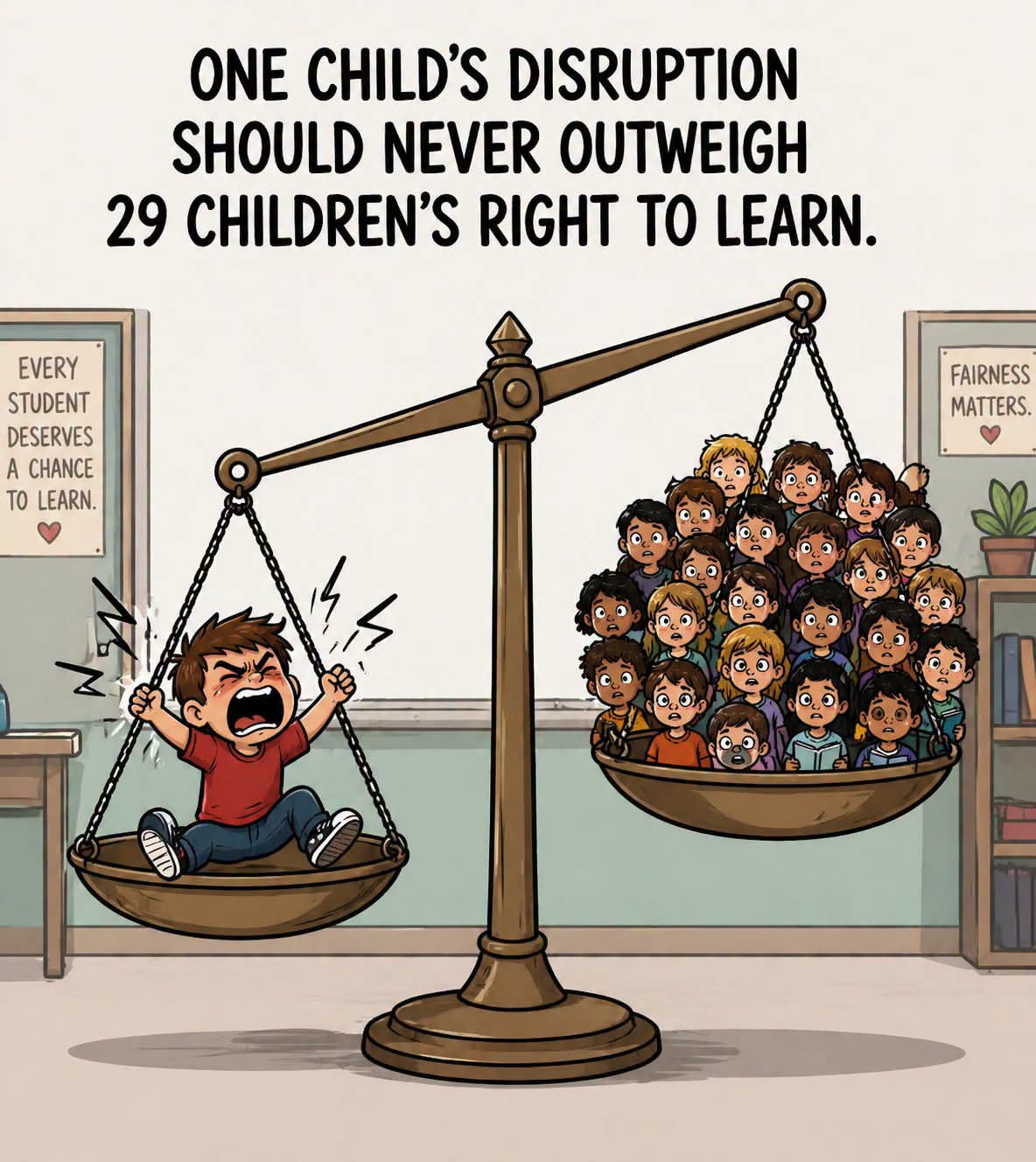
The illustration shows a classroom represented as a giant balance scale. On one side is one visibly upset child, while on the other side are 29 children waiting to learn. The message is simple: every child matters, but so does every other child in the room.
📚 Every Student Has a Right to Learn
A classroom isn’t just a place where teachers deliver lessons. It’s a shared environment where children are expected to learn, participate, ask questions, make mistakes, and develop social skills.
When repeated disruption makes it difficult for the rest of the class to concentrate, the impact can extend beyond a few lost minutes.
Students may miss explanations, struggle to complete assignments, lose concentration, or become frustrated themselves.
That doesn’t mean the disruptive child should simply be ignored or pushed aside.
It means the classroom has to consider everyone’s needs at the same time.
❤️ The Child Causing the Disruption Matters Too
One of the most important points in this discussion is that a disruptive child is still a child.
A student who is shouting, refusing to participate, leaving their seat, or interrupting the lesson may be communicating that something isn’t going well.
There could be difficulties with the work, emotional struggles, social conflict, frustration, boredom, sensory needs, or simply a lack of skills for managing strong emotions.
Calling a child “the problem” doesn’t solve the underlying issue.
Instead, educators and families can work toward understanding why the behavior is happening and what support might help.
Compassion and accountability don’t have to be opposites.
⚖️ Fairness Doesn’t Always Mean Treating Everyone Exactly the Same
The sign in the illustration says, “Fairness matters.”
That’s an important distinction.
Fairness doesn’t necessarily mean every student receives exactly the same response. Different students may need different forms of support.
One child might need a quiet space.
Another might need additional academic help.
Another may need clearer boundaries or predictable routines.
Someone else may simply need a reminder and a chance to reset.
The goal is to create an environment where individual support doesn’t come at the expense of everyone else’s opportunity to learn.
🏫 What Can Schools Do?
There isn’t one solution that works for every classroom, but several approaches can help.
1. Set clear expectations
Children should know what classroom behavior is expected of them and what happens when those expectations aren’t met.
Clear, consistent rules can make the classroom feel more predictable.
2. Address problems early
Small disruptions can sometimes become major interruptions when they continue unchecked.
A quiet reminder, change of activity, brief conversation, or other appropriate intervention may prevent a situation from escalating.
3. Understand the cause
Instead of asking only, “How do we stop this behavior?”, adults can also ask:
“What is causing this behavior?”
Understanding the cause can make it easier to find an effective response.
4. Protect instructional time
Teachers have a responsibility to support individual students, but they also have a responsibility to the rest of the class.
When intervention is necessary, it should ideally minimize the amount of learning time lost for everyone else.
5. Work together
Parents, teachers, counselors, administrators, and support professionals can sometimes accomplish more by working together than by handling the problem separately.
Communication matters.
👩🏫 Teachers Need Support Too
It’s easy to talk about what teachers should do.
But teachers are human beings managing classrooms filled with different personalities, learning styles, emotions, and needs.
A teacher shouldn’t be expected to solve every behavioral challenge alone while simultaneously teaching an entire class.
Schools need appropriate systems for supporting both students and educators.
When a child requires additional assistance, providing that support can benefit the child and protect the learning environment for everyone else.
🌱 Discipline Should Teach, Not Simply Punish
Another important question is what we want children to learn from difficult moments.
If a student behaves inappropriately, the goal shouldn’t necessarily be punishment for punishment’s sake.
A constructive response can teach children how to:
- Recognize their emotions
- Take responsibility for their actions
- Repair harm
- Respect other people’s boundaries
- Ask for help
- Make better choices next time
- Return to the classroom successfully
Those are skills children will need far beyond school.
👀 What About the Other 29 Children?
This is where the image makes its strongest point.
The students sitting quietly in the classroom have needs too.
They deserve to listen to their teacher.
They deserve to ask questions without being interrupted.
They deserve to feel safe and comfortable.
They deserve opportunities to learn without repeatedly losing instructional time.
Supporting one child should not require pretending that the other children don’t exist.
Their needs count too.
💬 The Real Challenge Is Finding the Balance
Perhaps the biggest lesson from this illustration is that the issue shouldn’t be framed as:
One child versus 29 children.
It should be:
How can we support one child while protecting the learning environment for everyone?
That’s a much harder question—but also a much more productive one.
A good classroom doesn’t have to choose between compassion and structure.
It can have both.
Children can be given support and boundaries.
Teachers can show understanding and maintain expectations.
Schools can accommodate individual needs and protect the educational experience of the wider class.
❤️ Every Child Deserves a Chance
The sign on the classroom wall says:
“Every student deserves a chance to learn.”
That includes the child struggling with behavior.
And it includes the 29 children sitting quietly and waiting for their lesson.
The challenge for educators isn’t deciding which group matters more.
It’s finding responsible ways to make room for both.
Because education isn’t just about getting through today’s lesson.
It’s about helping children learn how to live, communicate, cooperate, handle challenges, and respect the people around them.
And sometimes, the most important lesson in a classroom isn’t found in a textbook at all.
It’s learning how to balance compassion, responsibility, fairness, and the right of everyone to learn. ⚖️📚❤️
💭 What do you think?
Should schools focus on accommodating disruptive students first, or should protecting the learning time of the majority take priority?
Share your thoughts—this is one classroom debate where there are a lot of perspectives. 👇
