🌿
Sage has been sitting quietly in kitchens for centuries, adding its earthy, slightly peppery flavor to roasted meats, stuffing, soups, sauces, and teas.
But beyond the kitchen, common sage (Salvia officinalis) has also been studied for a variety of health-related uses—including menopause symptoms, memory and cognition, and cholesterol. The important catch is that the research is still limited, so some of the impressive claims circulating online go well beyond what science can currently establish. (NCCIH)
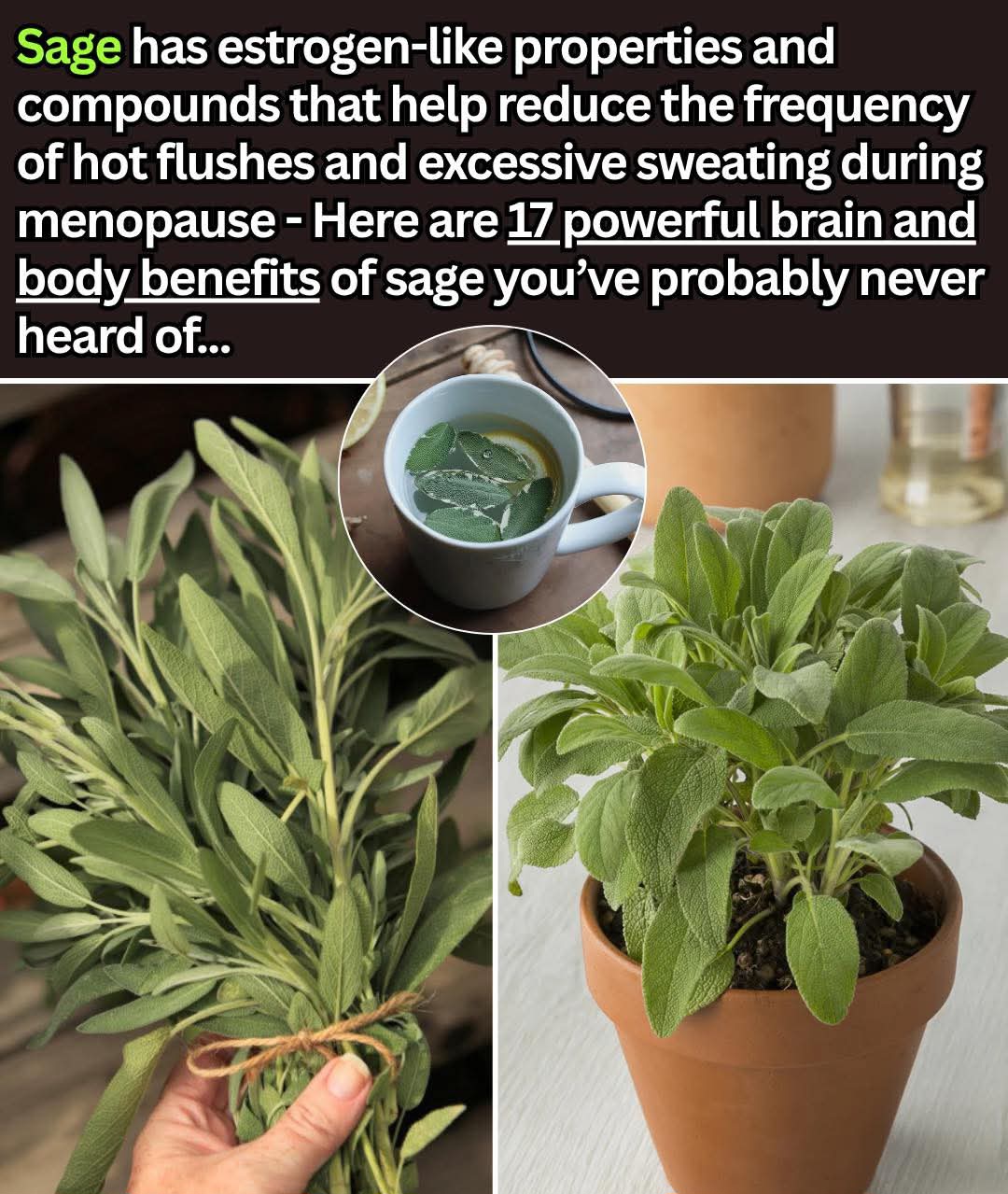
The image claims that sage has “estrogen-like properties” and can provide 17 powerful brain and body benefits. That’s an attention-grabbing headline, but the evidence deserves a closer look.
🌿 What Exactly Is Sage?
Common sage, or Salvia officinalis, is a Mediterranean herb belonging to the mint family.
Its soft, gray-green leaves are intensely aromatic, which is why sage has become such a familiar culinary herb.
Traditionally, sage has been used for digestive, respiratory, and skin complaints, while modern research has investigated it for several other purposes. (NCCIH)
You can find sage as:
- 🌿 Fresh leaves
- 🧂 Dried culinary seasoning
- 🍵 Herbal preparations
- 💊 Extracts and supplements
- 🌱 A garden plant
But these forms aren’t necessarily interchangeable. A few leaves used in cooking are very different from a concentrated extract or essential oil.
🔥 Can Sage Really Help With Hot Flashes?
This is one of the more interesting claims in the image.
Some small clinical studies have investigated sage for menopausal hot flashes. The results have been encouraging enough to warrant further research, but they aren’t strong enough to say that sage is a proven treatment.
A 2023 systematic review and meta-analysis examined four studies involving 310 postmenopausal women. The researchers found evidence suggesting sage could reduce the frequency of hot flashes, but the evidence for reducing their severity was not statistically significant in the meta-analysis. (PubMed)
So the accurate takeaway is:
Sage may help some women experience fewer hot flashes, but more high-quality research is needed.
That’s very different from saying it is a guaranteed menopause remedy.
🧬 What About “Estrogen-Like” Effects?
This is where social-media health posts can become misleading.
Sage contains numerous plant compounds, and some herbs contain compounds that can interact with biological pathways involved in hormone activity.
But saying that sage simply “acts like estrogen” can give the wrong impression.
Human evidence is not strong enough to treat ordinary sage as an equivalent to estrogen therapy or assume that drinking sage tea will reproduce the effects of estrogen.
The National Center for Complementary and Integrative Health notes that research on herbs and supplements for menopause symptoms remains limited overall. (NCCIH)
🧠 Could Sage Help Your Brain?
Sage has attracted scientific interest because some studies have examined its effects on memory, attention, and cognition.
A review of clinical studies involving Salvia officinalis and Salvia lavandulaefolia found promising results in some cognitive tests, including studies involving healthy people. However, the researchers also emphasized methodological limitations and differences between preparations, meaning the results aren’t definitive. (PMC)
So rather than saying:
“Sage boosts your brain.”
A more accurate statement is:
“Some early studies suggest sage may influence certain aspects of cognitive performance, but the evidence remains limited.”
That’s still interesting—but much more responsible.
❤️ Sage and Cholesterol
Another area that has produced intriguing results is blood lipids.
One randomized controlled trial involving people with elevated cholesterol or triglycerides found that a sage-leaf extract was associated with improvements in several lipid measurements after two months. (PubMed)
There has also been a systematic review of clinical trials reporting promising effects on serum lipids.
But these studies involved specific extracts and doses, not simply sprinkling dried sage over dinner.
That’s an important distinction.
A culinary herb can be part of a healthy diet without being considered a replacement for medical treatment.
🌱 What About Antioxidants?
Sage contains plant compounds with antioxidant activity, which is one reason researchers are interested in it.
Laboratory studies have identified various phenolic compounds in sage, and the antioxidant properties of extracts can vary depending on how the plant is processed and extracted. (PMC)
But there’s a major difference between:
“This plant contains antioxidant compounds”
and
“Eating this plant prevents disease.”
The first is a chemical observation.
The second requires strong human clinical evidence.
🍵 Sage Tea: A Simple Traditional Preparation
Sage is commonly consumed as a tea or infusion.
A basic preparation can be made by steeping a small amount of culinary sage in hot water and allowing it to infuse before straining.
The result has a distinctive herbal flavor—earthy, savory, and slightly bitter.
Some people add lemon or a little honey to soften the flavor. 🍋🍯
However, stronger isn’t necessarily better.
Concentrated herbal products can expose you to much higher amounts of active compounds than you’d receive from normal culinary use.
⚠️ Sage Isn’t Automatically Safe Just Because It’s Natural
This is perhaps the most important part of the entire discussion.
Natural doesn’t automatically mean harmless.
The NCCIH notes that common sage contains thujone, a compound that can be toxic in high amounts. Sage is considered likely safe in normal food quantities, while high doses or prolonged use may pose risks. (NCCIH)
That’s why regularly consuming large amounts of concentrated sage preparations isn’t something to approach casually.
Extra caution is appropriate with supplements and essential oils because their concentrations can be dramatically different from culinary sage.
🌿 17 “Benefits” — What Does the Evidence Actually Say?
The viral image lists 17 benefits, but science doesn’t currently support treating all 17 as established facts.
Here’s a more evidence-based way to look at the popular claims:
1. 🔥 Hot flashes
Promising but not proven. Small studies suggest sage may reduce hot-flash frequency. (PubMed)
2. 💦 Excessive sweating
Possible, but evidence is limited. Some traditional use and small studies have investigated sweating, but this isn’t firmly established.
3. 🧠 Memory
Interesting preliminary evidence. Some clinical studies have reported effects on aspects of memory and cognition. (PMC)
4. 🎯 Attention
Being studied. Research has suggested possible effects on certain cognitive measures, but evidence remains limited. (PMC)
5. ❤️ Cholesterol
Promising early evidence. Some trials have reported improvements in lipid measurements. (PubMed)
6. 🩸 Blood sugar
Not established. NCCIH says there isn’t enough evidence to determine whether sage meaningfully improves blood glucose. (NCCIH)
7. 🌿 Antioxidant activity
Yes at the chemical level. Sage contains compounds with antioxidant properties, but that doesn’t automatically translate into disease prevention. (PMC)
8. 🦠 Antimicrobial activity
Mostly laboratory/traditional evidence. Laboratory findings shouldn’t be interpreted as proof that sage treats infections in people.
9. 😌 Mood
Preliminary research exists, but more evidence is needed before making strong claims. (NCCIH)
10. 🍽️ Digestion
Sage has a long history of traditional use for digestive complaints, but modern clinical evidence is limited. (NCCIH)
11. 🫁 Respiratory comfort
Traditional use exists, but that isn’t the same as proven treatment for respiratory disease. (NCCIH)
12. 🦷 Mouth and throat
Sage has traditionally been used for throat and mouth complaints, and it has been studied for sore throat, but the evidence remains preliminary. (NCCIH)
13. 🧴 Skin
Traditional applications exist, but strong clinical evidence for treating specific skin diseases is lacking.
14. 🧬 Hormonal effects
There is interest in sage and menopause, but describing it as a natural replacement for estrogen would go beyond the evidence.
15. ⚡ Metabolism
Research is ongoing, but sage shouldn’t be presented as a proven metabolism booster.
16. 🛡️ General wellness
Using culinary herbs as part of a varied diet is reasonable, but “wellness” claims are often much broader than the available evidence.
17. 🌱 Overall health
Sage can certainly be part of a flavorful, plant-rich diet—but it shouldn’t be treated as a cure-all.
🍗 You Don’t Need a Supplement to Enjoy Sage
One of the simplest ways to enjoy sage is also one of the oldest:
Use it as a cooking herb.
Sage works beautifully with:
🍗 Chicken
🥔 Potatoes
🎃 Pumpkin
🍝 Pasta
🧈 Brown butter
🍞 Stuffing
🥕 Roasted vegetables
🫘 Beans
🍲 Soups
A few fresh leaves fried gently in butter can transform an ordinary meal into something wonderfully aromatic.
And unlike a concentrated supplement, culinary use generally involves much smaller quantities.
🌿 Grow Your Own Sage
Sage is also a wonderfully attractive garden herb.
Its soft, textured leaves make it useful both in the kitchen and as an ornamental plant.
A sunny location and well-drained soil are generally helpful, and once established, common sage can be relatively hardy.
Harvesting a few leaves whenever you need them means you can have fresh sage available without relying on packaged herbs.
There’s something satisfying about walking outside, picking a handful of leaves, and bringing them straight into the kitchen.
⚠️ A Final Word About Supplements
If you’re considering sage specifically for menopause symptoms, cholesterol, memory, or another health condition, it’s worth talking with a healthcare professional—particularly if you’re taking medications or considering concentrated extracts.
Herbal supplements can interact with medicines, and their long-term safety isn’t always well understood. (NCCIH)
And importantly, sage should not be viewed as a substitute for prescribed treatment.
🌿 The Real Story Behind Sage
Sage is fascinating precisely because it sits somewhere between food, tradition, and modern scientific investigation.
It has a long history of culinary and traditional use.
Researchers have found interesting signals involving hot flashes, cognition, and blood lipids.
But the scientific picture isn’t finished.
Some claims circulating online are supported by preliminary evidence.
Others are based mainly on traditional use or laboratory research.
And some viral claims simply go further than the available human evidence.
So perhaps the most sensible way to think about sage is this:
Enjoy it as a flavorful herb, appreciate its fascinating history, and stay cautious about claims that promise a miracle. 🌿❤️
💬 What do you use sage for?
Cooking, tea, gardening, or have you ever tried it as a traditional remedy? 🌿🍵
And if you’ve ever grown your own sage, what’s your favorite recipe for it? 👇
