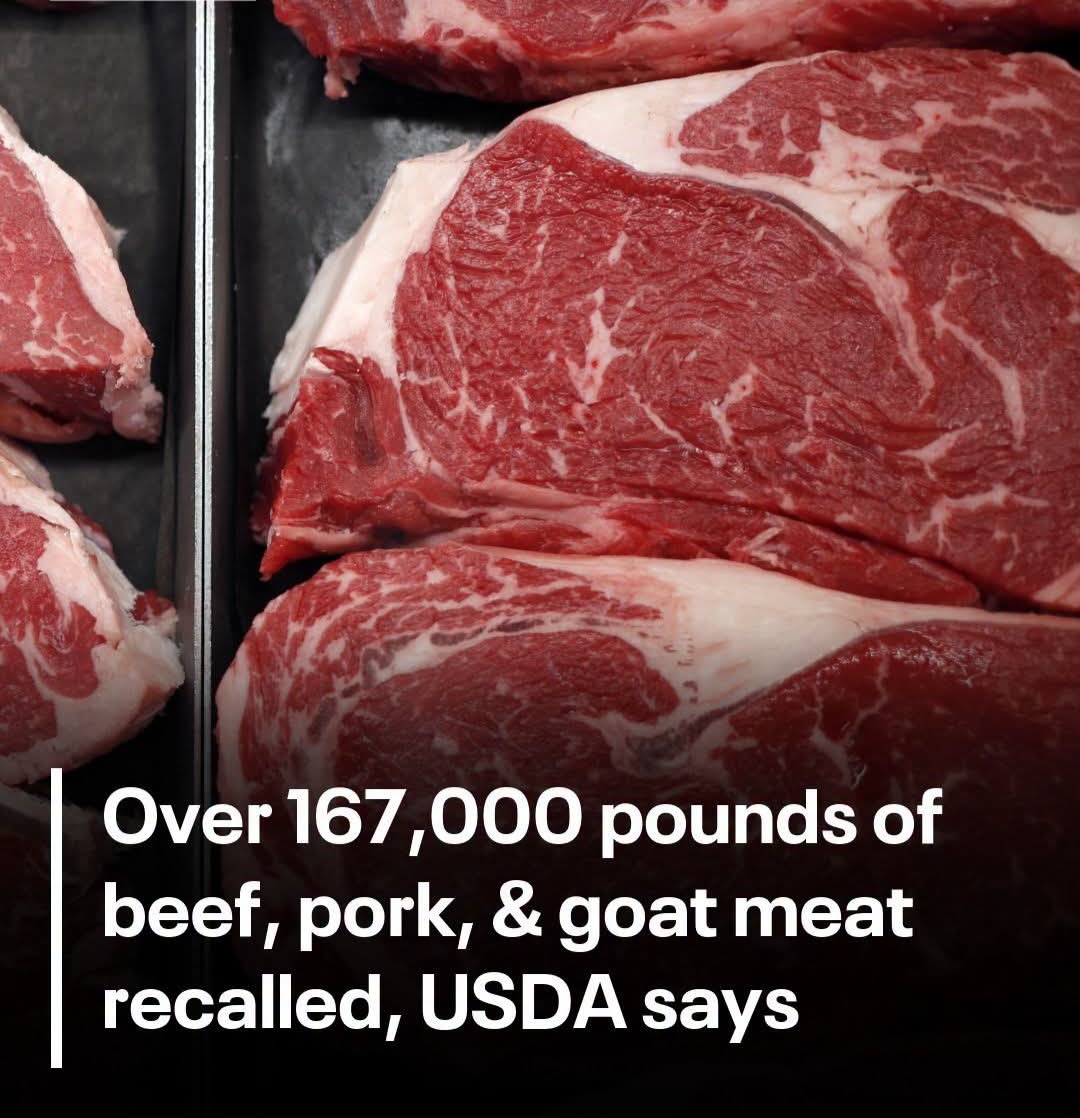
🚨 167,639 Pounds of Beef, Pork and Goat Products Pulled From the Market
A major nationwide meat recall has been announced after the U.S. Department of Agriculture’s Food Safety and Inspection Service (FSIS) discovered that a large quantity of raw meat products had been produced without federal inspection and carried a false USDA inspection mark.
The recall involves approximately 167,639 pounds of raw pork, beef and goat products produced by Star Meat Delivery Inc. of Lucama, North Carolina. FSIS said the problem was discovered during its surveillance activities. (meatpoultry.com)
The products were shipped to A&D Foods, a Georgia distributor, for further distribution to retail stores and restaurants around the country. (meatpoultry.com)
Because some of the products may already be in refrigerators, freezers, restaurants and retail locations, consumers are being urged to check their meat carefully.
🚨 Why Was the Meat Recalled?
According to FSIS, the recalled products were produced without the benefit of federal inspection.
They also carried a false establishment number:
EST. 1363
FSIS said that number does not correspond to a federally inspected establishment.
The agency considers the products misbranded and unsafe to eat. The recall was classified as Class I, which is the USDA’s most serious recall classification. (meatpoultry.com)
This doesn’t mean that every package has been shown to contain a harmful substance. Rather, the lack of required federal inspection means the products cannot be treated as meeting the applicable federal inspection requirements.
🥩 What Products Are Included?
The recall covers a large variety of raw meat products.
Among the products identified in reports based on the USDA announcement are:
- 🐖 Pork chorizo
- 🐖 Pork chops
- 🐖 Pork feet
- 🐖 Pork ribs
- 🐖 Pork Boston butt
- 🐖 Pork hock
- 🥩 Beef ribs
- 🥩 Beef short ribs
- 🥩 Ribeye
- 🥩 Beef chuck
- 🥩 Beef feet
- 🐐 Goat cuts
- 🐐 Goat burn-skin-on cuts
- 🍲 Menudo mix
- Other raw beef, pork and goat products
Many were vacuum-packed and placed inside cardboard boxes under the A&D Foods label. (FOX 5 DC)
Because there are numerous products and package sizes involved, consumers shouldn’t rely solely on remembering one product name.
The establishment number is particularly important.
🔎 Check Your Refrigerator and Freezer
FSIS specifically expressed concern that some of the recalled products could still be in consumers’ refrigerators or freezers, as well as in restaurants and retail locations. (AOL.com)
Look for products associated with:
EST. 1363
However, there’s an important complication.
Some individual consumer packages may not carry the original labeling because retailers may have applied their own stickers containing pricing and safe-handling information. (AOL.com)
That means checking only the package sitting in your freezer may not always be straightforward.
If you’re unsure whether meat is part of the recall, it’s safer to compare it against the official recall information rather than guessing based on appearance.
🛑 What Should Consumers Do?
If you determine that you have recalled meat, do not eat it.
FSIS advises consumers not to consume the affected products. Retailers and restaurants are likewise instructed not to sell or serve them. Recalled products should be discarded or returned to the place of purchase. (AOL.com)
And don’t rely on:
❌ Smell
❌ Appearance
❌ Color
❌ Cooking it extra thoroughly
to decide whether recalled meat is safe.
A food product can look and smell normal while still being unsuitable for consumption.
🍽️ What About Restaurants?
This recall isn’t limited to household refrigerators.
Because the recalled meat was distributed through a Georgia distributor for further distribution to retail and restaurant locations nationwide, restaurants may also have received affected products. (meatpoultry.com)
Restaurants should check their inventory and suppliers against the recall information before serving potentially affected products.
Consumers who are eating at restaurants can also ask staff about recalled ingredients if they have reason to believe a particular product may be involved.
⚠️ Why Federal Inspection Matters
Federal inspection is an important part of the U.S. meat safety system.
Inspection involves regulatory oversight intended to help ensure that meat products meet federal requirements before they enter commerce.
When meat is produced outside that inspection system, regulators cannot treat it as having gone through the required process.
That’s why the issue here goes beyond a simple labeling mistake.
FSIS stated that meat produced without inspection may potentially involve risks such as undeclared allergens, harmful bacteria or other contaminants. (AOL.com)
🩺 Have People Become Sick?
At the time of the reports available on September 23, there were no confirmed reports of illness or injury associated with consumption of the recalled products. (AOL.com)
That is an important distinction.
A recall can be issued as a precaution because a product doesn’t meet safety or inspection requirements even when illnesses have not been confirmed.
Anyone who believes they became ill after eating a recalled product should contact a healthcare professional.
🧊 What If You Already Cooked the Meat?
If you discover that meat you previously purchased is part of the recall, don’t assume that cooking it makes the recall irrelevant.
The appropriate action is to avoid consuming the recalled product and follow the USDA’s disposal or return guidance.
If you already ate it and feel well, there is no need to panic. But if you develop symptoms that concern you, particularly significant or persistent symptoms, contact a healthcare professional.
📦 Why This Recall Is Especially Important
There are several things that make this situation worth paying attention to.
1. It’s a large recall
Approximately 167,639 pounds of meat are involved. (meatpoultry.com)
2. It involves multiple types of meat
This isn’t just one steak or one sausage product. The recall includes beef, pork and goat products. (wpbf.com)
3. Distribution was nationwide
The products were sent through a distributor for further distribution to retail and restaurant locations across the country. (meatpoultry.com)
4. Some products may have different retail labels
Retailers may have applied their own stickers, potentially making identification more difficult. (AOL.com)
5. The investigation is continuing
Reports based on the USDA announcement indicate that additional products could potentially be identified as the investigation continues. (FOX 5 DC)
🔍 The Biggest Takeaway
If you have purchased meat recently, don’t automatically assume that everything in your freezer is affected.
Instead, check the specific recall information.
Look carefully at:
Product name → packaging → establishment number → purchase source → applicable production dates.
And if you find a recalled product, don’t eat it.
🧡 A Reminder for Anyone With Meat at Home
Food recalls can be easy to overlook.
The package may have been purchased days or weeks ago.
It may already be sitting in the freezer.
The label may look ordinary.
And if a product was repackaged by a retailer, the original identifying information may not be obvious.
That’s why checking official recall announcements is so important.
The USDA’s Food Safety and Inspection Service also provides a consumer complaint system and a Meat and Poultry Hotline for food-safety concerns. (foodcomplaint.fsis.usda.gov)
🚨 Final Reminder
The current recall involves approximately 167,639 pounds of raw beef, pork and goat products from Star Meat Delivery Inc.
The products were reportedly produced without federal inspection and carried a false “EST. 1363” USDA inspection mark. They were distributed through A&D Foods for retail and restaurant distribution nationwide. (meatpoultry.com)
If you have meat bearing the recalled establishment number, don’t eat it.
Check the official recall details carefully, and when in doubt, don’t guess about whether a package is affected.
🥩 Have you checked your freezer lately?
Share this information with someone who buys meat regularly—especially anyone who shops at independent meat markets or restaurants that may have received bulk products.
