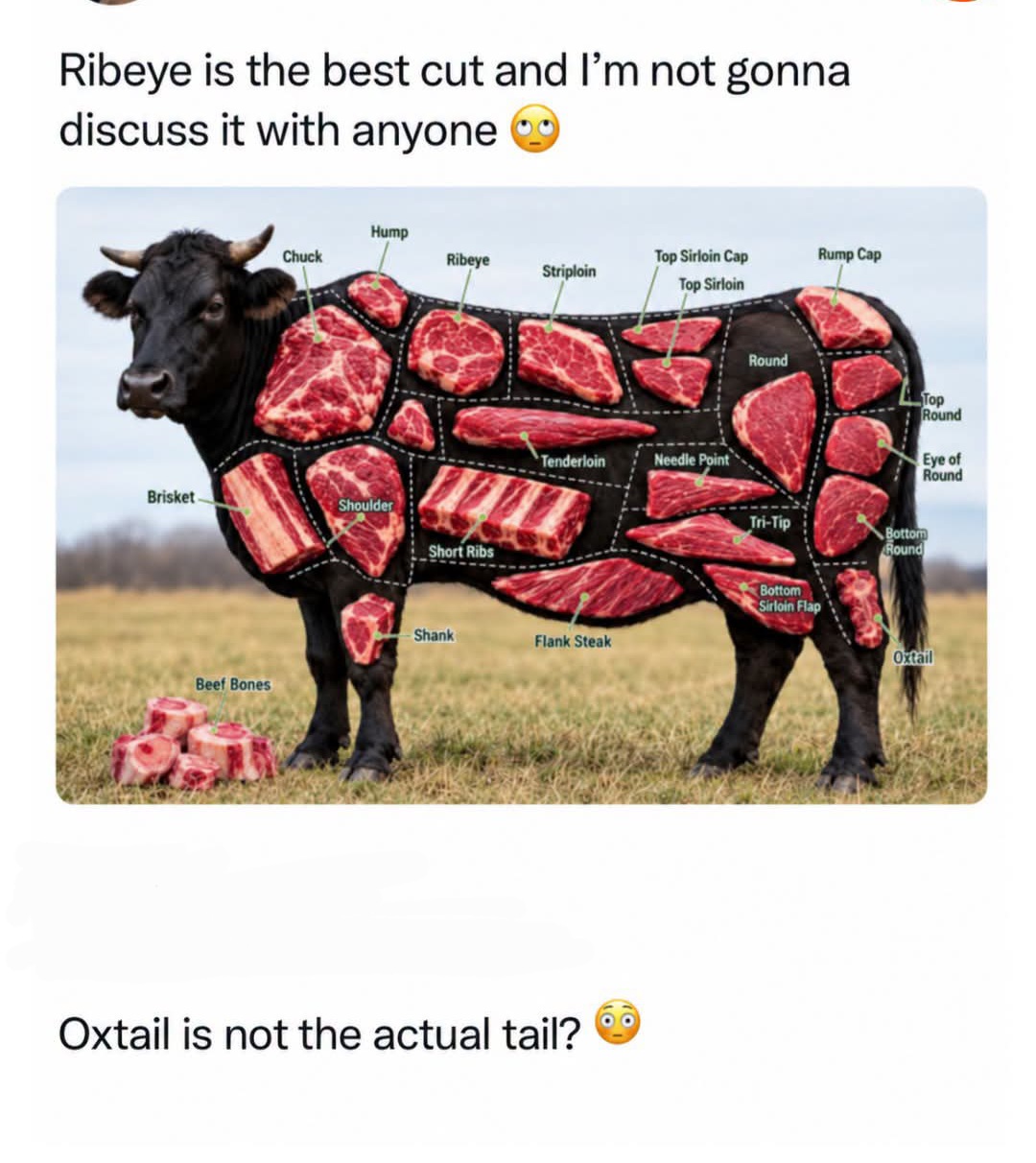
🐂😵💫 Oxtail Really IS the Tail?! Here’s the Part That Surprises Everyone!
If you’ve ever looked at a beef-cut diagram and wondered “Wait… where exactly does oxtail come from?”, you’re definitely not alone! 😂
The name sounds obvious, but here’s the surprising part: oxtail really is the tail of cattle. Today, the term “oxtail” generally refers to the tail of beef cattle—not necessarily an actual ox. (Cambridge Dictionary)
And yes… that means the delicious oxtail stew, soup and braises you’ve been eating really are made from the animal’s tail. 😳🥘
🐂 So Where Exactly Is the Oxtail?
Look at the very back of the cow.
The tail extends from the base of the spine and is made up of the coccygeal, or tail, vertebrae, surrounded by muscle, connective tissue and fat. (ScienceDirect)
Butchers generally remove the tail near its base and then divide it into smaller portions between the vertebrae.
That’s why oxtail at the butcher counter doesn’t usually look like one long tail.
Instead, you’ll see round, chunky pieces with a bone in the center. 🥩
And that central bone is a big part of what makes oxtail so special.
🤯 Why Is It Called “Oxtail”?
The word comes from the traditional use of “ox” to refer to a working bovine.
Historically, oxtail meant the tail of an ox. Today, however, the culinary term is generally used for the tail of cattle regardless of sex. (Wikipédia)
So when you’re ordering oxtail, you’re not necessarily ordering the tail of an actual ox.
You’re ordering beef tail.
That makes the name a little less mysterious—but arguably even more fascinating! 😂
🥩 Why Does Oxtail Look So Different?
Oxtail is not a big slab of meat like a ribeye or strip steak.
Instead, it’s made up of sections of the tail containing:
🦴 Bone
🥩 Muscle
🧈 Fat
🫧 Connective tissue
🦴 Marrow
When the tail is cut into sections, each piece has that characteristic circular bone in the middle with meat surrounding it.
And those pieces can vary in size because the tail gradually gets smaller toward its tip. (Aussie Beef & Lamb)
🍲 Here’s Why Oxtail Becomes SO Tender
Raw oxtail isn’t exactly the kind of meat you’d want to throw on the grill for five minutes.
It’s a hardworking part of the animal, and it contains a lot of connective tissue.
But give it low, gentle, moist heat for a long time, and something amazing happens.
The collagen gradually breaks down into gelatin, producing meat that becomes incredibly tender and a cooking liquid that can become rich, silky and wonderfully full-bodied. (Publications.gc.ca)
That’s why oxtail is so popular in:
🍲 Soups
🥘 Stews
🍛 Braises
🍷 Slow-cooked dishes
🥣 Rich stocks and broths
It’s basically a cut that rewards patience. ❤️
🔥 Why You Don’t Cook Oxtail Like a Ribeye
This is one of the biggest differences between the cuts.
A ribeye is prized for tenderness and marbling and can be cooked quickly over high heat.
Oxtail is a completely different story.
It needs time.
A typical approach is to brown the pieces first, then slowly braise them in liquid until the connective tissue has broken down and the meat is tender. (Aussie Meat HK)
And that long cooking time is what turns a tough piece of meat into something incredibly rich and spoon-tender.
🧡 The “Underrated Cut” That Became a Favorite
There’s also something wonderfully old-fashioned about oxtail.
It represents the traditional idea of using more of the animal rather than wasting valuable food.
Today, oxtail appears in cuisines all over the world, from hearty soups and stews to highly seasoned braises. (Allrecipes)
And once people discovered just how much flavor and richness could come from slow-cooking it, oxtail became much more than something tossed into a stockpot.
It’s now a prized ingredient in many kitchens.
🥩 And What About That Ribeye Claim?
The image also says:
“Ribeye is the best cut and I’m not gonna discuss it with anyone.” 😂
That’s certainly a valid opinion!
Ribeye is famous for its rich marbling and beefy flavor, while oxtail is prized for an entirely different experience—deep flavor, gelatinous richness and fall-apart tenderness after slow cooking.
So comparing them is almost like comparing two completely different styles of beef.
🥩 Ribeye: quick, juicy, marbled, steak-night luxury.
🍲 Oxtail: slow, rich, silky, stew-night comfort.
Honestly?
There’s room for both. 😍
🤯 THE FUNNIEST PART…
You can spend years eating oxtail without really stopping to think about what the name means.
Then you see the cow diagram and suddenly:
“WAIT… THAT’S ACTUALLY THE TAIL?!” 😵😂
Yep.
The diagram isn’t pulling a trick on you.
Oxtail is the actual cattle tail, usually separated into individual vertebrae and sold as meaty sections. (Aussie Beef & Lamb)
And now you’ll probably never look at a bowl of oxtail stew the same way again.
👀 BE HONEST…
Did you already know oxtail was literally the tail of the cow, or did this diagram just blow your mind? 😵🤯
And the bigger question…
