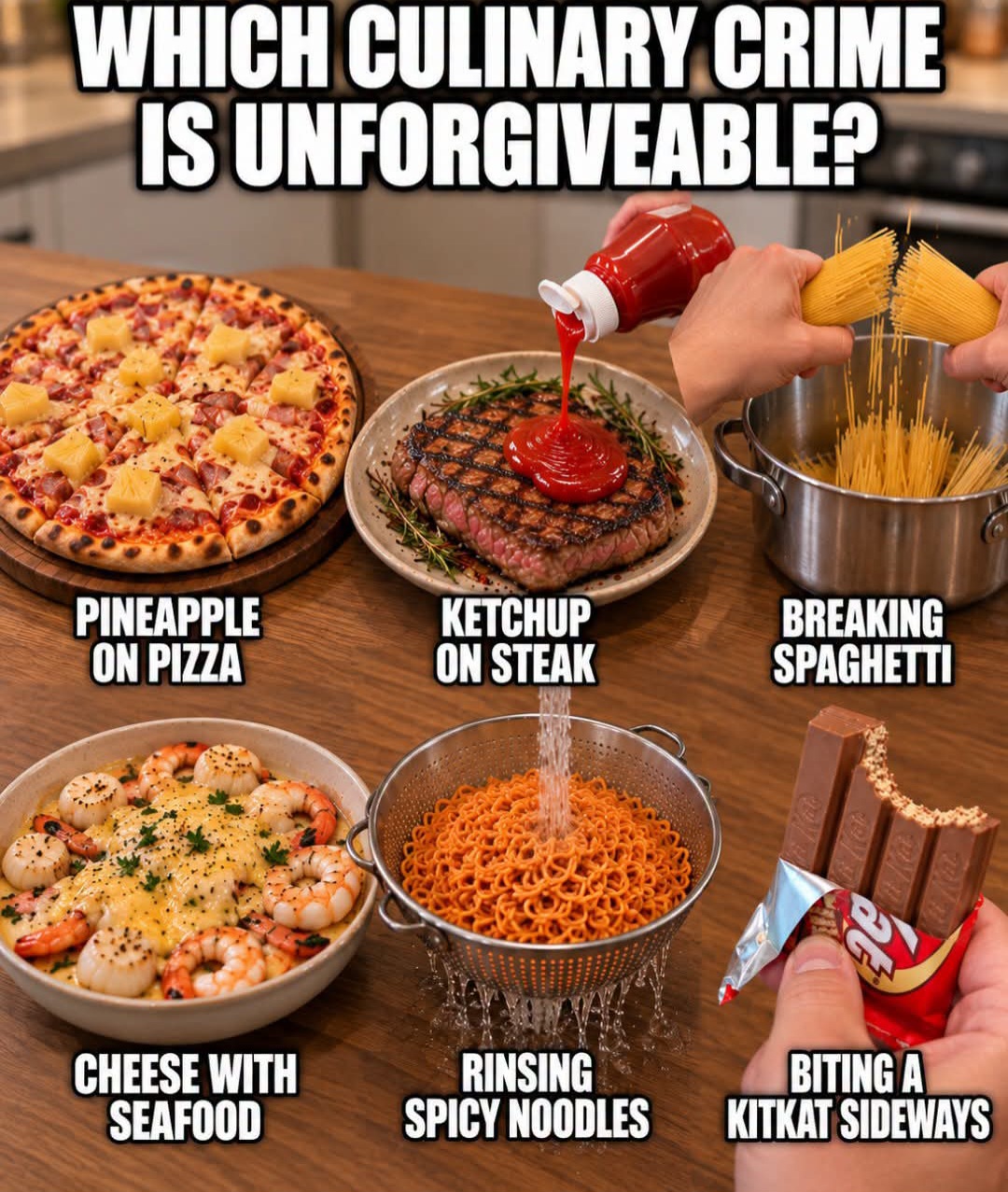
? 🍕🥩🍝 The Great Food Debate!
Food has a funny way of bringing people together—and starting arguments! Everyone has their favorite dishes, cooking habits, and food combinations they swear by. But what happens when someone puts ketchup on a perfectly cooked steak, breaks spaghetti in half before boiling it, or adds pineapple to a pizza?
Suddenly, dinner becomes a debate!
Some people believe food should be enjoyed however you like it. Others have strong opinions about the right way to cook, season, and serve certain dishes. And when it comes to culinary traditions, even the smallest change can spark a passionate discussion.
So, let’s settle one of the internet’s most entertaining questions: Which culinary crime is absolutely unforgivable? 👀🫣
🍍 1. Pineapple on Pizza: Delicious or Disrespectful?
Few food debates are as famous as the pineapple-on-pizza controversy.
Hawaiian pizza, typically made with ham and pineapple, combines sweet, juicy fruit with salty meat, melted cheese, and savory tomato sauce. For its fans, the contrast between sweet and savory flavors is precisely what makes it delicious.
For its critics, however, fruit has no place on pizza. They argue that the sweetness overwhelms the other ingredients and that traditional pizza toppings should remain savory.
But pineapple isn’t the only fruit that can work in savory dishes. Many cuisines combine fruit with meat, cheese, and spices to create balanced flavors.
Ultimately, pineapple pizza comes down to personal taste. If you enjoy the combination, there’s no reason to give it up just because someone else considers it a culinary disaster!
The big question: Is pineapple on pizza a delicious combination or a crime against Italian cuisine? 🍍🍕
🥩 2. Putting Ketchup on Steak: A Sauce Too Far?
For steak lovers, few things are more satisfying than a beautifully cooked piece of beef. A properly seared crust, a juicy center, and a little salt and pepper can create an unforgettable meal.
So imagine spending time selecting a good cut of steak, seasoning it carefully, and cooking it to perfection—only to watch someone cover it with ketchup!
For some food enthusiasts, that’s practically a personal insult.
Their argument is that ketchup’s sweetness, acidity, and strong tomato flavor can overwhelm the natural taste of the beef. A good steak may need nothing more than salt, pepper, and perhaps a little butter.
Others believe food should be enjoyed however people prefer. If ketchup makes steak more enjoyable for someone, why should anybody else care?
After all, steak sauces have existed for centuries, and people regularly serve beef with peppercorn sauce, chimichurri, béarnaise, and other flavorful accompaniments.
The real question may not be whether sauce belongs on steak, but whether the sauce complements the meat or completely masks its flavor.
The big question: Would you ever put ketchup on an expensive steak, or is that where you draw the line? 🥩🍅
🍝 3. Breaking Spaghetti Before Cooking It
For some people, breaking spaghetti in half before placing it in a pot is simply practical. Shorter strands fit more easily into smaller pots and can be easier to handle.
But to lovers of Italian cuisine, snapping spaghetti can feel like an unnecessary violation of pasta tradition.
Spaghetti is designed to be cooked whole. As the submerged ends soften, the strands can gradually bend into the boiling water without needing to be broken.
Keeping the pasta intact also preserves the traditional experience of twirling long strands around a fork.
There’s another consideration: pasta length can affect how a dish is eaten and how the sauce clings to the strands. While breaking spaghetti doesn’t ruin its flavor, it does change the final experience.
Still, not everyone has a large pot or the patience to wait for the pasta to soften. And if breaking it makes cooking easier, some people see absolutely no problem with it.
The big question: Do you cook spaghetti whole, or do you snap it in half before boiling? 🍝
🧀 4. Adding Cheese to Seafood
Cheese and seafood can be a controversial combination, especially among people who prefer traditional Italian seafood dishes.
Some cooks believe the rich, creamy flavor of cheese can overpower the delicate taste of fish, shrimp, scallops, and other seafood. Others argue that certain cheeses can complement seafood beautifully.
Think about creamy shrimp pasta, seafood gratins, cheesy crab dips, or baked scallops with a golden Parmesan topping.
These dishes demonstrate that cheese and seafood can work together when the ingredients are chosen carefully.
The key is balance. A delicate white fish might be overwhelmed by a heavy, strongly flavored cheese sauce, while shrimp or crab can pair wonderfully with cream cheese, mozzarella, Parmesan, or other suitable varieties.
Of course, personal preferences matter, and culinary traditions differ across regions.
There’s no universal rule that cheese and seafood can never share a plate.
The big question: Is cheese with seafood a delicious combination, or should these two ingredients stay apart? 🦐🧀
🌶️ 5. Rinsing Spicy Noodles After Cooking
This one might upset instant-noodle enthusiasts!
Many spicy noodle dishes are designed to be served with their seasoning, sauce, and flavorful cooking liquid. Rinsing the noodles after cooking can wash away some of the surface starch and seasoning, potentially changing the taste and texture.
For saucy instant noodles, rinsing after adding the seasoning can remove some of the flavor that makes the dish special.
However, rinsing noodles isn’t always wrong. In some recipes, cold-water rinsing is an intentional step that stops the cooking process, removes excess starch, or prepares noodles for a cold dish.
The important distinction is how the noodles are meant to be served.
If you’re making a spicy noodle dish that depends on a thick, flavorful sauce, rinsing everything away at the end probably isn’t the best approach.
But if you’re preparing noodles for a chilled salad or another recipe that calls for rinsing, it makes perfect sense.
The big question: Would you ever rinse your spicy noodles, or should every drop of that fiery sauce stay exactly where it belongs? 🌶️🍜
🍫 6. Biting a KitKat Sideways
Now here’s a culinary crime that has nothing to do with cooking!
Some people carefully separate the fingers of a KitKat before eating them. Others bite straight into the chocolate bar. And then there are those who bite across the fingers sideways, crunching through several layers at once.
For some chocolate lovers, the proper way to eat a KitKat is an important ritual. Separating the fingers creates a satisfying little break between bites and allows you to enjoy each piece individually.
Biting sideways, on the other hand, skips the ritual entirely.
But does it really matter?
Not particularly. The chocolate and wafer taste the same regardless of how you bite into them.
Still, the way we eat familiar foods can become part of the enjoyment. Small habits and rituals often make everyday snacks feel more satisfying.
The big question: Do you break your KitKat into individual fingers, or do you bite straight across the whole thing? 🍫
🤔 Which Culinary Crime Is the Worst of Them All?
Let’s put all six food controversies side by side.
| Culinary crime | Why people object | The counterargument |
|---|---|---|
| 🍍 Pineapple on pizza | Sweet fruit doesn’t belong on savory pizza. | Sweet-and-salty combinations can be delicious. |
| 🥩 Ketchup on steak | Ketchup can overpower the beef’s flavor. | Everyone should enjoy steak with their preferred condiment. |
| 🍝 Breaking spaghetti | It changes the traditional pasta experience. | Shorter pasta is easier to fit into small pots. |
| 🧀 Cheese with seafood | Rich cheese can overwhelm delicate seafood. | The right cheese can complement seafood beautifully. |
| 🌶️ Rinsing spicy noodles | It can wash away seasoning and sauce. | Some noodle recipes specifically require rinsing. |
| 🍫 Biting a KitKat sideways | It ignores the familiar tradition of separating the fingers. | It’s chocolate and wafer—eat it however you like! |
Each of these habits has its defenders and its critics. Some are matters of culinary tradition, others concern flavor and texture, and one is simply about how someone eats a chocolate bar.
But there’s an important distinction: not every unpopular food habit is actually a culinary mistake. Sometimes it’s simply a matter of personal preference.
Breaking spaghetti doesn’t make it inedible. Pineapple doesn’t automatically ruin pizza. And ketchup doesn’t make a steak dangerous to eat.
The real question is whether a food combination tastes good to the person eating it.
🍽️ Why Do We Have Such Strong Opinions About Food?
Food is more than something we eat to satisfy hunger. It connects us to our families, cultures, childhood memories, and traditions.
A particular dish might remind someone of Sunday dinners at their grandparents’ house. Another person might associate a specific recipe with holidays, celebrations, or meals shared with friends.
That’s why changing a familiar dish can sometimes feel surprisingly personal.
Food preferences are also shaped by our senses. Some people love the combination of sweet and salty flavors, while others prefer their meals firmly in the savory category. Some enjoy spicy food, while others can’t tolerate even a little heat.
Texture matters, too. One person might love the contrast between crunchy noodles and creamy sauce, while another prefers everything smooth and uniform.
These differences make food conversations so entertaining. We can disagree passionately about how pizza should be topped and still sit down together for dinner.
And sometimes, the best way to discover a new favorite is to try something we once thought we’d never enjoy.
❤️ The Golden Rule of Food: Let People Enjoy Their Meals
It’s perfectly fine to have strong opinions about cooking. Learning traditional techniques, respecting culinary heritage, and understanding how ingredients work together can make us better cooks.
But there’s a difference between discussing food traditions and making someone feel bad about what they enjoy eating.
If someone likes pineapple on pizza, let them have their pineapple.
If someone prefers ketchup with steak, that’s their choice.
If someone breaks spaghetti because their pot is too small, dinner will still happen.
And if someone bites a KitKat sideways, the chocolate police probably won’t be arriving anytime soon!
Food should bring people together, encourage creativity, and make everyday life a little more enjoyable.
There is certainly room to debate cooking techniques and flavor combinations, but there’s also room for experimentation. Some of the most popular dishes began as combinations that somebody else might once have considered unusual.
The best culinary rule is simple: learn the techniques, respect the ingredients, and enjoy what you eat.
🎉 Final Verdict: Which Food Crime Is Unforgivable?
If we had to choose one culinary crime from this list, putting ketchup on a perfectly cooked, high-quality steak might be the most controversial choice for serious steak enthusiasts because it can overwhelm the flavor of the meat.
Breaking spaghetti is a close contender for traditional pasta lovers, while rinsing spicy noodles might disappoint anyone who values every bit of that delicious sauce.
But there’s no official winner. Food preferences are personal, and what one person considers a culinary disaster might be another person’s favorite meal.
So now it’s your turn!
Which culinary crime is absolutely unforgivable? 👀🫣
🍍 Pineapple on pizza?
🥩 Ketchup on steak?
🍝 Breaking spaghetti?
🧀 Cheese with seafood?
🌶️ Rinsing spicy noodles?
🍫 Biting a KitKat sideways?
Choose your biggest food pet peeve and defend your answer in the comments! And if you think there’s an even worse culinary crime missing from this list, tell us what it is. The food debate is officially open! 😂🍽️
