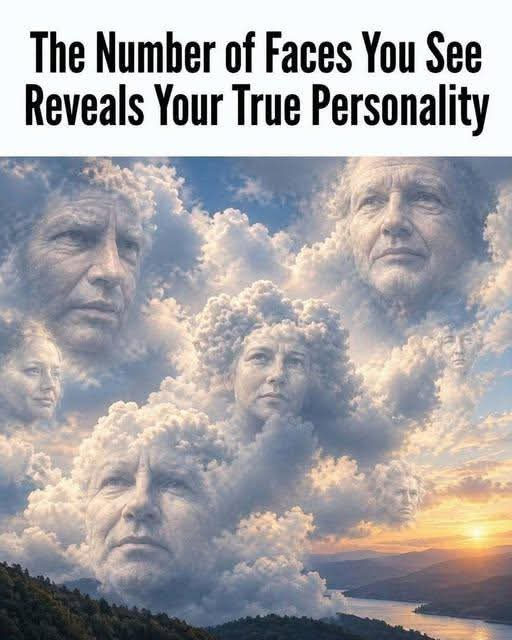
The Number of Faces You See in the Clouds Reveals Your Personality: What Does Your Answer Say About You?
Have you ever looked up at the sky and noticed a face hidden among the clouds? Perhaps you’ve spotted an old man’s face, a smiling woman, or several mysterious faces appearing to emerge from the clouds. Once you notice one, you may suddenly begin seeing others everywhere!
This fascinating optical illusion invites you to look closely at a beautiful sky filled with human faces. Some faces are large and easy to recognize, while others are smaller and hidden among the clouds. Depending on where you look, you might discover just a few faces—or many more than you expected.
But here’s the interesting question: Does the number of faces you see reveal something about your personality?
Although this popular visual challenge is often presented as a personality test, it can also be an entertaining way to explore how differently people observe the world. Let’s take a closer look at the illusion, what your answer might suggest for fun, and why two people can look at the same picture and see completely different things.
How Many Faces Can You Find in the Clouds?
Before reading the interpretations below, take a moment to study the picture.
Look at the entire image rather than focusing only on the largest faces. Pay attention to the clouds around the edges, the spaces between the larger faces, and the smaller shapes near the horizon.
You might notice that some faces appear immediately, while others become visible only after you spend more time looking.
Your challenge is simple: Count how many faces you can identify without guessing.
There is no need to rush. Look carefully and remember your final number.
Once you’ve finished counting, read the following playful interpretations to see which one resonates with you.
Remember: These descriptions are for entertainment and self-reflection, not scientifically validated personality assessments.
If You See 1–3 Faces: The Focused Observer
If you notice only a few faces, you might be someone who prefers to concentrate on the most obvious details before exploring the bigger picture.
You may appreciate clarity, simplicity, and straightforward solutions. Rather than searching for hidden meanings in everything around you, you might prefer to focus on what feels most relevant at the moment.
What this might say about you
You may enjoy:
- Focusing on one task at a time.
- Looking for practical solutions to everyday problems.
- Keeping things simple rather than overcomplicating them.
- Taking your time before making important decisions.
You might also be someone who values meaningful conversations and genuine relationships over having a large social circle.
Of course, seeing fewer faces doesn’t necessarily mean you’re less imaginative or observant. You may simply have focused on the largest and clearest shapes first.
A question to consider: Do you prefer concentrating deeply on a few important things rather than spreading your attention across many different details?
If You See 4–6 Faces: The Thoughtful Observer
If you discover between four and six faces, you may enjoy examining things from different angles.
You might notice details that other people overlook, especially when something catches your curiosity. Instead of accepting the first impression, you may take a little extra time to explore what else is there.
What this might say about you
You might identify with these qualities:
- Curiosity about the world around you.
- An interest in understanding different perspectives.
- A willingness to reconsider your first impressions.
- Enjoyment of puzzles, visual challenges, and creative activities.
Perhaps you are the person who notices a small detail in a photograph that everyone else missed.
You might also enjoy conversations that allow you to explore ideas rather than simply exchange information.
Seeing several faces, however, doesn’t prove that you have these personality traits. It may simply mean that you noticed more of the image’s visual details.
A question to consider: When something catches your attention, do you naturally want to investigate it further?
If You See 7–9 Faces: The Detail Explorer
Did you find seven, eight, or nine faces?
You may have spent more time scanning the picture, looking for smaller faces hidden among the clouds.
For this playful interpretation, imagine that you are someone who enjoys exploring possibilities and discovering details that aren’t immediately obvious.
What this might say about you
You might enjoy:
- Solving riddles and visual puzzles.
- Exploring new hobbies or learning unfamiliar skills.
- Looking for patterns and connections.
- Considering several possible explanations before settling on one.
You may also enjoy creative activities that encourage you to imagine different possibilities.
When faced with a problem, perhaps your first instinct is to ask, “What else could be going on here?”
That habit can be useful when solving complex problems, although sometimes the simplest explanation is the correct one.
A question to consider: Do you enjoy challenges that require patience, imagination, and a closer look?
If You See 10 or More Faces: The Imaginative Explorer
If you found ten or more faces, you may have searched every corner of the picture for additional shapes.
For this entertaining interpretation, let’s imagine that you enjoy looking beyond the obvious and finding unexpected possibilities in familiar things.
You might be the type of person who sees a rabbit in the clouds, a face in the bark of a tree, or a familiar shape in an ordinary object.
What this might say about you
You may relate to qualities such as:
- Enjoying creative thinking and imaginative activities.
- Being curious about unusual patterns.
- Finding pleasure in discovering new details.
- Approaching familiar things from a fresh perspective.
You might also enjoy activities such as photography, drawing, storytelling, crafting, or exploring nature.
However, identifying many faces doesn’t automatically mean you are more creative than someone who sees only a few. The image itself contains many overlapping shapes, and people differ in how they interpret them.
A question to consider: Do you often find yourself noticing shapes, patterns, or possibilities that other people don’t immediately see?
Why Do We See Faces in Clouds?
There is a fascinating scientific explanation for why faces seem to appear in clouds, trees, rocks, and even ordinary household objects.
This phenomenon is known as pareidolia.
Pareidolia occurs when our brains recognize familiar patterns in ambiguous visual information. A random collection of shapes may resemble a face, even when no actual face is present.
Human faces are especially meaningful to us. We spend much of our lives recognizing people, interpreting facial expressions, and noticing where others are looking.
As a result, our visual system is particularly responsive to arrangements that resemble eyes, a nose, and a mouth.
When you look at the clouds in this picture, your brain may interpret certain combinations of light and shadow as faces.
Another person might look at exactly the same clouds and notice different faces—or fail to recognize some of the ones you see.
Neither person is necessarily more intelligent, observant, or imaginative.
Their attention, expectations, and interpretation of the shapes may simply differ.
Does the Number of Faces Really Reveal Your Personality?
TO CONTINUE READING THE ARTICLE PLEASE SEE PAGE 2
