Moldy Food: Which Foods Can You Safely Eat and Which Should You Throw Away?
Have you ever opened your refrigerator, noticed a tiny patch of mold on your favorite food, and wondered whether you really need to throw the whole thing away?
Perhaps you’ve found a little green spot on a slice of bread, a fuzzy patch on a strawberry, or a small area of mold on a block of cheese.
It’s tempting to think that removing the visible mold is enough. After all, why waste perfectly good food because of one tiny spot?
But here’s something important: not all foods react to mold in the same way. Some foods may be safely salvaged by cutting away a generous portion around the affected area, while others should be discarded entirely.
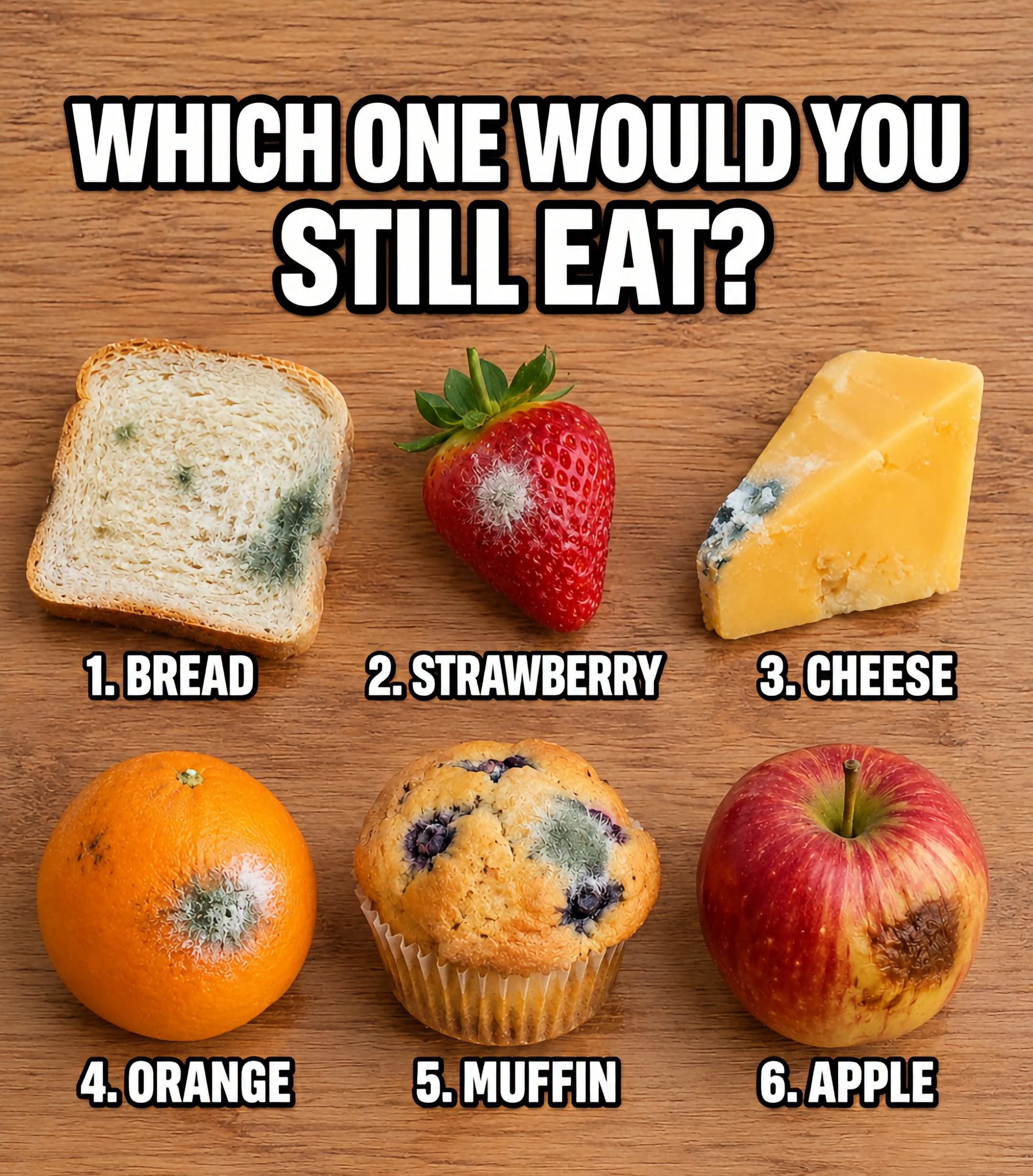
The image highlights six familiar foods: bread, strawberries, cheese, oranges, muffins, and apples. Let’s look at each one and understand what food-safety recommendations actually say.
1. Bread – Throw the Whole Slice Away 🍞
Verdict: DISCARD.
Bread is one of the foods you should never try to save by simply cutting away the visible mold.
Because bread is soft and porous, mold can spread through its interior using microscopic structures that aren’t visible to the naked eye.
Even if you see only one small green or white spot, other parts may already be contaminated.
What to do: If you discover mold on bread, discard the affected slice. If mold appears in a loaf, the safest recommendation is to discard the entire loaf. UC Agriculture and Natural Resources
2. Strawberries – Don’t Just Remove the Bad Spot 🍓
Verdict: DISCARD.
Strawberries contain a lot of moisture, making them particularly vulnerable to mold growth.
When one strawberry develops fuzzy mold, simply cutting away the affected section isn’t considered safe.
Mold can spread beneath the surface, even when the rest of the fruit looks perfectly normal.
What to do: Throw away moldy strawberries. Inspect the surrounding berries and discard any that have become moldy or contaminated. Keep the remaining sound berries clean and refrigerated. extension.uconn.edu
3. Hard Cheese – Sometimes You Can Save It! 🧀
Verdict: CAN BE SALVAGED, WITH PRECAUTIONS.
Here’s where things get interesting!
Hard cheeses, such as cheddar and Parmesan, are denser and have less moisture than soft cheeses. This makes it more difficult for mold to penetrate deeply.
If a block of hard cheese develops a small patch of unexpected mold, you may be able to save the remaining portion.
How to do it safely:
- Use a clean knife.
- Cut at least 1 inch (2.5 cm) around and below the moldy area.
- Avoid touching the mold with your knife.
- Discard the contaminated section.
- Wrap the remaining cheese in fresh packaging and refrigerate it.
Important: This recommendation applies to intact blocks of hard cheese, not shredded, sliced, crumbled, or soft cheese. Those should be discarded if unexpected mold appears. Mayo Clinic
4. Orange – Throw It Away 🍊
Verdict: DISCARD.
Oranges have a protective peel, but once mold develops on the fruit, you shouldn’t assume the inside is safe.
Citrus fruits contain moisture, and mold can spread beyond the visible area.
If you notice fuzzy growth on an orange, particularly around damaged or softened skin, the safest choice is to discard the entire fruit.
Don’t simply peel away the moldy section and eat the rest.
5. Muffin – Don’t Try to Save It 🧁
Verdict: DISCARD.
Muffins may look firm on the outside, but their interiors are soft and porous.
Mold can spread through the baked product beyond the visible patch.
Removing the fuzzy section doesn’t guarantee that the rest is safe.
What to do: Discard the entire moldy muffin. Don’t try to toast it, microwave it, or bake it again to make it safe. UC Agriculture and Natural Resources
6. Apple – It Depends on the Condition 🍎
Verdict: SOMETIMES SALVAGEABLE.
Apples are firmer and denser than strawberries, making them a different case.
Food-safety guidance allows small moldy spots on firm fruits to be removed if the surrounding fruit remains sound.
If an otherwise firm apple has a small isolated moldy area:
- Wash your hands.
- Use a clean knife.
- Cut away at least 1 inch (2.5 cm) around and below the affected area.
- Keep the knife away from the mold itself.
- Discard the removed portion.
However, if the apple is extensively moldy, soft, rotten, or damaged, discard the whole fruit. extension.uconn.edu
Why Is Mold on Food a Concern?
Mold is a type of fungus that grows in different environments, including on food.
Some molds are harmless in specific food-production processes, while others can cause allergic reactions or produce substances called mycotoxins.
Mycotoxins are potentially harmful compounds produced by certain molds.
The biggest problem is that the fuzzy part you see isn’t necessarily the entire mold colony. Microscopic structures can spread underneath the surface, especially in soft and moist foods.
That’s why removing the visible patch isn’t always enough. Cleveland Clinic
7 Simple Ways to Prevent Mold on Food
A few everyday habits can help reduce food waste and keep your kitchen safer.
1. Store bread properly.
Keep bread in a clean, dry bread box or suitable sealed packaging. Freeze bread you won’t use before it spoils.
2. Refrigerate fresh strawberries.
Keep berries refrigerated and remove damaged fruit before it affects others.
3. Store cheese correctly.
Keep cheese refrigerated and wrapped appropriately to reduce unwanted moisture and contamination.
4. Inspect fruit regularly.
Check apples, oranges, berries, and other produce before storing them.
5. Keep your refrigerator clean.
Clean spills promptly and check shelves for spoiled food.
6. Avoid unnecessary moisture.
Excess moisture encourages mold growth, so dry produce when appropriate before storing it.
7. Don’t ignore suspicious food.
If you aren’t sure whether something is safe, throwing it away is the safer choice.
What If You Accidentally Eat Moldy Food?
Don’t panic immediately. Accidentally eating a small amount of moldy food doesn’t necessarily mean you’ll become sick.
However, some people may experience nausea, vomiting, diarrhea, abdominal discomfort, or allergic reactions.
People with weakened immune systems, serious allergies, and other health vulnerabilities should be particularly cautious.
If you develop concerning symptoms after eating moldy food, seek medical advice. Cleveland Clinic
The Final Verdict: Which Foods Can You Save?
| Food | What should you do? |
|---|---|
| 1. Bread | ❌ Discard |
| 2. Strawberry | ❌ Discard |
| 3. Hard cheese | ✅ Cut away at least 1 inch around and below mold |
| 4. Orange | ❌ Discard |
| 5. Muffin | ❌ Discard |
| 6. Apple | ⚠️ May be salvaged if firm and only slightly affected |
These recommendations concern unexpected mold, not foods intentionally made with edible molds, such as certain blue cheeses.
Final Thoughts
Nobody likes throwing away food, especially when groceries are expensive and every ingredient matters.
But saving a few dollars isn’t worth risking your health.
Understanding which foods can be safely trimmed and which must be discarded can help you make smarter decisions in the kitchen, reduce unnecessary waste, and protect your family.
Now it’s your turn!
Be honest: Which of these foods have you previously tried to save by cutting off the moldy part?
Have you ever eaten moldy bread after removing the green spots?
Share your experiences in the comments. You might help someone avoid a common food-safety mistake!
