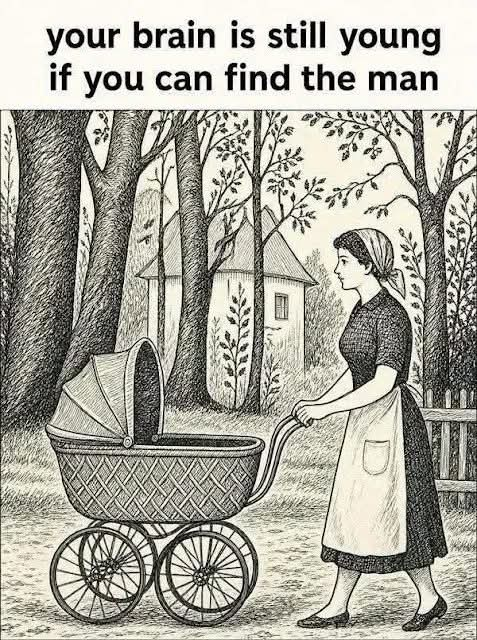
At first glance, this peaceful park illustration looks like a beautiful vintage scene. A mother is pushing her baby in a stroller beneath leafy trees, enjoying what appears to be a quiet afternoon outdoors. Everything seems perfectly ordinary. But look a little closer, because something unusual is hiding in the background: a man’s face cleverly disguised among the trees and shadows!
It’s the kind of picture that makes you stop scrolling and take a second look. You might notice the mother, the stroller, the trees, and the winding park scenery right away. But the hidden face? That can be surprisingly difficult to spot!
This vintage-style optical illusion is a fun little test of observation. It challenges your eyes to look beyond the obvious shapes and notice how ordinary details can come together to create something completely unexpected.
Take a good look before reading any further. The hidden man may be closer than you think!
The challenge sounds simple: find the man’s face concealed somewhere in the illustration.
But don’t be fooled by how easy it sounds.
Your eyes are naturally drawn to the main subject of a picture. In this case, that’s the mother pushing her baby in the stroller. The trees, branches, and shadows create the peaceful setting, so your brain may automatically treat them as background details.
That’s exactly what makes this illusion tricky.
The hidden face is designed to blend into the surrounding scenery. Instead of appearing as a separate person standing in the park, its features are incorporated into the shapes and patterns of the illustration.
You may need to stop looking at the picture as a normal park scene and start looking at the overall arrangement of shapes.
Sometimes the secret isn’t in one particular leaf or branch. It’s in how several details work together.And once your eyes recognize the face, you may find it difficult to look at the illustration the same way again!
There’s a reason hidden-object pictures can be so frustrating.
When you first see an illustration, your brain quickly identifies the main subject and organizes the rest of the image around it. This process helps you understand a scene without examining every tiny detail.
In this picture, your attention is likely to settle on the mother and her baby. The park setting feels familiar, so your brain doesn’t immediately question the trees and shadows.
The hidden man’s face takes advantage of that tendency.
Your Brain Looks for Familiar Shapes
Human faces are especially recognizable, but they can be harder to identify when their features are incomplete or mixed into another object.
A collection of branches might simply look like branches at first. Once you recognize a face-like arrangement, however, those
same shapes can suddenly appear to form facial features.
The Background Competes for Your Attention
The illustration contains several visual elements:
The mother and stroller
The baby
The trees and foliage
The park surroundings
The shadows and overlapping shapes
With so much to look at, it’s easy to overlook a detail that isn’t part of the main action.
Expectations Can Fool Your Eyes
You expect a park illustration to show people, trees, and outdoor scenery. You don’t necessarily expect a hidden face.
That expectation can make you overlook unusual patterns hiding in plain sight.
Hints to Help You Find the Hidden Man
Still searching? Don’t worry! These illusions are meant to make you look twice.
Try working through these hints one at a time rather than immediately giving up.
Hint 1: Look Beyond the Main Characters
The mother and stroller are meant to attract your attention, but they aren’t the
only important parts of the illustration.
Shift your focus toward the background.
Hint 2: Study the Trees and Shadows
Look closely at the shapes formed by the branches, leaves, and darker areas.
Instead of asking what each object represents, ask whether the overall shapes could form something else.
Hint 3: Look for the Outline of a Face
Think about the basic features of a human face:
A forehead
Two eyes
A nose
A mouth
A chin
The hidden man may not have clearly drawn features. You may need to recognize the overall facial arrangement.
Don’t rush. Sometimes taking a short break and looking again helps more than staring at the same spot.
What Makes Hidden-Face Optical Illusions So Fascinating?
Hidden-face illustrations are a type of visual puzzle that plays with the way we recognize patterns.
They often combine two different images into one. At first, you see an ordinary scene.
Then, after noticing the hidden subject, you begin to see a second image within the first.
This effect is closely related to pareidolia, the tendency to recognize familiar patterns—especially faces—in ambiguous shapes.
It’s why people sometimes see faces in clouds, wood grain, building fronts, or the patterns on everyday objects.
In a vintage park illustration, branches and shadows can create just the right combination of shapes to suggest a human face.
The artist’s clever arrangement encourages you to switch between two ways of seeing the same picture.
And that’s what makes these puzzles so entertaining!
The Hidden Man Revealed
<text color=”secondary”>Spoiler alert: If you’re still searching, pause here and take one more look before reading on.</text>
The hidden man is incorporated into the park scenery rather than shown as an ordinary person standing beside the mother and stroller.
Look for the facial outline formed by the background shapes, particularly the arrangement of the trees and shadows. The key is to stop viewing those details as separate pieces of foliage and recognize how they can combine into a face.
Because the exact placement can be difficult to describe without marking the original illustration, use the picture itself as your guide rather than relying on a specific branch or leaf as a landmark.
Once you spot the face, the illusion becomes much easier to understand!
What This Optical Illusion Says About Your Observation Skills
Finding the hidden man can be a fun way to challenge your attention, but remember that an optical illusion is not a scientific personality test.
Spotting the face quickly doesn’t prove that you’re more intelligent, more observant, or better at solving problems than someone who takes longer.
People approach visual puzzles differently. Some immediately notice large patterns, while others focus on
TO CONTINUE READING THE ARTICLE PLEASE SEE PAGE 2
