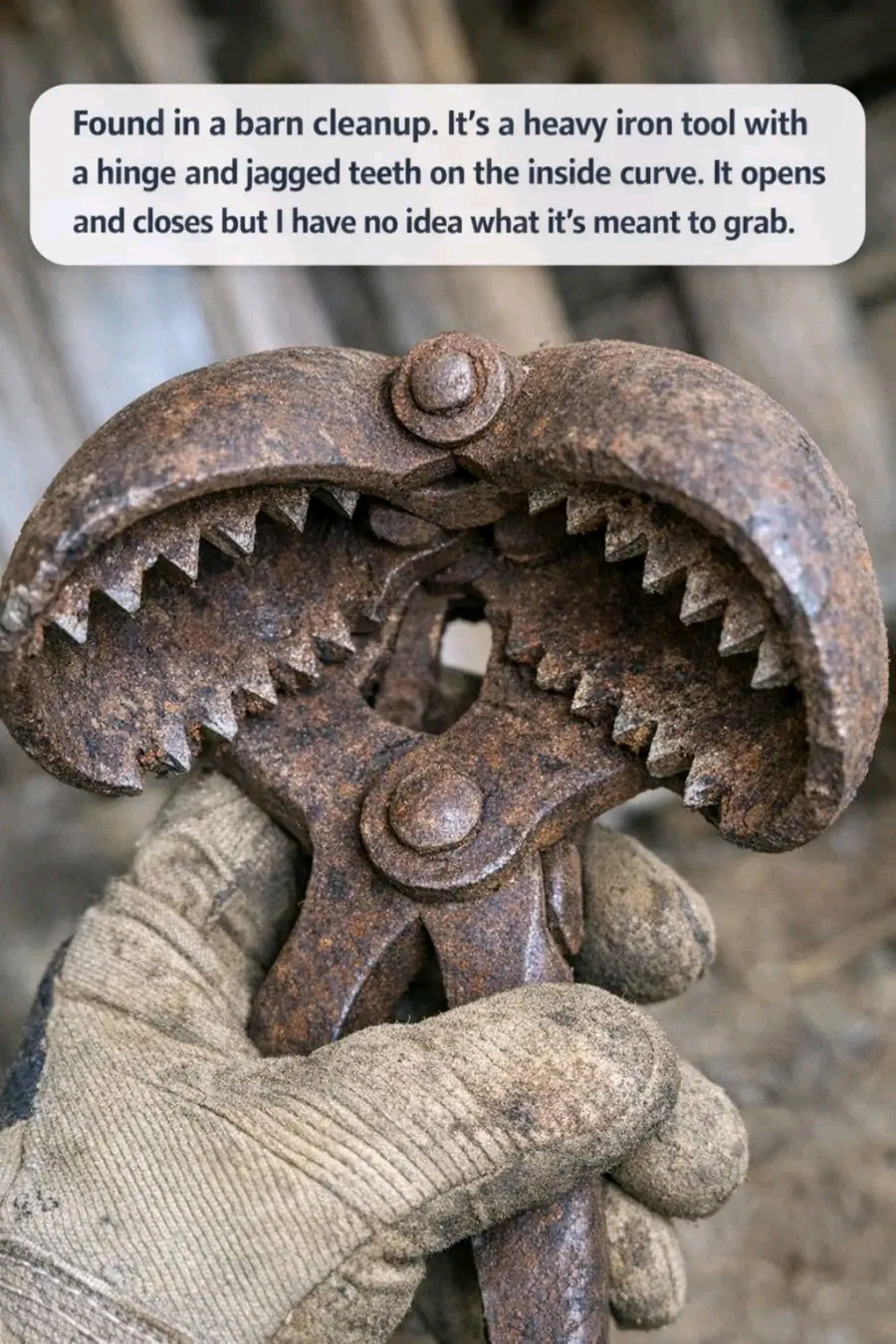
In the quiet corners of old barns, treasures often lie hidden, waiting to be rediscovered. These relics of the past, while often covered in dust and rust, hold stories of the bygone days when they were essential tools for daily life. One such find, discovered during a routine barn cleanup, presents itself as a perplexing piece of history: a heavy iron tool with a hinge and jagged teeth along its inner curve.At first glance, the tool is a mystery. Its solid construction and articulate design suggest a specific purpose, yet to the untrained eye, it remains an enigma. This article seeks to unravel the secret of this intriguing implement, exploring its origins, functionality, and the role it played in agricultural history.
1. The Mystery Tool: Heavy Iron, Hinged, And ToothyThe tool in question is substantial, made entirely of iron, which suggests it was built to withstand significant use. It measures approximately 12 inches in length with a hinge at its midpoint, allowing it to open and close like a pair of pliers. The inner curve of each arm is lined with jagged teeth, each about a quarter of an inch long, designed to grip or shred something with precision.Its weight, around 3 pounds, indicates it was intended for handheld operation but required a certain amount of manual strength. The hinge is robust, suggesting it needed to endure repetitive motion without failing. This combination of features points towards a tool designed for a very specific task, likely related to agriculture given the barn setting.
2. Clues In The Design: Why Those Jagged Inner Teeth MatterThe presence of jagged teeth on the inner curve of the tool’s arms is a crucial detail in understanding its intended use. These teeth are not merely decorative; they are functional, designed to grasp, shred, or strip something from a base material. The even spacing and uniform size of the teeth suggest a repetitive action, likely involving stripping or shelling.Such a design would be ineffective for cutting but ideal for gripping a cylindrical object and removing its outer layer. This leads us to consider its use in processing natural materials, possibly crops, where the goal is to separate a usable part from a husk or shell.
3. How Antique Handheld Corn Shellers Actually WorkAntique handheld corn shellers were ingenious solutions to the labor-intensive task of removing kernels from corn cobs. These tools utilized a simple yet effective mechanism: the cob was placed between the hinged arms, and as the tool closed, the jagged teeth would strip the kernels away from the cob.The process was straightforward. By holding the cob firmly in one hand and applying pressure with the tool in the other, the user could efficiently separate the kernels without damaging them. This method was not only faster than hand-picking but also less wasteful, ensuring that nearly all kernels were collected for use.
