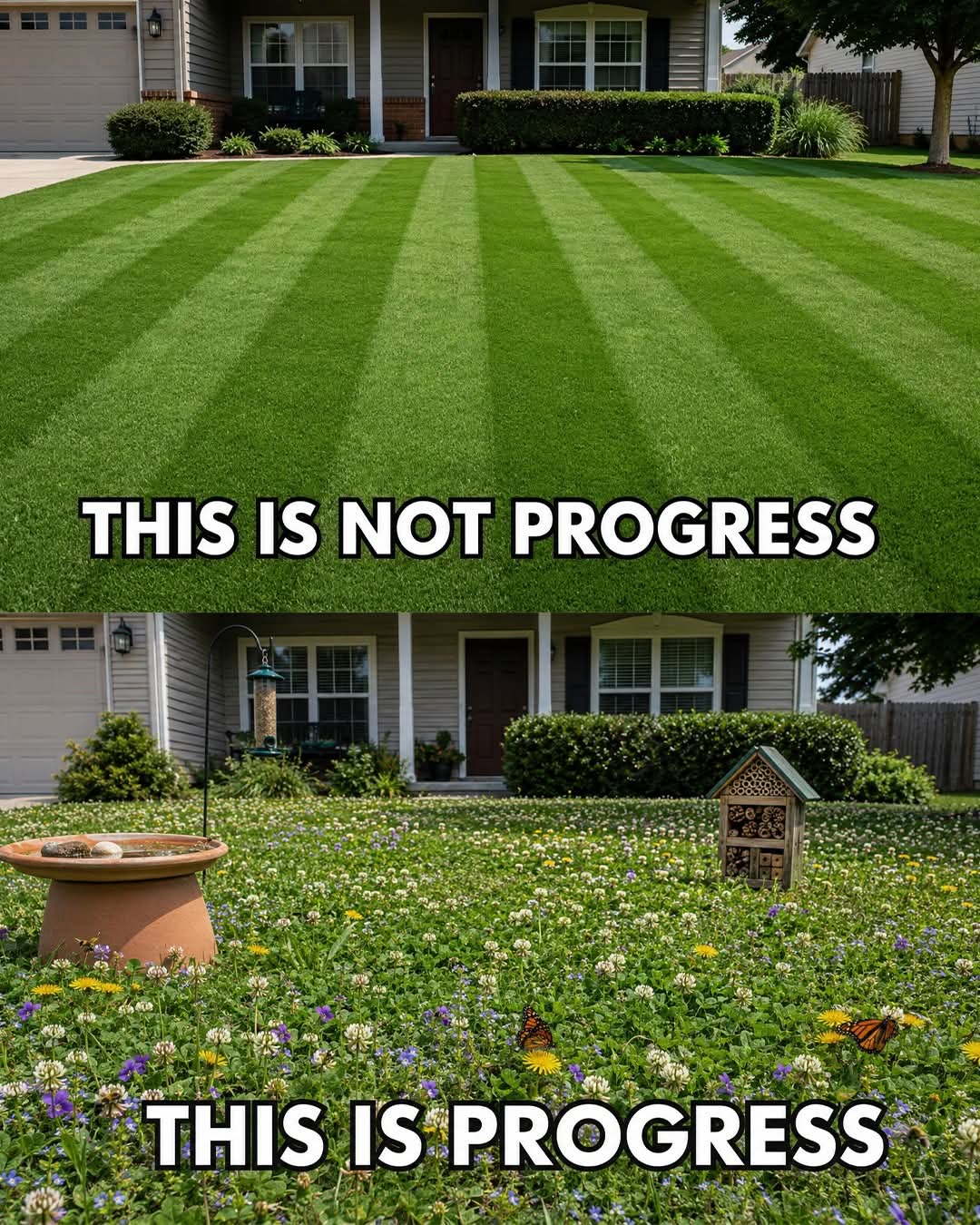
🌱 A perfect lawn doesn’t have to be a lifeless lawn.
🐝 You can still keep your yard clean, neat, and arranged while helping pollinators survive. Set your mower to the highest cutting height, around 4 inches, and mow less often so small flowers like clover, dandelions, wild violets, plantain, and other low-growing plants can bloom.
🦋 These tiny flowers are not “just weeds.” For bees, butterflies, and other pollinators, they are food. And without pollinators, many plants, flowers, fruits, and vegetables struggle to grow.
✂️ Keep the edges trimmed, mow clean paths if needed, and let the little flowers stay where they can.
🌼 This is real progress: a yard that looks good, stays managed, and still helps life continue.
🌱 A Perfect Lawn Doesn’t Have to Be a Lifeless Lawn
For decades, the ideal lawn was often portrayed as a flawless carpet of green—perfectly trimmed, free of flowers, and completely uniform from edge to edge.
But times are changing.
More homeowners are discovering that a beautiful yard and a pollinator-friendly yard do not have to be opposites. In fact, some of the healthiest and most vibrant landscapes are those that make room for both people and wildlife.
A lawn can still look neat, organized, and well-maintained while providing valuable food and habitat for bees, butterflies, and other important pollinators.
🐝 Why Pollinators Matter
Pollinators play a crucial role in our ecosystems.
Bees, butterflies, moths, beetles, and other pollinating insects help plants reproduce by moving pollen from one flower to another.
This process supports:
🌸 Wildflowers
🍓 Fruits
🥒 Vegetables
🌳 Trees
🌱 Countless plant species
Without pollinators, many plants would struggle to produce seeds, fruits, and future generations.
In other words, healthy pollinator populations help support the natural systems that many forms of life depend upon.
🌼 The Problem with Perfect Lawns
Traditional lawns often provide very little food for pollinators.
When every flowering plant is removed and grass is cut extremely short, bees and butterflies may have few places to find nectar and pollen.
A lawn can appear lush and green while offering almost no resources for local wildlife.
That’s why many gardeners are beginning to rethink what a “perfect” lawn actually means.
✂️ Raise the Mower Deck
One of the simplest changes homeowners can make is adjusting mowing height.
Many experts recommend mowing higher rather than lower.
Setting your mower to approximately 4 inches (10 cm) can offer several benefits:
✅ Encourages deeper grass roots
✅ Helps retain soil moisture
✅ Reduces heat stress
✅ Allows low-growing flowers to bloom
✅ Creates a healthier lawn overall
Longer grass can often tolerate drought and summer heat better than closely cropped turf.
🌸 Let the Tiny Flowers Bloom
When mowing less frequently and at a higher setting, small flowering plants often appear naturally.
Common examples include:
🌼 Dandelions
🍀 Clover
💜 Wild violets
🌿 Plantain
🌸 Self-heal
These plants are frequently labeled as weeds, but many provide valuable nectar and pollen for pollinators.
To a bee searching for food, a clover flower can be every bit as important as a carefully planted garden bloom.
🦋 Supporting Butterflies and Bees
A pollinator-friendly lawn creates opportunities for insects to feed throughout the growing season.
Benefits may include:
🐝 More visiting bees
🦋 Increased butterfly activity
🌸 Greater plant diversity
🌱 Healthier local ecosystems
Even small changes can make a difference when multiplied across neighborhoods and communities.
🏡 Keeping It Neat and Attractive
Some people worry that supporting pollinators means allowing a yard to become overgrown.
Fortunately, that’s not necessary.
A lawn can remain tidy while still providing ecological benefits.
Consider:
✂️ Keeping borders trimmed
🚶 Mowing clear walking paths
🌿 Defining garden edges
🌼 Allowing flowering patches in selected areas
🏡 Maintaining a purposeful appearance
These simple techniques help create a landscape that looks intentional and well cared for.
🌎 Small Actions Add Up
One yard may seem insignificant, but collective efforts can have a meaningful impact.
When thousands of homeowners allow a few extra flowers to bloom, the result can be a network of feeding areas that supports pollinators across entire communities.
Every flower matters.
Every nectar source helps.
Every pollinator-friendly choice contributes to a healthier environment.
🌱 A New Definition of a Beautiful Lawn
The idea of lawn perfection is evolving.
Today, many people see beauty not only in uniform grass but also in a landscape filled with life.
A yard buzzing with bees, visited by butterflies, and dotted with small flowers can be just as attractive—if not more so—than a lawn stripped of all diversity.
It’s a balance between appearance and purpose.
Between order and nature.
Between beauty and biodiversity.
The Bottom Line
A perfect lawn doesn’t have to be a lifeless lawn.
By mowing a little higher, mowing a little less often, and allowing small flowers to bloom, homeowners can create landscapes that remain neat and attractive while helping pollinators thrive.
The tiny blossoms many people overlook provide essential food for bees and butterflies that support entire ecosystems.
Sometimes the most beautiful yard isn’t the one with the fewest flowers—it’s the one that makes room for life.
🐝🌼 Would you be willing to leave a few clover and wildflower blooms in your lawn if it meant helping pollinators in your community?
