🥛 Which Glass Actually Has the Most Water? The Viral Puzzle That Tricks Almost Everyone
At first glance, the challenge seems incredibly simple.
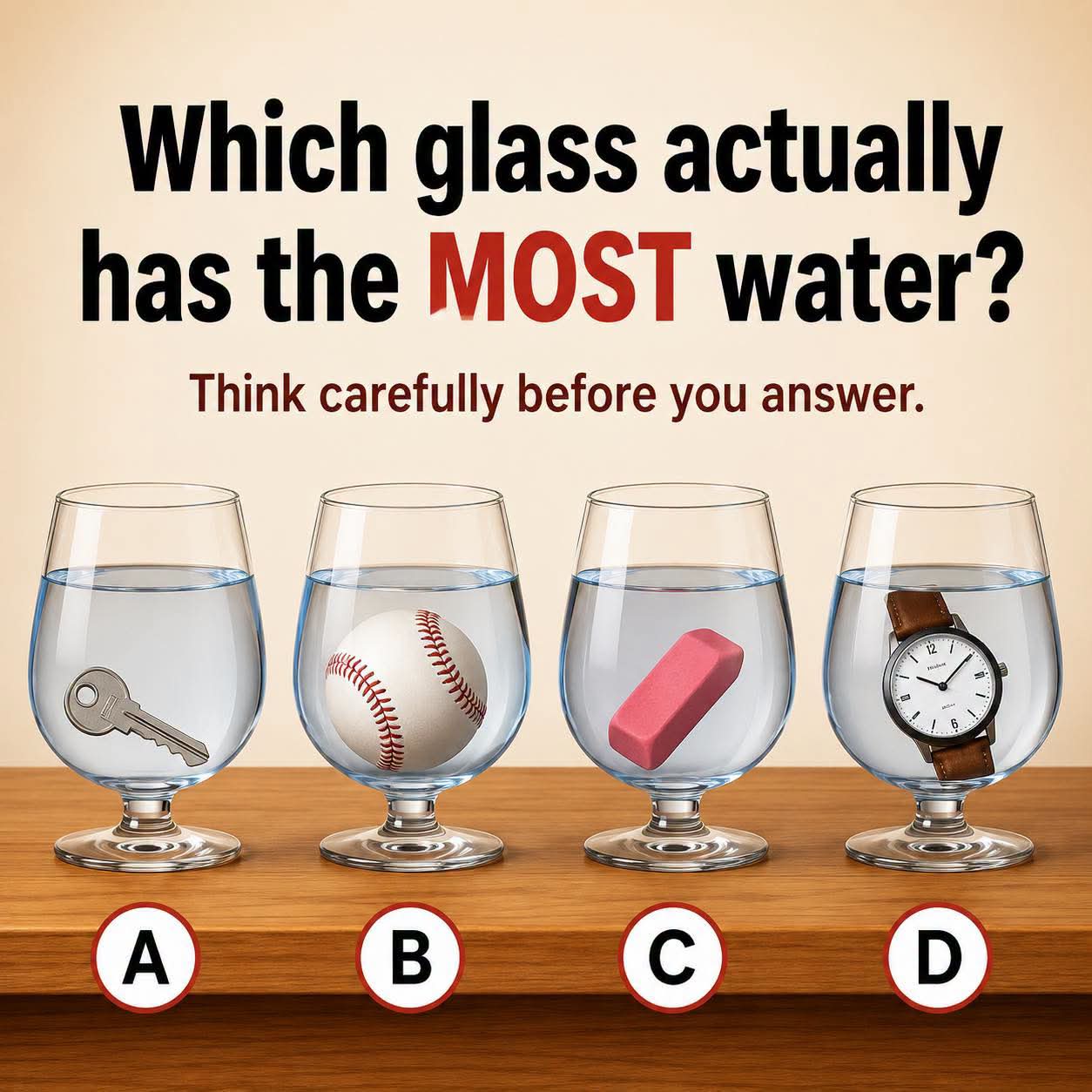
Four glasses sit on a table, each filled to roughly the same level. Inside each glass is a different object:
🔑 Glass A contains a key
⚾ Glass B contains a baseball
🩹 Glass C contains an eraser
⌚ Glass D contains a watch
The question is:
Which glass actually contains the most water?
Most people immediately start guessing based on appearances. But this puzzle isn’t really about water—it’s about observation and understanding how volume works.
🤔 Why This Puzzle Is So Tricky
When an object is placed into water, it takes up space.
That space pushes water aside, causing the water level to rise.
This principle is known as displacement.
The larger the object, the more space it occupies inside the glass.
And the more space it occupies, the less actual water can fit inside.
💧 The Secret to Solving It
Many people focus on the height of the water.
But the real question isn’t:
“Which glass has the highest water level?”
The real question is:
“Which glass contains the most water?”
To answer correctly, you must consider how much space each object occupies.
🔑 Glass A: The Key
A key is relatively small.
Although it displaces some water, it occupies very little volume compared to the other objects.
That means this glass can hold a larger amount of water.
⚾ Glass B: The Baseball
A baseball takes up a significant amount of space.
Even though the water level may appear similar to the others, much of the glass’s interior volume is occupied by the ball.
As a result, there is less actual water present.
🩹 Glass C: The Eraser
An eraser is larger than a key but generally much smaller than a baseball.
It displaces a moderate amount of water.
⌚ Glass D: The Watch
A watch may appear compact, but depending on its size and shape, it can occupy more space than a simple key.
Still, it usually displaces less water than a baseball.
🧠 The Most Common Answer
In most versions of this puzzle, the correct answer is:
🔑 Glass A (the key).
Why?
Because the key occupies the least amount of volume inside the glass.
Less displacement means more room for water.
If all the glasses are filled to the same visible level, the glass containing the smallest object will generally contain the greatest amount of water.
🚀 What This Puzzle Teaches
This challenge is a great reminder that first impressions can be misleading.
Many people assume the answer must involve the largest object or the highest water line.
Instead, the solution depends on understanding the space taken up by each item.
It’s a simple demonstration of:
✅ Observation
✅ Critical thinking
✅ Volume and displacement
✅ Looking beyond appearances
Why People Love These Puzzles
Visual brain teasers are popular because they seem easy at first.
Then they reveal a hidden twist.
They challenge us to slow down, think carefully, and question our assumptions.
That’s why they spread so quickly across social media.
Everyone wants to see if they can spot the trick.
The Bottom Line
If all four glasses are filled to the same visible level, the glass containing the smallest object usually contains the most water because less space is occupied inside the glass.
In this puzzle, that means the key often wins.
Sometimes the smartest answer isn’t about what you see first—it’s about what you don’t immediately notice.
🥛👇 So, before reading the explanation, which glass did you choose: A, B, C, or D?
