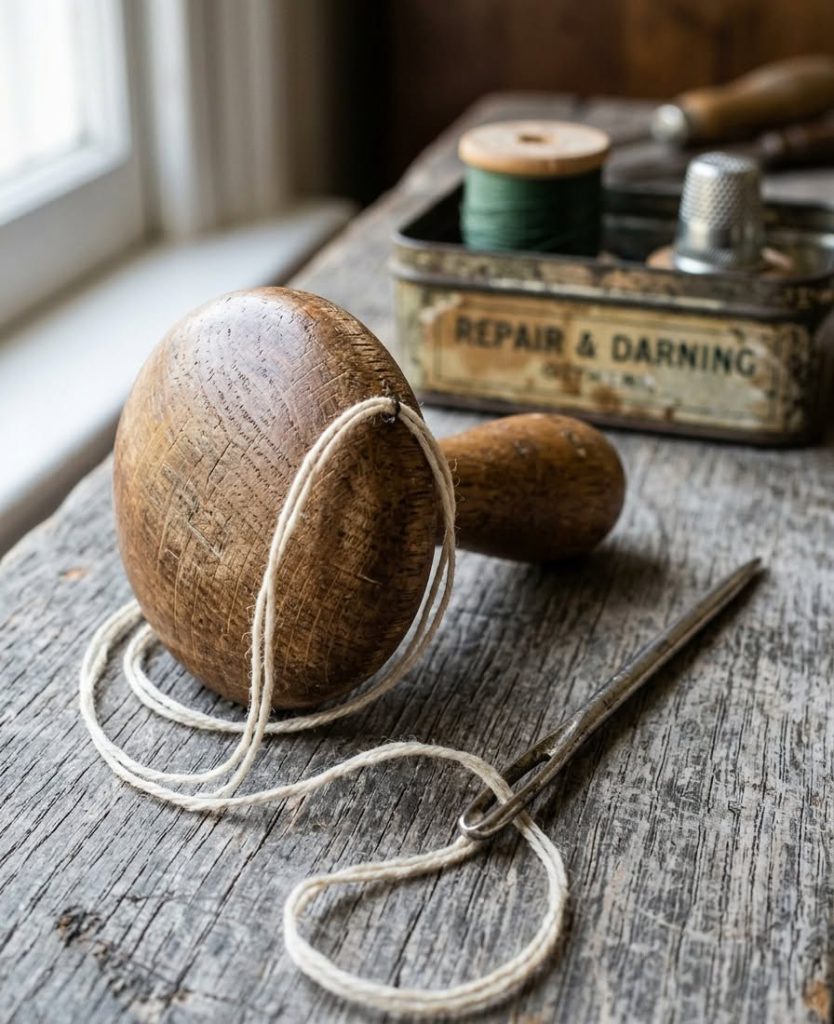
I love finding old sewing tins. Not the perfectly curated antique-shop ones either—the real ones. The slightly rusty cookie tins stuffed with tangled thread, loose buttons, bent safety pins, and those mystery objects nobody in the family can identify anymore.
And every now and then, tucked between the needles and faded measuring tape, there’s this odd little wooden thing.
Smooth. Rounded. Kind of mushroom-shaped.
At first glance, it looks like it should belong in a kitchen drawer, not a sewing kit. Some people guess it’s a tiny pestle. Others think it’s decorative. My uncle once thought it was for cracking walnuts, which… honestly made me laugh harder than it should have.
But it turns out this little object had a very practical job. A job most people under 40 have probably never even seen done in real life.
It’s called a darning mushroom.
And once you know what it is, you start seeing an entire lost world behind it.
The Shape Is Weird Until You Realize What It Was Made For
The first clue is the size.
A real pestle would usually have a longer handle and a heavier feel to it. This thing doesn’t. The handle is short, almost stubby, and the rounded top is unusually smooth—like it was meant to protect fabric rather than crush anything.
That smoothness matters.
You can tell it was handled constantly over the years too. Old wooden tools develop this soft shine that only comes from decades of human hands touching them. It’s hard to fake. Kind of comforting, actually.
And once you notice it came from a sewing tin, the mystery starts to unravel pretty quickly.
Before Cheap Socks, People Repaired Things
That’s the part modern life erased a little.
Today, if a sock gets a hole in it, most people toss it. Maybe not immediately—we all have that “around the house” sock phase—but eventually it’s gone.
A hundred years ago? Different story.
Clothing cost more relative to income, and people simply didn’t waste fabric if it could still be saved. So instead of throwing socks away, they repaired them. Over and over sometimes.
That’s where the darning mushroom came in.
You’d stretch the damaged sock over the rounded wooden cap so the fabric stayed firm and stable while you stitched the hole closed. The mushroom basically acted like a tiny stand-in for a foot.
Simple idea. Brilliant design.
Honestly, It’s Kind of Ingenious
The rounded top wasn’t just for appearance.
It let the fabric stretch naturally without pulling too tight. That made weaving new thread into the damaged area much easier. If the surface had rough edges, it would snag delicate fibers, especially on thinner stockings.
And the handle? Just enough grip to hold steady while sewing.
That’s it. No moving parts. No gimmicks. Just a really well-thought-out little tool.
A lot of them were made from hardwoods like maple or beech because they could withstand years—sometimes generations—of use without cracking.
Some were plain. Others had painted tops or carved details. You occasionally find really charming ones with floral patterns or chipped red paint still hanging on after decades.
Those are my favorite, honestly. They feel lived in.
There Were “Darning Eggs” Too, Which Sounds Slightly Ridiculous
Not every darning tool looked like a mushroom.
Some looked exactly like wooden eggs. Same idea, slightly different shape. People often used the terms interchangeably depending on where they grew up.
And if you spend enough time looking through antique sewing collections, you’ll notice people got surprisingly creative with them.
Tiny decorative handles. Turned wood patterns. Painted finishes.
It’s funny—people used to add beauty to ordinary household objects in a way we don’t do much anymore. Even practical tools had personality.
Now everything comes in matte gray plastic and sadness.
The Actual Repair Process Took Patience
And skill, honestly.
To darn a sock properly, you’d place the hole over the mushroom, pull the fabric snug, then start weaving thread across the gap in one direction.
After that, you’d weave back across the opposite way—over, under, over, under—almost like building tiny fabric from scratch.
Not glamorous work.
But it kept clothes wearable, especially during hard times. During wars, depressions, rationing periods… people repaired everything they possibly could.
See Continuation On Next Page 👇
