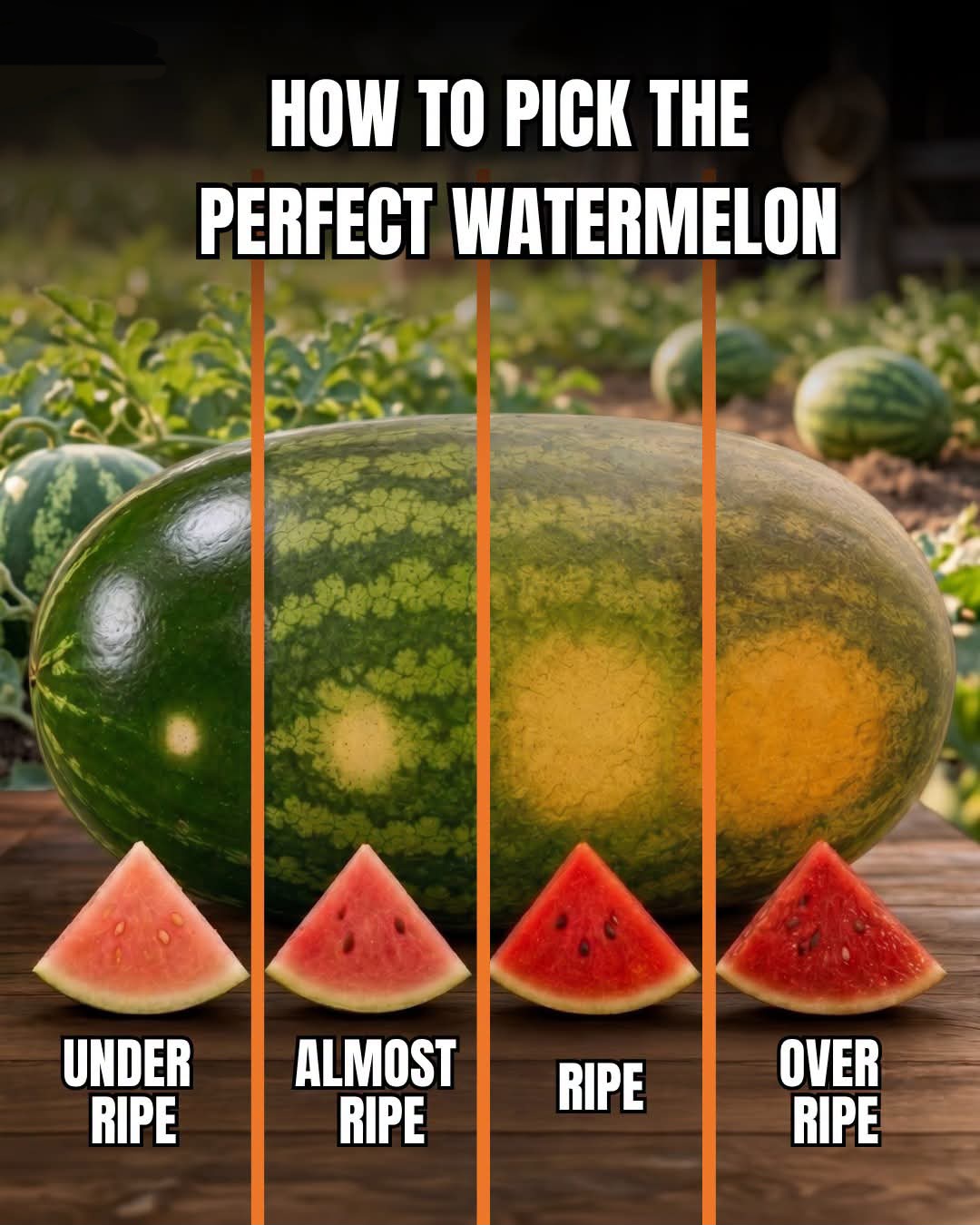
🍉 How to Pick the Perfect Watermelon Every Time
Few things are more disappointing than bringing home a watermelon that looks amazing on the outside only to discover it’s bland, dry, or underripe on the inside.
The good news is that you don’t need luck to choose a great watermelon. By paying attention to a few simple signs, you can dramatically increase your chances of bringing home a sweet, juicy, and flavorful fruit.
Here’s how to pick the perfect watermelon like a pro.
🍉 Look for the Field Spot
One of the most important clues is the “field spot.”
This is the area where the watermelon rested on the ground while growing.
A ripe watermelon should have a creamy yellow or golden field spot.
What the Color Means
✅ Deep yellow or creamy gold = Usually ripe
⚠️ Pale yellow = May be less ripe
❌ White or nearly white = Often picked too early
The darker and creamier the field spot, the longer the melon likely spent ripening on the vine.
✋ Pick It Up
A good watermelon should feel heavy for its size.
Why?
Because watermelons are mostly water, and a heavier melon typically contains more juice.
When comparing two similar-sized watermelons:
🍉 Choose the heavier one.
A heavy watermelon is often sweeter and juicier than a lighter one.
👀 Check the Shape
Look for a watermelon that is symmetrical.
Whether it’s round or oval doesn’t matter as much as consistency.
Avoid melons with:
❌ Odd lumps
❌ Uneven bulges
❌ Irregular shapes
A uniform shape usually indicates steady growth and even ripening.
👂 Give It a Tap
Many people swear by the “thump test.”
Gently tap the watermelon with your knuckles.
What You’re Listening For
✅ Deep, hollow sound = Usually ripe
⚠️ Dull sound = May be overripe
❌ Sharp or metallic sound = May be underripe
While this method takes practice, it can provide another useful clue.
🌿 Examine the Stem
If the stem is still attached, take a look at it.
A dried, brown stem often indicates that the melon ripened naturally on the vine.
A green stem may suggest it was harvested too early.
✨ Look for a Dull Surface
Many people assume shiny fruit is best.
With watermelons, the opposite is often true.
A ripe watermelon typically has:
✅ A slightly dull appearance
❌ An overly shiny surface
The dull finish can be a sign that the fruit has reached maturity.
🕸️ Don’t Fear Webbing
Some watermelons have rough brown web-like marks on the skin.
These are sometimes called “sugar spots” or “webbing.”
Many growers believe these marks indicate pollination activity and can be associated with sweeter fruit.
While not a guarantee, they are often considered a positive sign.
🍉 Round vs. Oval Watermelons
You’ll often hear claims that:
🍉 Round watermelons are sweeter
🍉 Oval watermelons are juicier
In reality, sweetness depends more on ripeness and growing conditions than shape.
Both can be delicious when properly ripened.
🚫 Common Mistakes
Avoid choosing a watermelon based solely on:
❌ Color of the stripes
❌ Perfect appearance
❌ Largest size
❌ Shiny skin
Instead, use several indicators together for the best results.
Why No Method Is Perfect
Nature doesn’t always follow rules.
Even experienced farmers occasionally find a watermelon that surprises them.
The goal is simply to improve your odds by looking for multiple signs of ripeness.
The Bottom Line
The best watermelon is usually:
🍉 Heavy for its size
🍉 Symmetrical in shape
🍉 Dull rather than shiny
🍉 Equipped with a creamy yellow field spot
🍉 Producing a deep, hollow sound when tapped
Use these clues together, and you’ll have a much better chance of bringing home a sweet, juicy watermelon that tastes like summer in every bite.
🍉👇 What’s your favorite watermelon-picking trick?
