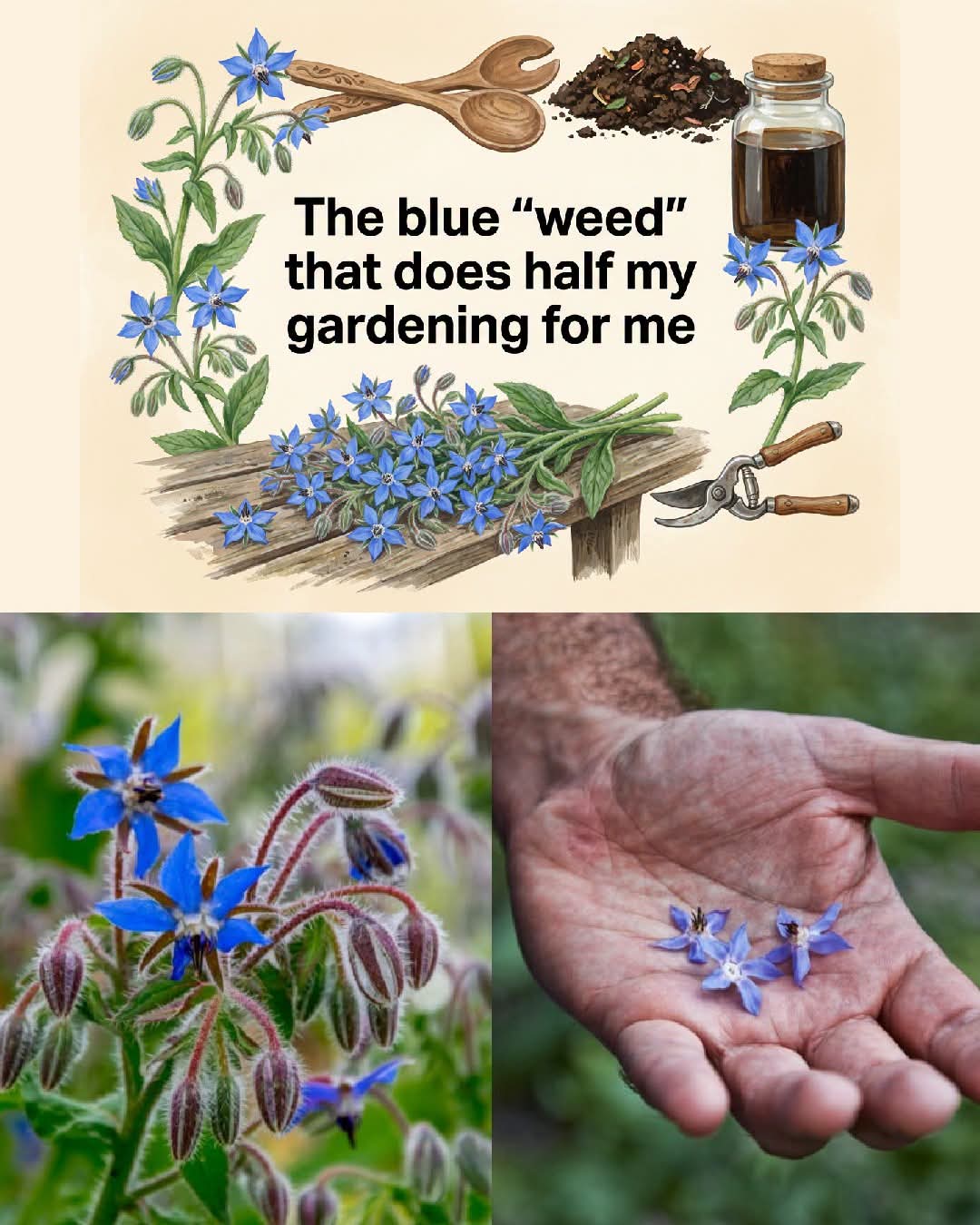
🌿 The Blue-Flowered “Weed” I Let Grow in My Vegetable Garden
Every spring, gardeners spend money on liquid fertilizers, pest-control products, soil amendments, and other products designed to make the garden easier to manage.
But sometimes, one of the most useful plants in the garden is the one nobody planted.
For me, that plant is borage.
With its fuzzy leaves, hairy stems, and beautiful star-shaped blue flowers, borage can look like an ordinary weed when it suddenly appears among the vegetables. Many gardeners pull it out immediately.
I don’t.
I let it grow.
Once you understand what this tough little plant can bring to a garden, you may start looking at those volunteer borage seedlings very differently.
🌱 Meet Borage
Borage (Borago officinalis) is an annual herb known for its rough, fuzzy foliage and bright blue, star-shaped flowers.
It grows quickly and can become surprisingly large, especially when it has plenty of sunshine and reasonable soil moisture.
Its flowers are one of its biggest attractions.
Bees absolutely love them, and borage can become a busy little pollinator station when it’s in bloom.


And once you let a few plants flower and set seed, you may find that borage begins appearing on its own in future seasons.
That’s one of the reasons I think of it as a garden helper rather than a weed.
🐝 1. It Brings Pollinators Into the Garden
One of the best reasons to keep borage is its flowers.
The blue flowers produce nectar that attracts bees and other pollinating insects. When borage is flowering near your vegetables and fruiting plants, you’re creating another food source for pollinators.
That’s especially useful in a productive garden where you want plenty of insect activity around crops that depend on pollination.
Rather than spending money trying to attract pollinators, you can simply allow some flowering plants to share the garden with your vegetables.
🌸 And It Keeps Flowering
Borage can have a long flowering period under favorable conditions.
As individual flowers fade, new ones can continue appearing, giving pollinators a reliable source of nectar.
If you grow it, try not to remove every flower the moment it appears.
Those flowers are doing useful work.
🐛 2. It Can Help Create a More Diverse Garden
Borage is often recommended as a companion plant because it attracts pollinating insects and other beneficial garden visitors.
It’s also frequently described by gardeners as a trap or decoy plant for certain pests.
That doesn’t mean borage magically prevents insects from reaching your vegetables. Garden pests vary by location, weather, crop, and season.
But adding plants with different characteristics to your garden can make the space more biologically diverse.
And sometimes, letting a few non-crop plants exist alongside your vegetables is preferable to trying to maintain a perfectly sterile garden.
🌿 3. Its Deep Root System Can Access Lower Soil Layers
Borage develops a substantial root system, including a taproot that can reach deeper than many shallow-rooted vegetables.
That’s useful because plants with deeper roots can access water and nutrients from soil layers that aren’t being used as heavily by shallow-rooted crops.
Borage is sometimes called a dynamic accumulator, although claims about exactly how much nutrient it brings up—and how much becomes available to neighboring plants—are often exaggerated.
The practical benefit is simpler:
When the plant grows vigorously, all that plant material eventually becomes organic matter.
And that’s where the real garden value begins.
✂️ 4. Chop It Down and Turn It Into Mulch
This may be my favorite trick.
When borage becomes too large, you don’t necessarily need to pull it out and throw it away.
Simply cut it back.
The leaves and stems can be used as green mulch around appropriate garden areas.
Place chopped material around established plants, keeping it away from direct contact with delicate stems.
As the plant material breaks down, it contributes organic matter to the soil.
You’re essentially taking something that grew for free and returning it to the garden.
No bagging.
No hauling.
No wasted plant material.
🌱 5. You Can Let It Reseed Itself
Borage is especially appealing to gardeners who like a slightly more natural approach because it can readily reseed.
Once flowers mature and produce seeds, new plants may appear in subsequent seasons.
That’s convenient—but it also means you should decide where you actually want it growing.
I don’t recommend letting it take over every square inch of the vegetable patch.
Instead, allow a few plants to remain in useful locations and remove the extras.
That gives you the benefits without turning the garden into a borage jungle.
💙 6. It Adds Beauty to a Vegetable Garden
A vegetable garden doesn’t have to look like rows of vegetables and bare soil.
Borage adds height, texture, and color.
Its blue flowers can be especially striking against green vegetables.
And because the plant looks somewhat wild and informal, it fits beautifully into cottage gardens, pollinator gardens, herb gardens, and more natural-looking vegetable patches.
Sometimes the plants that weren’t part of the original garden plan end up making it look better.
🥗 7. Yes, the Flowers Can Be Eaten
Borage flowers are edible and have traditionally been used as a decorative garnish.
The beautiful blue flowers can be added to salads, desserts, drinks, or other dishes where you want a little color.
They have a mild flavor and make a particularly pretty finishing touch.
Important: Only eat flowers that you have positively identified as borage and that have been grown without pesticides or other chemicals not intended for edible crops.
Also, borage leaves contain naturally occurring pyrrolizidine alkaloids, so borage shouldn’t be treated as an everyday leafy vegetable or consumed in large quantities. The flowers are best thought of as an occasional garnish rather than a major food source.
🌿 8. It’s Surprisingly Tough
Borage isn’t one of those delicate plants that needs constant attention.
Once established, it can grow vigorously with relatively little fuss.
That’s exactly the kind of plant I want around a vegetable garden.
Instead of constantly asking:
“How do I make this plant grow?”
you’re often asking:
“How much do I need to cut this back?”
That’s a much easier gardening problem to have.
✂️ How I Use Borage in My Garden
Here’s my simple routine:
Step 1: Let a few plants grow
When borage appears, I don’t automatically pull it out.
I look at where it is growing.
If it’s in a useful location, I leave it alone.
Step 2: Let it flower
I allow the flowers to develop so pollinators can use them.
Step 3: Keep an eye on its size
Borage can become quite large.
If it’s beginning to shade smaller vegetables or crowd a pathway, it’s time for a haircut.
Step 4: Cut it back
Use clean garden shears or pruners to cut the plant down.
Step 5: Use the healthy cuttings
Chop the stems and leaves into smaller pieces and use them as green mulch around established plants.
Avoid putting diseased plant material into the garden.
Step 6: Leave a few plants to reseed
If you want borage to return naturally, allow a few plants to complete their flowering and seed production.
Then thin out the volunteers next season.
⚠️ Don’t Let “Let It Grow” Become “Let It Take Over”
There’s an important distinction here.
I love useful volunteer plants, but no plant should be allowed to completely overwhelm a vegetable garden.
Borage can become large and may self-seed generously.
Keep plants away from narrow paths, small seedlings, and crops that need plenty of sunlight.
If it appears somewhere inconvenient, pull it or cut it down.
The goal isn’t to create a garden where everything grows everywhere.
The goal is to stop treating every volunteer plant as an enemy.
🌻 A Better Way to Think About Garden “Weeds”
This is the bigger lesson.
Not every plant that appears without permission is automatically a problem.
Some volunteer plants provide nectar.
Some provide habitat.
Some protect the soil.
Some can be eaten.
Some contribute organic matter.
And some simply make the garden more interesting.
Of course, genuinely invasive or harmful weeds should still be controlled. But before pulling an unfamiliar plant, it can be worth asking:
What is this plant actually doing here?
You might discover that the “weed” you’ve been removing is doing more for your garden than the expensive product sitting on the garden shelf.
🌿 The Little Blue Flower I Don’t Mind Seeing
Borage isn’t a miracle fertilizer.
It isn’t a guaranteed pest-control solution.
And it shouldn’t replace good soil management, crop rotation, watering, or sensible pest monitoring.
But it can be an incredibly useful supporting plant.
It feeds pollinators, provides plenty of biomass, has an impressive root system, can be used as green mulch, may reseed itself, and produces beautiful edible flowers.
And perhaps the biggest benefit is the philosophy behind it.
Not every corner of a garden needs to be controlled.
Sometimes you can let a plant grow, watch what happens, and make use of it when it gets too big.
The garden doesn’t always need more products.
Sometimes it just needs a little more room to do what gardens naturally do.
💙 So the next time you see a fuzzy green plant covered in little blue flowers…
Don’t pull it immediately.
Take a closer look.
You may have just found one of the hardest-working “weeds” in your vegetable garden. 🌿🐝💙
