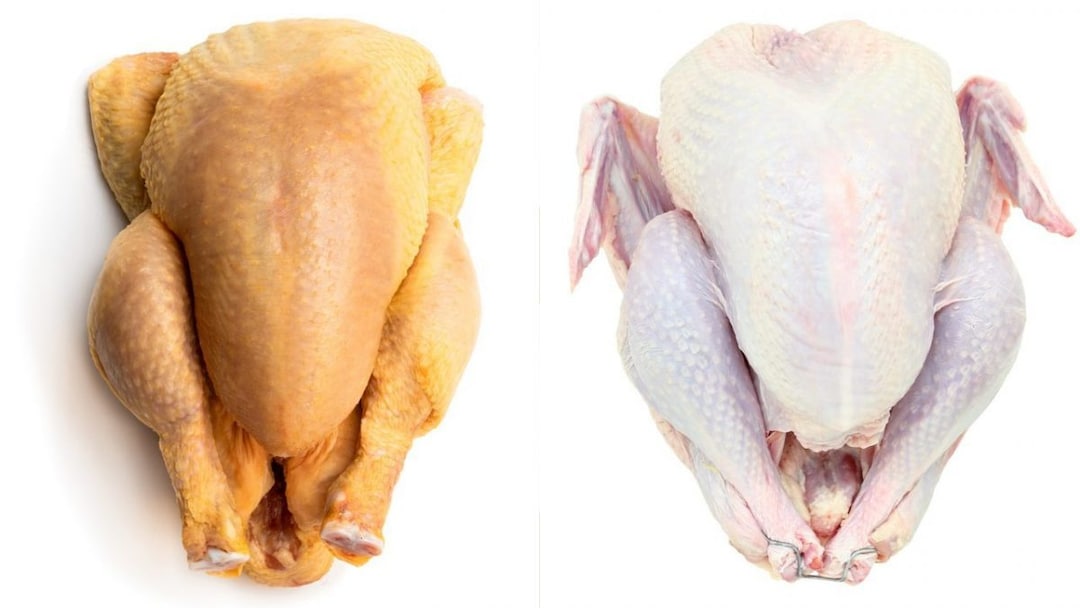
All the Differences Between White Chicken and Yellow Chicken 🍗
Have you ever stood at the grocery store and noticed that some chicken has pale white skin while other chicken has a noticeably yellow or golden color?
At first glance, yellow chicken can look completely different from the white chicken most of us are used to buying.
But what actually causes the difference?
Does yellow chicken taste better? Is it healthier? Is it a different breed? And does the color tell you anything about how the chicken was raised?
The answer is a little more complicated than simply saying “white chicken” or “yellow chicken.”
🐔 What Is White Chicken?
When people talk about white chicken, they’re usually referring to chicken with relatively pale skin and fat.
The skin can range from creamy white to pale yellow depending on the bird, its diet, breed, age, and processing.
The meat itself is generally the familiar pale pink color associated with raw chicken.
White or pale-skinned chicken is extremely common in supermarkets, especially in commercial poultry production.
🐔 What Is Yellow Chicken?
Yellow chicken generally has more noticeably yellow skin and/or yellow-colored fat.
This doesn’t automatically mean that it is a different species or that it has been given a special treatment.
In many cases, the yellow color is related to pigments called carotenoids.
Carotenoids occur naturally in many plants and can be present in poultry feed.
Some breeds of chickens also naturally have more yellow skin than others.
So when you see a yellow-skinned chicken, the color can reflect a combination of genetics, diet, and production practices.
🌽 Diet Can Affect Chicken Color
One of the biggest reasons chicken skin and fat can become yellow is the bird’s diet.
Certain plant-based ingredients contain pigments that can accumulate in the bird’s skin and fat.
Corn, for example, contains carotenoid pigments.
Depending on the chicken’s genetics and diet, these pigments can contribute to a more golden appearance.
That means two chickens raised under otherwise similar conditions can potentially look different because of their genetics and what they ate.
🧬 Breed Matters Too
Diet isn’t the only factor.
Genetics can play an important role in skin color.
Some chicken breeds naturally have yellow skin, while others have white or pale skin.
This means that the color of the chicken isn’t necessarily a reliable way to determine whether it was raised on a farm, whether it was free-range, or whether it was raised organically.
A yellow-skinned chicken isn’t automatically a “better” chicken, and a white-skinned chicken isn’t automatically lower quality.
🍗 Does Yellow Chicken Taste Different?
This is one of the most common questions.
Some people believe yellow chicken has a richer or more flavorful taste.
But skin color alone doesn’t determine flavor.
Taste and texture can be influenced by many factors, including:
- Breed
- Age of the bird
- Diet
- Exercise and activity
- How the chicken was raised
- Processing
- Freshness
- Cooking method
A yellow-skinned chicken may taste different from another chicken because of differences in breed, diet, age, or production system—but you can’t assume that the yellow color itself creates the flavor.
🧈 What About the Yellow Fat?
If you’ve ever cut into a chicken and noticed that the fat is distinctly yellow, you may have wondered whether something was wrong.
Not necessarily.
Yellowish poultry fat can occur naturally.
Dietary pigments can contribute to the color, and some chickens naturally deposit more pigment in their fat.
As long as the chicken has been properly handled and stored, yellow fat by itself isn’t a sign that the chicken has spoiled.
Food safety should instead be judged by proper storage, handling, expiration/use-by information where applicable, and cooking practices.
🥩 Is Yellow Chicken Healthier?
Not necessarily.
The color of the skin or fat isn’t enough to tell you whether one chicken is healthier than another.
Nutritional differences can depend on the particular cut, the amount of skin and fat, the bird’s diet, and how it was raised and processed.
For example, removing the skin changes the amount of fat you consume regardless of whether the chicken had white or yellow skin.
So if you’re choosing chicken based on nutrition, look beyond the color.
🌿 Does Yellow Chicken Mean It’s Organic?
No.
Yellow chicken isn’t automatically organic.
Likewise, white chicken isn’t automatically conventionally raised.
Organic certification is based on specific production standards, not simply the color of the chicken’s skin.
The same goes for labels such as free-range or pasture-raised. You shouldn’t use skin color alone to determine how a chicken was raised.
🐔 Does Yellow Chicken Mean It’s Free-Range?
Again, not necessarily.
A chicken can have yellow skin because of genetics or diet without being raised outdoors.
Likewise, a chicken raised under a particular production system may not have noticeably yellow skin.
If you want to know how a chicken was raised, check the actual packaging and the relevant labeling rather than relying on color.
🍳 Does Yellow Chicken Cook Differently?
Generally, you can cook yellow-skinned and white-skinned chicken using the same basic cooking methods.
You can:
- Roast it
- Bake it
- Grill it
- Fry it
- Air-fry it
- Braise it
- Simmer it
- Add it to soups and stews
The cooking time depends much more on the size and cut of the chicken than on whether the skin is yellow or white.
Regardless of skin color, poultry should be cooked to a safe internal temperature of 165°F (74°C), measured with a food thermometer.
👀 Why Does Store-Bought Chicken Sometimes Look So Different?
There are many reasons.
Two packages of chicken can look noticeably different because of:
Breed:
Different genetics can influence skin pigmentation.
Diet:
Pigments from feed can affect the color of skin and fat.
Age:
Older birds can have different fat and skin characteristics than younger birds.
Processing:
Scalding and other processing methods can affect the appearance of poultry skin.
Storage:
The way chicken is packaged and stored can also influence its appearance.
So judging chicken quality by color alone isn’t a good strategy.
🧂 What About Corn-Fed Chicken?
Because corn contains carotenoids, people sometimes associate yellow chicken with corn-fed birds.
There can be some truth to the connection between diet and pigmentation, but yellow chicken does not prove that the bird was fed corn.
Other dietary ingredients and genetics can contribute to skin color as well.
In other words:
Yellow chicken ≠ automatically corn-fed chicken.
💰 Is Yellow Chicken More Expensive?
It can be, but there’s no universal rule.
Price depends on factors such as:
- Breed
- Brand
- Farming system
- Certification
- Region
- Processing
- Cut of meat
- Supply and demand
If you see yellow chicken selling for more than white chicken, don’t assume the color itself is responsible for the price.
Look at the product’s labeling to find out what you’re actually paying for.
🌎 Why Is Yellow Chicken More Common in Some Places?
Chicken appearance can vary considerably between countries and regions.
Different breeds, traditional farming practices, consumer preferences, and feed systems can all influence what shoppers see at the market.
In some places, yellow-skinned chicken is particularly valued and may be associated with traditional breeds or specific culinary traditions.
In other markets, pale-skinned commercial chicken is much more common.
Neither color automatically tells the whole story.
🧐 Which One Should You Buy?
The answer really depends on what matters to you.
If you’re choosing chicken for a recipe, color usually shouldn’t be the deciding factor.
Instead, consider:
- Freshness
- Proper refrigeration
- Packaging condition
- The cut you need
- Price
- Farming claims you care about
- Certification and labeling
- How you plan to cook it
And, of course, choose chicken from a reliable source and handle it safely at home.
🍗 White vs. Yellow Chicken: Quick Comparison
| Feature | White/Pale Chicken | Yellow Chicken |
|---|---|---|
| Skin color | White, cream, or pale | Yellow to golden |
| Main influences | Breed, diet, processing | Breed, diet, pigments |
| Automatically healthier? | No | No |
| Automatically tastier? | No | No |
| Automatically organic? | No | No |
| Automatically free-range? | No | No |
| Can be roasted? | Yes | Yes |
| Can be fried? | Yes | Yes |
| Safe cooking temperature | 165°F / 74°C | 165°F / 74°C |
🐔 The Biggest Myth to Remember
Perhaps the most important thing to remember is this:
Color alone doesn’t tell you the quality of the chicken.
Yellow skin doesn’t automatically mean the chicken is healthier, tastier, more natural, organic, free-range, or better raised.
And white skin doesn’t automatically mean the opposite.
The color is simply one visible characteristic of the bird.
🍽️ So, Which Chicken Would You Choose?
Next time you’re shopping and see two chickens sitting side by side—one pale and one beautifully golden—take a closer look.
Instead of immediately thinking:
“The yellow one must be better!”
or
“The white one must be fresher!”
remember that chicken color can be influenced by genetics, diet, and other factors.
The real story is usually found on the label, not in the color.
👀 Now We’re Curious…
Which one do you usually buy?
🍗 WHITE CHICKEN
💛 YELLOW CHICKEN
🤷 I’VE NEVER NOTICED A DIFFERENCE!
And if you’ve cooked both, which one do you think tastes better? 👨🍳🍗
