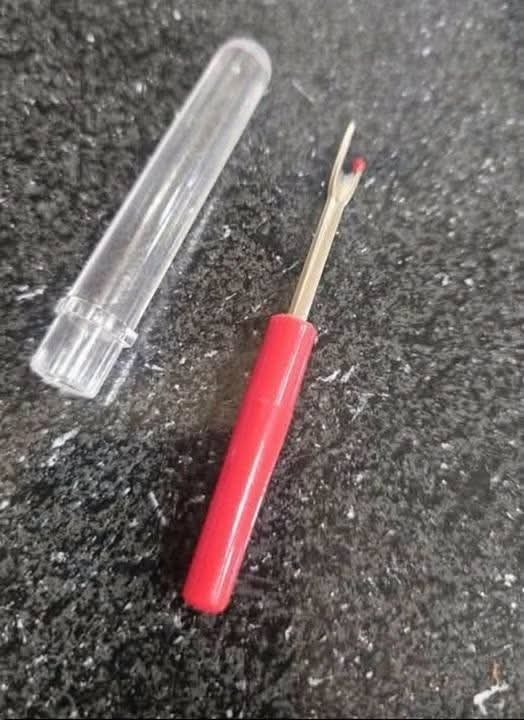
Does Anyone Born in the 21st Century Know What This Is? 🧵🪡
Does anyone born in the 21st century know what this little tool is? 👀
If you recognize it immediately, you probably grew up around someone who sewed, mended clothes, embroidered, quilted, or kept a little sewing kit tucked away in a drawer.
It’s a needle threader—one of those tiny household tools that looks almost too simple to be useful, but can save you from an incredible amount of frustration.
And for anyone who has ever tried to push a piece of thread through the tiny eye of a needle, you already know exactly why it exists!
🪡 So, What Is a Needle Threader?
A traditional needle threader is a small tool with a very thin wire loop attached to a handle.
The wire is designed to pass through the eye of a sewing needle.
Once the wire is through, you put your thread through the loop and pull the wire back out.
The thread comes along with it.
That’s the whole trick.
It sounds incredibly simple—and it is—but it’s surprisingly effective. (Wikipédia)
The tool in the picture has a red handle and a clear protective cover. The cover helps protect the delicate wire when the threader isn’t being used.
👵 Why Did People Keep These in Sewing Kits?
Before modern conveniences made many household tasks easier, sewing was an ordinary part of everyday life.
People repaired socks, shirts, buttons, hems, curtains, children’s clothes, and other household textiles rather than automatically replacing them.
A sewing kit might contain:
- Needles
- Thread
- Buttons
- Small scissors
- Pins
- A thimble
- Measuring tape
- Safety pins
- And, of course, a needle threader
For someone who sewed regularly, a needle threader could be one of the most useful little tools in the box.
🧵 How Does It Work?
The traditional method is wonderfully simple.
Step 1: Put the Wire Through the Needle
Hold the needle in one hand and the threader in the other.
Push the thin wire loop through the eye of the needle.
The wire is flexible enough to pass through the tiny opening. (iFixit)
Step 2: Put the Thread Through the Loop
Once the wire is through the needle, pass your sewing thread through the larger loop.
You don’t have to struggle to aim the thread directly through the tiny needle eye anymore.
The loop temporarily makes the target much larger.
Step 3: Pull the Threader Back
Gently pull the wire loop back through the eye of the needle.
The thread comes with it.
And just like that…
Your needle is threaded! 🪡
The University of Florida’s sewing guidance describes the same basic technique: push the metal loop through the needle eye, put the thread through the loop, and pull the threader back through. (Ask IFAS – Powered by EDIS)
👀 Why Is It So Useful?
Threading a needle can be surprisingly difficult.
The eye of a needle can be tiny, while thread can fray at the end and become difficult to control.
Poor lighting can make the job even harder.
That’s why a needle threader can be especially useful for:
- Fine sewing needles
- Embroidery
- Quilting
- Mending clothes
- Hand sewing
- Fine thread
- Anyone who struggles to see a tiny needle eye
It’s a tiny tool designed to solve one very specific problem.
And it does that problem extremely well.
🕰️ This Tool Is Older Than You Might Think
Needle threaders aren’t a recent invention.
The exact origins are uncertain, but surviving evidence places needle-threading devices in Europe as far back as the 18th and early 19th centuries. (trc-leiden.nl)
The familiar wire-loop style became particularly recognizable in the 19th century.
The Science Museum Group, for example, has a needle threader in its collection that was made in London in 1855. (Science Museum Group Collection)
So when someone sees one of these little gadgets and says, “That’s an old-fashioned thing,” they’re absolutely right—but it’s also a clever invention that has been around for a very long time.
👑 The Famous Victorian Needle Threader
Some antique needle threaders are particularly recognizable because their handles were decorated with a woman’s profile.
This style became associated with Victorian-era needlework tools.
The handle could be made from thin metal, while the delicate wire loop did the actual threading. (ehow.com)
Today, needle threaders come in many different designs, including plastic-handled versions like the one shown in the picture.
🧵 Why Does the Little Wire Break So Easily?
If you’ve ever used one, you may remember this problem:
The wire is incredibly delicate.
That’s because it has to be thin enough to pass through the eye of a needle.
If you bend it sharply, pull too hard, or use it with an unsuitable needle, the wire can become bent or break.
That’s why the little plastic or metal cover is useful—it helps protect the wire when the tool is sitting in your sewing box.
And if your old needle threader still works after years in a drawer…
You have a survivor. 😂
🧺 A Tiny Tool That Says a Lot About the Past
There’s something fascinating about objects like this.
A needle threader isn’t expensive or complicated. It doesn’t have electronics, batteries, or a screen.
It’s simply a small piece of wire and a handle.
Yet it represents a time when mending was a normal household skill.
A loose button wasn’t necessarily a reason to throw out a shirt.
A small tear could be repaired.
A hem could be fixed.
A favorite piece of clothing could be given another few years of life.
And someone with a small sewing kit could handle many of those jobs at home.
👀 Do Younger People Still Know What It Is?
Absolutely—but probably fewer people encounter one in everyday life than previous generations did.
Sewing is still very much alive, of course. Quilters, tailors, crafters, embroiderers, costume makers, and countless hobbyists still use needle threaders.
But if you grew up in a home where nobody sewed, you could easily reach adulthood without ever seeing one.
That’s what makes old household-object photos so fun.
Something that was once completely ordinary can suddenly look like a mystery object.
🪡 It’s Still Useful Today
Despite its old-fashioned appearance, there’s nothing obsolete about the basic needle threader.
The same principle works today exactly as it did generations ago:
Wire through the eye → thread through the wire → pull the wire back → threaded needle.
Modern versions are also available in different shapes and sizes, while some sewing machines have built-in needle-threading mechanisms. (Wikipédia)
But the little handheld version remains one of the simplest solutions.
😂 The Real Question…
If you recognize this immediately, you probably didn’t need the explanation.
You probably looked at the picture and thought:
“Of course I know what that is!” 😂
And if you didn’t recognize it?
Now you know.
It’s not a strange miniature tool, a tiny kitchen gadget, or something that belongs in a toolbox.
It’s a needle threader.
A tiny invention that has been helping people get thread through impossibly small needle eyes for generations.
🧵 Now Let’s See Who Remembers!
Did you grow up with one of these in your family’s sewing box?
🪡 YES — I still use one!
👵 My mother/grandmother had one!
🤔 I’ve seen one but never knew what it was!
😂 I thought it was something completely different!
And the biggest question of all:
