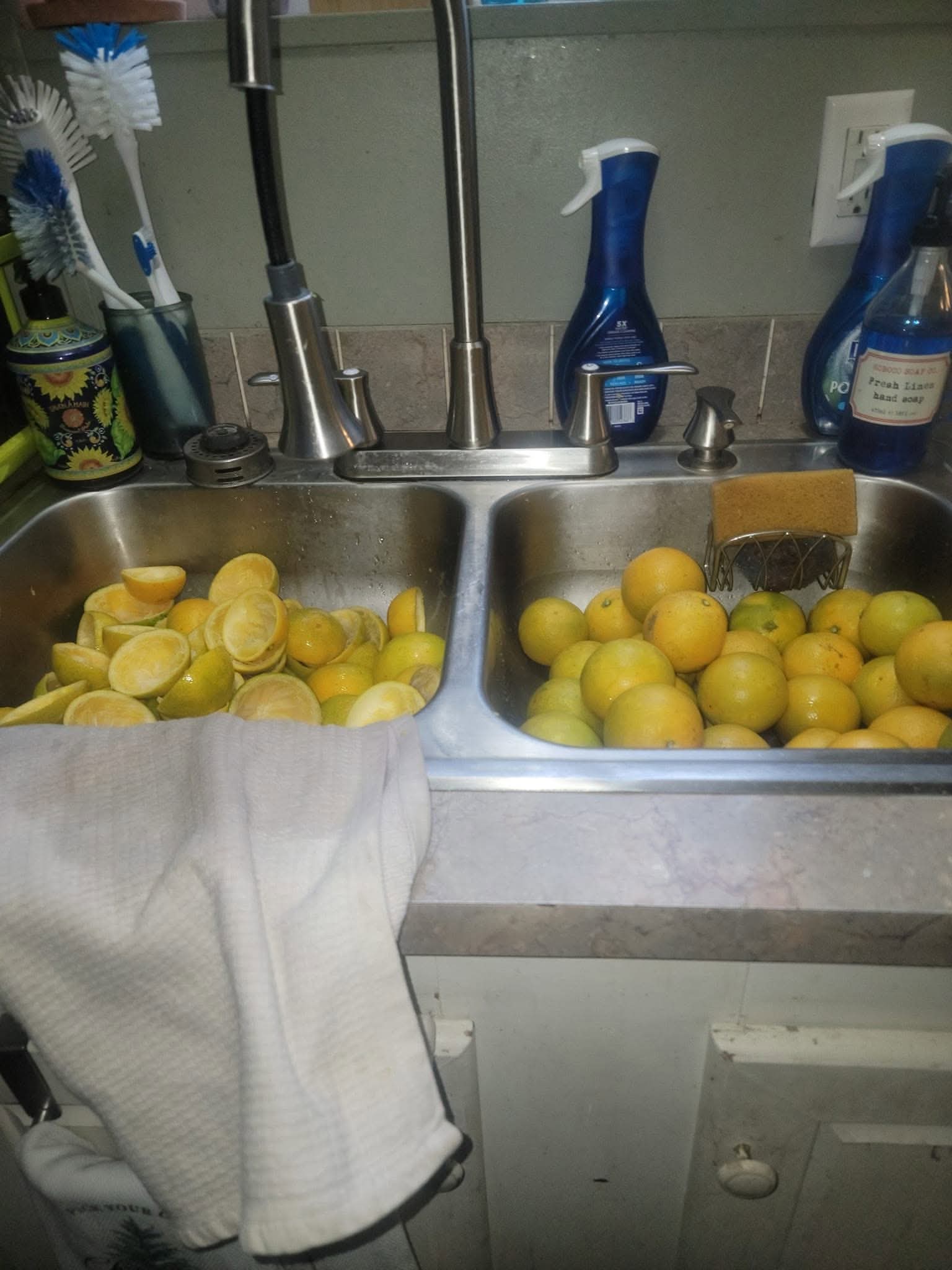
🍋 Two Boxes of Lemons, One Very Productive Weekend: Lemonade Concentrate, Candied Peels, Lemon Water, Simple Syrup & Limoncello
Buying two big boxes of organic lemons can look like a lot of fruit—until you realize just how many ways you can use a single lemon.
Instead of squeezing the juice and throwing everything else away, you can turn a large lemon haul into a whole collection of homemade staples: lemonade concentrate, candied lemon peel, lemon water, lemon simple syrup, limoncello, and even lemon seedlings.
It is a wonderful way to stretch your grocery budget while making the most of every part of the fruit.
One important note: the exact yield will depend heavily on the size and juiciness of your lemons. So rather than promising exactly 50 pints, this is best treated as a large-batch lemon-processing plan.
🍋 What You’ll Need
Main ingredients
- 2 large boxes organic lemons
- Granulated sugar, approximately $5 worth
- Vodka, approximately $25 worth
- Water
Helpful equipment
- Citrus juicer
- Fine-mesh strainer
- Vegetable peeler or citrus zester
- Large bowls
- Large saucepan
- Measuring cups
- Clean jars or freezer containers
- Freezer-safe containers
- Baking sheets
- Parchment paper
- Cheesecloth or coffee filters
- Funnel
- Clean bottles or jars
🍋 PART 1: Homemade Lemonade Concentrate
This is one of the best ways to preserve a large quantity of fresh lemon juice.
Freshly squeezed lemon juice can be frozen for longer-term storage. The National Center for Home Food Preservation recommends packing citrus juice into containers, leaving appropriate headspace, sealing, and freezing. (CNCAD)
Ingredients
- Freshly squeezed lemon juice
- Granulated sugar, to taste
Instructions
1. Wash the lemons
Wash the lemons thoroughly before cutting them.
Since you’re planning to use the peels as well as the juice, this step is particularly important.
2. Juice the lemons
Cut the lemons in half and squeeze them using a citrus juicer.
Strain the juice through a fine-mesh strainer to remove seeds and excess pulp.
Don’t throw away the leftover peels!
Set them aside for the candied peel and other projects.
3. Sweeten the juice
For each 1 cup of fresh lemon juice, start with approximately ½ to ¾ cup sugar, depending on how sweet you want the concentrate.
Stir until the sugar dissolves.
Taste and adjust.
4. Portion the concentrate
Pour the lemonade concentrate into freezer-safe containers.
Leave room for expansion during freezing.
For convenience, you can freeze it in pint-sized containers so each container makes one convenient batch.
5. Freeze
Label each container with the date and contents.
Freeze until solid.
When you’re ready to make lemonade, thaw the concentrate in the refrigerator and dilute it with cold water to taste.
Commercial frozen lemonade concentrate is generally formulated at a much higher soluble-solids concentration than ordinary lemonade, so homemade concentrate doesn’t have to imitate a commercial product exactly. (Institut d’Information Juridique)
🍋 PART 2: Candied Lemon Peel
Don’t throw away those beautiful lemon peels!
Candied lemon peel turns what would normally be kitchen waste into a sweet treat.
Ingredients
- Lemon peels
- Water
- Granulated sugar
Instructions
1. Prepare the peels
Cut the lemon peels into strips.
Try to remove some of the thick white pith if your peels have a lot of it. Leaving some pith is perfectly fine, but removing excess pith produces a less bitter candy.
2. Blanch the peels
Place the peels in a saucepan and cover with water.
Bring to a boil.
Drain the water.
Repeat this process 2–3 times if the peels are particularly bitter.
3. Make the syrup
Combine equal parts water and sugar in a saucepan.
For example:
- 2 cups water
- 2 cups sugar
Bring to a simmer and stir until the sugar dissolves.
4. Add the peels
Add the blanched lemon peels.
Simmer gently until the peels become translucent and tender.
This can take approximately 45–60 minutes.
Don’t boil aggressively.
5. Dry the peels
Remove the peels from the syrup and place them on a rack or parchment-lined baking sheet.
Allow them to dry until they’re tacky but no longer dripping.
6. Coat with sugar
Toss the pieces in granulated sugar.
Allow them to finish drying.
Store the finished candied lemon peel in an airtight container.
It’s wonderful chopped into:
- Cakes
- Cookies
- Fruit breads
- Muffins
- Biscotti
- Panettone-style breads
- Chocolate desserts
🍋 PART 3: Lemon Water
If you have more lemon juice than you can immediately use, make convenient lemon water.
Ingredients
- Fresh lemon juice
- Cold water
- Optional lemon slices
Instructions
Mix lemon juice with cold water according to your taste.
A simple starting point is:
- ¼ cup lemon juice
- 4 cups cold water
Add more or less lemon juice depending on how tart you like it.
Pour into clean containers and refrigerate.
You can also freeze lemon juice in ice-cube trays and drop the cubes into water whenever you want a quick lemon drink.
🍋 PART 4: Homemade Lemon Simple Syrup
This is one of my favorite ways to use extra lemons because it makes future drinks and desserts incredibly easy.
Ingredients
- 4 cups water
- 4 cups granulated sugar
- 1 cup fresh lemon juice
- Optional: strips of lemon zest
Instructions
1. Combine sugar and water
Add the water and sugar to a saucepan.
Heat gently, stirring until the sugar completely dissolves.
2. Add lemon
Add the fresh lemon juice.
If desired, add a few strips of lemon zest for extra lemon flavor.
3. Simmer
Bring the mixture to a gentle simmer.
Don’t aggressively boil it.
Simmer for several minutes.
4. Cool
Remove from the heat and allow the syrup to cool.
Remove any pieces of zest.
5. Store
Pour into clean containers and refrigerate.
For longer storage, you can freeze the syrup in convenient portions.
Don’t assume homemade lemon syrup is shelf-stable simply because it contains lemon juice and sugar. Shelf-stable preservation requires a validated preservation process; refrigerated or frozen storage is the safer approach for this homemade version. (FSIS)
🍋 PART 5: Homemade Limoncello
And now for the part that makes a mountain of lemons feel like a very good idea. 😂
Limoncello is made by infusing lemon zest in vodka and then sweetening the resulting infusion.
Ingredients
- 10–12 organic lemons
- 750 ml vodka
- 2 cups sugar
- 2 cups water
Instructions
1. Wash and dry the lemons
Since you’re using the outer peel, wash the lemons thoroughly and dry them.
2. Peel the lemons
Use a vegetable peeler to remove thin strips of yellow zest.
Try to avoid as much of the white pith as possible.
The yellow portion contains the fragrant citrus oils you want.
3. Combine with vodka
Place the lemon zest in a clean large glass jar.
Pour the vodka over the zest.
Seal the jar.
4. Infuse
Keep the jar in a cool, dark place.
Shake it gently every day or two.
The vodka will gradually turn bright yellow as it extracts the lemon oils.
Allow approximately 2–4 weeks for a strong infusion.
5. Make the syrup
Combine:
- 2 cups water
- 2 cups sugar
Heat gently until the sugar dissolves.
Cool completely.
6. Strain the vodka
Strain the lemon-infused vodka through a fine strainer.
For an especially clear limoncello, strain it again through cheesecloth or a coffee filter.
7. Add the syrup
Mix the cooled sugar syrup into the infused vodka.
Taste.
If you want it sweeter, add more syrup.
8. Bottle and chill
Pour into clean bottles.
Refrigerate or freeze.
Serve very cold in small glasses.
🌱 PART 6: Save Those Lemon Seeds!
This might be the most fun part if you enjoy gardening.
Instead of throwing away the seeds, save some and try growing your own lemon seedlings.
How to Start Lemon Seeds
Remove the seeds from fresh lemons.
Rinse them thoroughly to remove the sticky fruit residue.
Plant them while they’re still fresh rather than allowing them to dry out completely.
Place each seed about ½ inch deep in moist potting mix.
Keep the soil warm and lightly moist.
Covering the pot loosely with clear plastic can help retain humidity, but make sure there is some ventilation.
With patience, seedlings can emerge.
🌱 What Happens Next?
Once the seedlings develop several leaves, move them into their own pots if necessary.
Give them plenty of bright light.
Lemon trees grown from seed can eventually become beautiful plants, but there’s an important catch:
A lemon tree grown from seed isn’t guaranteed to produce fruit identical to the lemon the seed came from.
And it may take years before a seed-grown tree produces fruit.
That’s why these little lemon trees can make charming gardening gifts—but they’re better viewed as a fun long-term project than a guaranteed fruit tree.
💰 How Much Can You Get From Two Boxes?
This is where things get interesting.
Depending on the size, variety, juiciness, and weight of your lemons, two large boxes could provide a tremendous amount of usable material.
You could potentially end up with:
🍋 Lemonade concentrate — dozens of portions
🍋 Candied lemon peel — several batches
🍋 Lemon water — multiple containers
🍋 Lemon simple syrup — several quarts
🍋 Limoncello — approximately a gallon or less depending on your batch size
🍋 Lemon seeds — potentially dozens of seedlings
But the exact yield can’t be guaranteed without knowing the weight and variety of the lemons.
🧊 Don’t Forget the Freezer
The freezer is your best friend when you’re processing a huge quantity of lemons.
Fresh lemon juice can be frozen, and NCHFP specifically recommends freezing citrus juice in containers with appropriate headspace. (CNCAD)
You can freeze:
- Lemon juice
- Lemon zest
- Lemonade concentrate
- Lemon syrup
- Lemon juice ice cubes
Freeze in small portions so you don’t have to thaw an entire batch every time you need a little lemon.
♻️ Almost Nothing Goes to Waste
That’s what makes a giant lemon haul so satisfying.
You can use:
JUICE → lemonade, cooking, desserts and drinks
ZEST → baking, sauces, seasoning and limoncello
PEELS → candied lemon peel
SEEDS → lemon seedlings
And even the leftover squeezed-out lemon halves can still be useful for household purposes before they’re finally composted.
Instead of thinking:
“I have two boxes of lemons!”
you can think:
“I have enough lemons to stock my kitchen for months.” 🍋
🍋 A Full Lemon-Processing Weekend
If you really want to tackle a huge batch, organize the work into stages.
Day 1
Morning:
Wash and sort all the lemons.
Late morning:
Zest the lemons you’ll use for limoncello.
Afternoon:
Juice the lemons.
Evening:
Start the limoncello infusion and prepare your lemonade concentrate for freezing.
Day 2
Prepare:
- Candied lemon peel
- Lemon simple syrup
- Lemon water
- Lemon juice ice cubes
Save the seeds for planting.
Afterward
Label everything.
Write the date on every container.
Keep refrigerated items refrigerated and frozen items frozen.
🍋 The Best Part
For the price of a couple of boxes of lemons, some sugar, and vodka, you can turn one huge fruit haul into an impressive collection of homemade food and drink.
There’s something incredibly satisfying about using the whole lemon instead of throwing half of it away.
Juice becomes lemonade.
Peels become candy.
Zest becomes limoncello.
Extra juice becomes frozen concentrate.
Sugar and lemon become syrup.
Seeds become tiny trees.
And suddenly those two boxes of lemons don’t look like such a huge amount anymore.
🍋 Have you ever bought lemons in bulk and tried to use every single part?
LEMONADE 🍋 | CANDIED PEEL 🍬 | LIMONCELLO 🍸 | LEMON SYRUP 🥤 | LEMON TREES 🌱
Which one would you make first?
