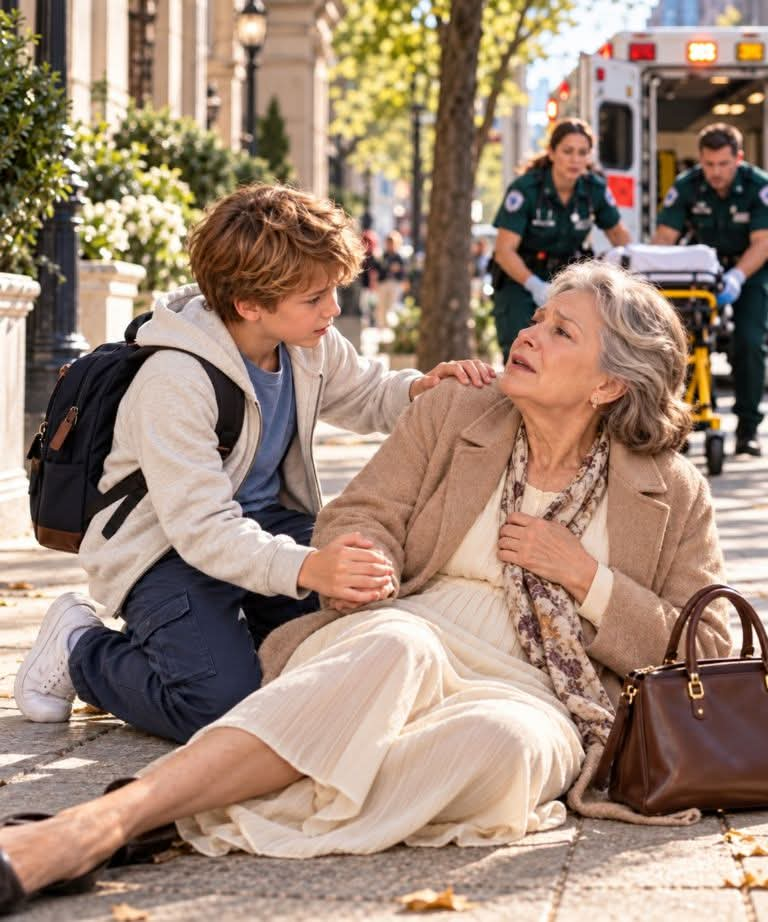
“I can get them.”
“I said I’ll get them.”
He left before I could answer.
Eleanor watched him walk away.
“He is not the only person responsible for what happened,” she said quietly.
I turned toward her.
“What do you mean?”
“I’m still trying to understand that myself.”
She removed a small white business card from her coat.
“My number is on this. If you or your family need anything, please call me.”
I accepted it reluctantly.
“My mom doesn’t like taking things from people.”
“Neither do I.”
“Then why are you giving me your number?”
“Because sometimes help is not charity. Sometimes it is gratitude.”
I examined the card.
Beneath her name appeared a familiar organization: Bennett Community Health Foundation.
“You work at a hospital?”
“I help fund several community programs. The foundation supports clinics, emergency services, and after-school programs.”
“Like the one near our neighborhood?”
“Probably. What neighborhood do you live in?”
I told her where our apartment was located.
Her eyebrows rose.
“What is your mother’s name?”
“Marissa Parker.”
Something changed in her expression.
“Marissa Parker,” she repeated.
“You know her?”
“I’m not sure.”
Before I could question her further, Caleb returned carrying my lunch container and notebook.
“I’m sorry, Julian,” he said.
His voice now sounded less defensive.
I collected my possessions.
“Thank you.”
“I mean it.”
I nodded without promising forgiveness.
Perhaps forgiving someone required time, just as injuries needed time to heal. I wasn’t sure yet.
Eleanor accompanied me outside.
Sunlight reflected from the surrounding windows. Buses stopped along the curb, people crossed the pavement, and the city continued its usual noisy morning.
“Will you be all right getting home?” she asked.
“Yes.”
“Does your mother know what happened?”
I looked away.
“Not everything.”
“Would you like me to speak with her?”
The suggestion made me nervous.
“No. I need to tell her.”
“That is a good choice.”
I started toward the bus stop before turning around.
“Ms. Bennett?”
“Yes?”
“Did you survive because I found you?”
My question seemed to catch her off guard.
“The paramedics told me I was very lucky.”
“That’s not what I asked.”
Her expression softened.
“Yes,” she said. “You helped save my life.”
I pressed my lunch container against my chest.
“Then I’m glad I was late.”
She regarded me silently.
“So am I.”
I traveled home with her card in my pocket and countless questions occupying my thoughts.
Our small apartment sat above a laundromat on a street with cracked sidewalks and dusty windows.
When I entered, Mom was sitting at the kitchen table, arranging receipts into separate piles.
She looked up.
“You’re home early.”
“I lost my job.”
Her hands became still.
“What?”
I placed my backpack beside a chair.
“Mr. Morgan fired me yesterday.”
Mom stood abruptly, scraping her chair across the floor.
“Why?”
“I was late.”
Her face fell.
“Julian, we talked about this. You have to call if something happens.”
“I did call the office. They said it didn’t matter.”
“What happened?”
I explained everything: the collapsed woman, the emergency call, and Caleb’s furious accusations.
Mom listened without interrupting.
When I finished, she slowly sat down.
“You did the right thing,” she said.
“But we need the money.”
“We’ll manage.”
“You said that last month when the electricity bill came.”
“And we managed.”
“You skipped dinner.”
Her expression shifted.
“That was because I wasn’t hungry.”
“I know when you’re pretending.”
We sat quietly.
Eventually, Mom reached across the table and held my hand.
“I’m proud of you.”
“I don’t want you to be proud. I want to help.”
“You are helping. But you are not supposed to carry this family by yourself.”
“I’m ten.”
“Yes,” she said. “You are ten. That is why I should never have let you believe our problems were yours to solve alone.”
I stared at our hands.
Since Dad left, Mom had worked two jobs. She prepared food at a café during the day and cleaned offices at night.
When I was younger, I simply believed she was always tired.
Later, I understood that her exhaustion came from constantly fighting to keep us afloat.
“I brought something home,” I said.
I retrieved Eleanor’s business card.
Mom read the name.
Her complexion suddenly paled.
“Where did you get this?”
“The woman I helped gave it to me.”
She stared at the card with unmistakable alarm.
“Her name is Eleanor Bennett,” I said. “She works with a foundation.”
Mom pushed it back toward me.
“You need to stay away from her.”
I blinked in confusion.
“Why?”
“I don’t know her.”
“But you recognized her name.”
“No.”
“You repeated it.”
“I was surprised.”
“Why?”
Mom stood and began gathering receipts she’d already organized.
“Some people have money and influence. That doesn’t mean they belong in our lives.”
“She didn’t act like she wanted anything.”
“That is how trouble begins sometimes.”
I’d never heard such fear in her voice.
“What are you hiding?”
She stopped moving.
“I’m not hiding anything.”
“Then why are you upset?”
“I’m not upset.”
“You’re shaking.”
Mom glanced at her unsteady fingers.
After a long silence, she sat down again.
“Your father once worked for the Bennett Foundation.”
I knew little about Dad’s past.
His name was Daniel Parker, and he’d disappeared from our lives when I was six.
Mom always explained that adults sometimes made regrettable decisions. She never described him as evil, but she never promised he’d return.
“What did he do there?”
“He managed community outreach projects.”
“Did he know Eleanor?”
“Yes.”
“How well?”
“Well enough.”
Her voice grew distant.
“What happened?”
She stared through the window.
“Your father found irregularities in some of the foundation’s financial records. He believed money intended for neighborhood clinics was being redirected.”
“By Eleanor?”
“No. Not by her.”
“Then who?”
“I don’t know.”
“Did he tell her?”
“He tried.”
“What happened?”
Mom folded one of the receipts.
“The foundation investigated. Your father was blamed for the missing funds.”
I sat motionless.
“Was he guilty?”
“No.”
She answered immediately.
“Then why did he leave?”
“Because the investigation damaged his reputation. He lost his job, and people stopped trusting him. He said he needed to go somewhere else and start over.”
“Did he clear his name?”
“Not publicly.”
“Why not?”
Tears formed in Mom’s eyes.
“Because by then, we were already struggling. He believed disappearing would protect us from the attention.”
“That makes no sense.”
“I know.”
“Did he contact you?”
“Sometimes.”
“Where is he now?”
“I don’t know.”
I pushed away from the table.
The apartment suddenly seemed unbearably cramped.
“You knew all this and never told me?”
“You were a child.”
“I’m still a child.”
“That is exactly why I didn’t tell you.”
I walked toward the window.
Below us, people entered the laundromat carrying heavy bags. A delivery vehicle occupied part of the street.
“Does Eleanor know what happened to him?”
“I don’t know.”
“Did she know he was innocent?”
Mom lowered her gaze.
“I think she believed him.”
“Then why didn’t she help?”
“She may have tried.”
I looked at the business card again.
“What does this have to do with me?”
“Nothing.”
Her reply came too quickly.
I turned around.
“Mom.”
She closed her eyes.
“There is something you need to know.”
Before she could continue, someone knocked at our apartment door.
We both looked toward the hallway.
Another quiet but deliberate knock followed.
Mom’s expression changed.
“Who is it?” I asked.
She remained silent.
Then a woman spoke from outside.
“Marissa? It’s Eleanor Bennett.”
Mom grabbed the table’s edge.
For several moments, neither of us moved.
I approached the door, but she caught my wrist.
“Wait.”
“Why?”
“I need to speak with her first.”
“You said to stay away from her.”
“I was wrong.”
That admission frightened me more than her earlier warning.
Mom released me and opened the door slightly.
Eleanor stood outside without her coat, holding a narrow brown envelope.
Her expression was composed, but her gaze remained fixed on Mom.
“May I come in?”
After hesitating, Mom opened the door.
Eleanor entered and looked toward me.
“I’m sorry to arrive without calling,” she said. “But after I spoke with Julian, I realized there was something I needed to bring you.”
“What is it?” Mom asked.
Eleanor extended the envelope.
“I found this in an old foundation file.”
Mom refused to take it.
“Why would you bring it here?”
“Because your name was written on the back.”
Mom stared at it.
“Where did you find it?”
“In a storage archive. I was reviewing the records from the year Daniel left.”
My heartbeat quickened.
“I had always been told that Daniel Parker took documents from the foundation before disappearing. Today, I discovered that the file was incomplete.”
Mom whispered her next question.
“What did you find?”
“A letter.”
Eleanor held it out again.
“This letter was never delivered. It was addressed to you.”
Mom finally accepted the envelope.
Her hands shook as she examined the faded handwriting.
Even I recognized the name.
Daniel Parker.
She pressed the envelope against her chest.
Eleanor looked between us.
“There is one more thing,” she said. “The letter was dated three days before your father left. And according to the note attached to it, Daniel claimed he had proof that someone inside the foundation had been using his name to hide the missing money.”
Mom shut her eyes.
“He also wrote that if anything happened to him, the evidence would be sent to the one person he trusted most.”
I watched Mom carefully.
“Who?” I asked.
Eleanor looked toward her.
“Your mother.”
Mom opened the envelope.
Inside lay one folded sheet of paper and a small brass key secured beneath it.
As she read the opening line, her expression changed.
Then she whispered an unfamiliar name.
“Caleb Morgan.”
**Part 3: The Letter and the Hidden Records**
I stared at Mom, unable to understand why my former boss appeared in a letter written long before my birth.
“Caleb?” I asked. “My boss?”
Mom folded the paper against her palm.
“You knew him?” I asked.
“Not the way you think.”
Eleanor approached gently.
“Marissa, please read the letter before you decide what it means.”
Mom lowered her gaze.
For a moment, I thought she’d return the document to its envelope without reading it. Instead, she slowly unfolded the yellowed sheet.
The handwriting was cramped, suggesting Dad had written it in a hurry.
Mom read silently.
Confusion crossed her face, followed by disbelief and overwhelming sadness.
“What does it say?” I asked.
She didn’t answer.
Eleanor moved beside her.
“May I?”
Mom handed her the letter.
After reading every paragraph, Eleanor pressed her lips together.
“It’s from Daniel,” she said.
“I know.”
“He says the money was transferred through a consulting company.”
Mom looked up.
“Which company?”
Eleanor hesitated.
“Parker and Morgan Consulting.”
I felt dizzy.
“Parker?” I repeated.
Mom tightened her grip on the key.
“Our name?”
Eleanor nodded.
“Daniel wrote that he had never created such a company. He believed someone had registered it using his old employment records and Caleb Morgan’s accounting credentials.”
I glanced at the brass key.
“Then Caleb stole the money?”
“No,” Eleanor said quickly. “The letter doesn’t say that.”
“But his name is there.”
“It says Caleb’s credentials were used. That is not the same thing.”
Mom lowered herself into a chair.
“Why would Daniel write this to me and never send it?”
“That is what I’m trying to understand,” Eleanor replied.
I pointed toward the key.
“What does it open?”
“We don’t know,” Eleanor said. “It was taped beneath the letter when I found it.”
Mom rubbed its worn surface with her thumb.
“I’ve seen this before.”
We both looked at her.
“When?” I asked.
“Years ago. Daniel kept a key like this on his key ring.”
“Do you know what it opened?”
“He said it was for a storage locker.”
“Where?”
She turned toward the window.
“I don’t remember.”
Her quick response sounded unconvincing.
Eleanor noticed too.
“Marissa.”
Mom sighed.
“Daniel rented a small locker at the central train station. He said it was for work documents, but I never saw inside.”
“Why didn’t you go there after he left?” I asked.
“Because I didn’t know the locker number.”
“Could this be the key?”
“It could.”
Eleanor examined the metal under the kitchen light.
A tiny number appeared beneath numerous scratches.
“Thirty-one,” she said.
Mom shook her head.
“There were hundreds of lockers.”
“Not anymore,” Eleanor said. “The station replaced the old storage area several years ago.”
My hope immediately weakened.
“What happens to the things inside?”
“They transfer them to an archive facility.”
“Can we still find it?”
Eleanor studied the key.
“Possibly.”
Mom abruptly stood.
“No.”
Her refusal was quiet but unmistakable.
“Why not?”
“Because we don’t know what is there.”
“That’s why we should find out.”
“Julian, this isn’t a game.”
“I know.”
“You don’t understand what your father’s disappearance did to us.”
“Then help me understand.”
Mom pressed her fingers against her forehead.
Eleanor remained silent, allowing us to speak.
Finally, Mom explained.
“Your father believed someone had used his name to move money out of the foundation. He kept saying he could prove it, but every time he tried, another problem appeared. A missing file. A changed password. A document that no longer existed.”
“Did he suspect Caleb?”
“He suspected several people.”
“Why did he write Caleb’s name?”
“I don’t know.”
“Was Caleb working for the foundation then?”
“Yes.”
“As what?”
“An accountant. He handled invoices and vendor payments.”
I remembered Caleb’s locked filing cabinet and how uncomfortable he became whenever anyone mentioned older records.
“Does he still have the documents?” I asked.
“Probably not,” Eleanor said. “But the agency may have inherited some files from the company he worked for.”
Mom regarded her suspiciously.
“You think he knows what happened?”
“I think he may know more than he has said.”
“Then why did you bring this here?”
“Because I found it in the foundation archive, and because your son told me Caleb blamed him for a decision that had already been made.”
“What does that have to do with the letter?”
“I don’t know yet. But the timing concerns me.”
I remembered Caleb insisting that my lateness had cost the agency its contract.
“Maybe he was trying to keep people from asking questions,” I said.
Eleanor addressed me seriously.
“That is possible. But we must be careful. Guessing can hurt innocent people.”
I lowered my eyes.
I desperately wanted one explanation for everything.
It would be easier if Caleb were responsible for Dad’s disappearance, Mom’s struggles, and my dismissal.
But suspicion wasn’t proof.
Mom folded the letter.
“I don’t want Julian involved.”
“I’m already involved,” I said.
“You’re ten.”
“And you said I’m old enough to know the truth.”
“I said you were old enough to know your father’s name.”
“You also said I shouldn’t carry the family’s problems alone. That doesn’t mean you should carry them alone either.”
Mom studied me.
Instead of becoming angry, she softened.
“You sound like him,” she whispered.
“Like Dad?”
“Yes.”
Emotion tightened my chest.
Eleanor moved toward the entrance.
“I can arrange for the foundation’s legal adviser to help us request access to the archive. Nothing will be taken, and nobody will be accused. We’ll simply find out whether the locker records still exist.”
Mom shook her head.
“Not today.”
“Of course not.”
“I need time.”
“You have it.”
Eleanor placed another business card on the table.
“This is my private number. Call whenever you’re ready.”
Mom looked at it.
“Why are you doing this?” she asked.
Regret crossed Eleanor’s face.
“Because I should have looked harder years ago.”
“You were young.”
“I was twenty-eight. Old enough to question the report.”
“What report?”
“The internal review that blamed Daniel.”
Mom seemed startled.
Eleanor continued explaining.
“I had just joined the foundation board. I believed the people who told me he had misused funds and disappeared when confronted. I never met him, but I remember thinking the evidence felt incomplete.”
“Then why didn’t you say anything?”
“Because I let more experienced people convince me that doubt was disloyalty.”
Her voice remained controlled, but remorse was unmistakable.
“I’m sorry,” she said. “I can’t change what happened to your family. But I can stop pretending the file was complete.”
Mom picked up the card.
“Thank you.”
Eleanor looked toward me.
“And Julian?”
“Yes?”
“Your decision to help me yesterday was not connected to any of this. Please remember that.”
I nodded.
Before leaving, she added:
“If we find something belonging to your father, we will decide together what happens next. No one will pressure you or your mother.”
“Will you tell the police?”
“If the evidence shows that money was stolen, we will speak with the proper authorities. But first, we need facts.”
After Eleanor departed, Mom rested against the closed door.
Even the laundromat downstairs seemed unusually quiet.
“What did Dad look like?” I asked.
“You know what he looked like.”
“I know from pictures.”
“He had dark hair. It curled behind his ears when it grew too long. He laughed loudly, even when something wasn’t very funny.”
“Did he laugh with me?”
Mom smiled faintly.
“All the time.”
“Then why don’t I remember?”
“Because you were little.”
I sat beside the folded letter.
“Did he love me?”
Mom came over and knelt beside my chair.
“He loved you more than anything.”
“More than the foundation?”
“Much more.”
“Then why did he leave?”
Her eyes filled with tears.
“I don’t know.”
That uncertainty hurt worse than almost anything she could have told me.
She placed her hand over mine.
“Your father thought he could fix everything before it reached us. He believed if he disappeared for a little while, he could find proof and come back with answers.”
“Did he promise to come back?”
“Yes.”
“Did you believe him?”
“I did.”
“Do you still?”
Mom gazed toward the envelope.
“I don’t know what I believe anymore.”
The following morning, Eleanor phoned before I left for school.
Mom answered and passed me the phone.
“Hello?”
“Good morning, Julian. How are you feeling?”
“Confused.”
“That seems reasonable.”
“Did you find anything about the locker?”
“I found a retired station manager who remembers the old storage system. The key number alone isn’t enough, but he believes the lockers were assigned under the renter’s name. We may be able to search the archived records.”
“Can we go today?”
“There is no need to rush.”
“There might be something important inside.”
“There might also be nothing. We need to be prepared for either possibility.”
Mom stood nearby folding a towel.
“Can we go?” I asked her.
She hesitated.
“After school.”
Eleanor heard her answer.
“I’ll meet you at three-thirty outside the station.”
“Okay.”
“And Julian?”
“Yes?”
“Please don’t tell anyone at the agency about the key.”
“Why?”
“Because we don’t know who can be trusted with information that may affect other people.”
I remembered my former boss.
“Does that include him?”
“It includes everyone until we understand the facts.”
School seemed endless that day.
I couldn’t concentrate on my teacher’s reading or the workbook in front of me.
Instead, I pictured a locked compartment beneath the train station, perhaps holding documents written by Dad.
At lunchtime, my friend Marcus sat opposite me.
“You look like you didn’t sleep.”
“I didn’t.”
“Did something happen?”
I almost explained everything but remembered Eleanor’s warning.
“My mom had a bad night.”
“Is she okay?”
“Yes.”
Marcus pushed half his sandwich toward me.
“You can have this.”
“I’m not hungry.”
“That’s what people say when they’re hungry.”
I accepted it.
His simple kindness made the afternoon a little easier.
After school, Mom and I met Eleanor outside the central station.
She had brought a folder and an older man with silver hair.
He introduced himself as Harold Price, the station’s former manager.
“I’m not sure how much help I’ll be,” Harold said, “but I remember the storage rooms. They were beneath Platform Four.”
He guided us through a side entrance and down a narrow staircase.
The air smelled dusty, and old stone surrounded rows of metal filing cabinets.
“These are the archived locker records,” Harold explained. “The physical contents were transferred to a municipal storage facility when the station renovated. Some items were claimed. Others were discarded according to the holding period.”
Mom looked uneasy.
“How long ago was the renovation?”
“Sixteen years.”
“That was the year Daniel left,” she whispered.
Harold opened a thick handwritten ledger.
“The old system was handwritten. If you know the renter’s name, we can search.”
He began scanning the entries.
“Parker… Parker…”
My pulse quickened.
Then his finger stopped.
“Here it is. Daniel Parker. Locker thirty-one.”
Mom grabbed my shoulder.
“What does it say?”
“Contents transferred to municipal storage, crate number four hundred twelve. Not claimed.”
Eleanor exhaled.
“Can we see it?”
Harold looked up.
“The storage facility is across town. It closes in an hour.”
“Then we should go,” I said.
Mom exchanged an uncertain glance with Eleanor.
Finally, she nodded.
“Let’s go.”
The municipal storage facility occupied an unremarkable brick building behind a recycling center.
Inside, shelves held numerous cardboard boxes, suitcases, and plastic containers.
A clerk examined Harold’s documents while Eleanor described the old foundation investigation.
Mom stood beside me, gripping my hand.
Eventually, the clerk returned.
“Crate four hundred twelve is still here,” she said. “But it was marked for disposal next month.”
Mom’s grip tightened.
“Why wasn’t it disposed of before?”
“Some records were delayed during a cataloging review.”
Eleanor looked toward Harold.
“Can we open it?”
The clerk agreed.
An employee led us toward the rear storage area and brought out a dusty wooden crate.
The number 412 was painted across its lid.
Mom stepped forward and rested her palm against the wood.
“I thought this was gone,” she whispered.
Eleanor carefully pried open the container.
Inside were folders, receipts, a weathered blue notebook, and an envelope protected by plastic wrapping.
Mom immediately recognized the handwriting.
“That’s his.”
She reached forward but stopped.
The envelope wasn’t addressed to her.
Instead, someone had written a date and one word:
MORGAN.
Caleb’s surname.
Eleanor lifted it carefully.
“Why would your father leave something addressed to Caleb?” she asked.
Mom shook her head.
“I don’t know.”
I pointed toward the notebook.
“Maybe the answer is there.”
Mom opened it.
Its pages contained payment records, account numbers, and names. Several entries had been crossed out and replaced.
Eleanor leaned closer.
“These are foundation disbursements.”
Harold stepped aside.
Mom turned another page, revealing a handwritten note in the margin.
“Ask C.M. about the second ledger.”
Eleanor read the words aloud.
“C.M.,” I said. “Caleb Morgan.”
Mom looked pale.
Eleanor opened the envelope marked MORGAN and removed a single sheet.
After reading it, she handed it to Mom.
Mom barely finished the first line before sinking onto the concrete floor.
I crouched beside her.
“What does it say?”
Her trembling fingers passed me the letter.
The handwriting belonged to Dad.
Caleb,
If you are reading this, then you already know the truth about the second ledger. I am leaving it with you because you were the only person who warned me before the transfers began. I trusted you to protect the records until I could return.
Do not give them to Marissa unless you are certain she is safe.
Below Daniel’s signature, another person had written:
He never returned. I kept my promise as long as I could.
Caleb.
Mom covered her mouth.
“He knew,” I whispered.
Eleanor took the sheet.
“He knew Daniel was innocent.”
“And he kept quiet,” Mom said.
“But why?” I asked.
Eleanor turned the paper over.
Faint writing had left an impression on the reverse side.
Harold held it beneath the light.
“There’s writing on the back,” he said.
Eleanor adjusted its angle.
Only a few words could be distinguished.
“Second ledger… beneath the conference room floor…”
Mom turned toward me.
“The conference room,” I said.
I immediately remembered the room where Caleb had accused me of ruining the presentation.
Eleanor gathered the documents.
“We need to leave.”
“Why?” I asked.
“Because if the ledger is still there, we should not search for it without documenting everything properly.”
Mom stood unsteadily.
“Are you saying Caleb hid it at the agency?”
“I’m saying we have reason to believe something may be hidden there.”
I remembered Caleb’s office, the locked cabinet, and the wooden conference-room floor.
Perhaps he’d been trying to clear that room.
Perhaps he’d wanted to prevent anyone from discovering something.
Maybe my dismissal had never really concerned punctuality.
As we approached the exit, the clerk called out.
“Ms. Bennett?”
Eleanor turned.
“There was one more item in the crate.”
The clerk held a small paper packet.
“This was tucked beneath the notebook.”
Eleanor accepted it.
“What is it?”
“It’s a copy of a deposit receipt. The account holder is listed as Caleb Morgan.”
Mom stopped immediately.
Eleanor opened the packet.
Inside was a banking receipt dated three days after Dad disappeared.
The amount was enormous.
Near the bottom appeared a handwritten statement.
Paid in full.
And beneath those words, in Daniel’s recognizable handwriting, was another message:
He thinks I am dead.
**Part 4: The Truth Beneath the Conference Room**
Eleanor held the receipt carefully while Mom stared at its final words.
He thinks I am dead.
For several seconds, nobody spoke.
Then I looked up.
“Does that mean my father was alive when he wrote it?”
“Not necessarily,” she said carefully. “It means Daniel believed Caleb thought he was dead. The receipt could have been written before he disappeared, or afterward.”
“But why would Caleb pay him?”
Mom slowly stood.
“He didn’t pay Daniel. The words may mean the deposit was made using money taken from the foundation.”
Eleanor examined the document again.
“The account information is incomplete. We need a bank investigator to verify whether this is genuine and where the funds came from.”
Mom looked toward the envelope.
“Then Caleb knew Daniel was innocent.”
“Perhaps,” Eleanor said. “But the note suggests Daniel trusted him with something. We still don’t know what happened afterward.”
I remembered the warning in Dad’s letter.
Do not give them to Marissa unless you are certain she is safe.
“Who were ‘they’?” I asked.
Eleanor glanced toward Mom.
“That is one of the questions we need answered.”
Mom placed the receipt carefully into the folder.
“We should go to the agency.”
Eleanor looked concerned.
“We should not accuse Caleb without evidence.”
“I’m not going to accuse him,” Mom said. “I’m going to ask him why my husband’s name appears in a file he kept hidden for sixteen years.”
“That conversation should happen with a lawyer present.”
Mom lowered her shoulders.
“You’re right.”
Agreeing seemed difficult for her.
She’d spent years believing that investigating Dad’s disappearance would only create more suffering. But now she was prepared to confront the past carefully.
Eleanor contacted her legal adviser from the parking lot.
While she explained the situation, Mom and I waited in the back seat of Eleanor’s car.
The receipt rested inside a clear plastic sleeve.
I couldn’t stop looking at it.
“Do you think Dad is alive?” I asked.
Mom stared through the window.
“I want to believe he is.”
“That isn’t an answer.”
“No,” she said softly. “It isn’t.”
She took my hand.
“I don’t want you to build your hopes around a sentence written sixteen years ago. We will find out what we can, but we have to be prepared for the truth, whatever it is.”
“I’m scared.”
“So am I.”
It was the first time she’d openly admitted her fear.
Eleanor finished the call and turned toward us.
“Her name is Priya Shah. She can meet us at the agency. She has asked that we preserve every document exactly as we found it.”
“Can we go inside?” I asked.
“Yes, but only with permission.”
When we arrived at the agency, everything appeared almost unchanged.
Employees worked at their desks, but their conversations faded whenever Eleanor passed.
Caleb wasn’t in his office.
An assistant directed us toward the conference room.
Its door stood open.
Inside, Caleb was kneeling near a floor vent, holding a screwdriver.
When he saw us, he froze.
His gaze shifted from Mom to Eleanor and finally to the folder.
“You found it,” he said.
Mom entered.
“You knew there was something in the archive.”
Caleb set down the screwdriver.
“I knew Daniel left records.”
“You knew he was innocent.”
“I knew he had been telling the truth about the transfers.”
“Then why did you let everyone believe he stole from the foundation?”
Caleb rose slowly.
For the first time, I noticed how tired and burdened he appeared.
Until then, I’d seen him only as an impatient, angry boss. Now there seemed to be years of fear behind his expression.
“I didn’t let them believe it,” he said. “I tried to correct it.”
“Not very hard,” Mom replied.
“You’re right.”
His admission surprised her.
A few minutes later, Priya arrived carrying a leather case.
She introduced herself and instructed Caleb to leave everything untouched.
“I’m not here to threaten you,” she said. “I’m here to understand what happened.”
He nodded, then turned toward me.
“Julian, I owe you an apology.”
I remained silent.
“Not only for firing you. For blaming you for the failed presentation.”
“Why did you do it?”
He lowered his eyes.
“Because I was afraid.”
“Of what?”
“That the client would discover the old records before I knew what they had. When Eleanor arrived yesterday, I realized the past had found its way back to me.”
Eleanor crossed her arms.
“You still haven’t explained the presentation.”
Caleb rubbed his forehead.
“The proposal included a financial appendix. It was prepared from old templates stored on the agency server. I recognized several account codes connected to the foundation. I removed the appendix before the meeting, but not before Eleanor’s team received a copy.”
Priya looked at him.
“You blamed the presentation on Julian,” Priya said.
“I panicked. The clients were already angry, and Julian had arrived late. It was easy to make him responsible.”
His voice weakened.
I remembered standing before the other employees as Caleb shouted at me.
“You made me think I had ruined everything.”
“I know.”
“You told me I should have walked away from the woman.”
“I was wrong.”
Silence settled over the conference room.
Caleb faced Mom.
“Daniel was my friend.”
Her expression hardened.
“Then why did you disappear when he needed you?”
“I didn’t disappear.”
“You signed the report that blamed him.”
“I signed a preliminary statement.”
“You knew what it would do to him.”
“I thought I could fix it before it became final.”
Caleb spoke more urgently.
“Daniel discovered that someone was creating false vendors inside the foundation’s payment system. The money was moved through companies that appeared legitimate. One of them used our names—Parker and Morgan Consulting.”
Eleanor questioned him.
“Who created it?”
“I never proved it.”
“Who did you suspect?”
“A senior administrator named Victor Hale.”
Eleanor looked shocked.
“Victor Hale was the foundation’s chief financial officer.”
“He controlled approvals. But he also had allies on the board. When Daniel brought me the first records, I helped him copy the payment history. We planned to take it to an outside auditor.”
Mom leaned forward.
“What happened?”
“Daniel disappeared before we could.”
“Did you report that?”
“I tried to contact him. His phone was disconnected. His apartment was empty. Then Victor showed me documents that appeared to prove Daniel had taken the money.”
Eleanor stared at him.
“You believed them?”
“No.”
“Then why sign anything?”
Caleb briefly closed his eyes.
“Because Victor told me Daniel had threatened to expose me as part of the scheme. He showed me bank records with my name on them. I was frightened. I thought I would be arrested too.”
Mom spoke more quietly.
“So you protected yourself.”
“Yes.”
His answer seemed to weigh heavily on him.
“I told myself I was waiting for proof. Then months passed. The foundation hired lawyers. Daniel never returned. Eventually, I convinced myself that staying quiet was the only way to keep my life from collapsing.”
“You left us with nothing,” Mom said.
“I know.”
“You could have told me.”
“I was ashamed.”
“That was not your decision to make.”
Caleb nodded.
“You’re right.”
Priya redirected the conversation.
“What is beneath the conference room floor?”
Caleb glanced toward the vent.
“Daniel left a small metal case there.”
“Why didn’t you retrieve it?”
“Because I didn’t know whether anyone was watching the agency. The company that employed us closed after the investigation. Years later, when I started this agency, I found the case while renovating the conference room. I moved it beneath the vent and left it there.”
“Why?” Eleanor asked.
“Because I was afraid to open it.”
Mom stared at him.
“You had sixteen years to be afraid.”
“I know.”
Priya asked another question.
“Have you opened the case?”
“No.”
“Then we will do so under supervision.”
Caleb moved aside.
Priya knelt by the vent, removed its cover, and lifted a narrow metal plate.
Beneath it was a shallow compartment containing a dusty black case.
My heart raced.
Caleb placed it on the conference table.
It was locked.
Mom held up the brass key.
“May I?” she asked.
He nodded.
The key slipped into the lock perfectly.
Mom turned it.
A quiet click followed.
Inside were several USB drives, photocopied bank statements, and an envelope bearing Dad’s handwriting.
Mom reached for the letter, then hesitated.
“Eleanor,” she said, “you should open it.”
Eleanor looked at her.
“Are you sure?”
“Yes.”
She carefully opened the envelope and examined the first paragraph.
Then she passed the letter to Mom.
My mother began reading aloud.
“Marissa,
If you are reading this, then I failed to return when I promised. I need you to know that I never abandoned you or Julian by choice. I believed the truth would protect us, but I underestimated how far people would go to protect themselves.
Caleb has copies of the records. He is frightened, but he is not part of the theft. If he gives you these documents, believe that he waited too long because he was afraid—not because he wanted you to suffer.
I am going to meet someone who says they can help expose Victor Hale. If I cannot come home, please do not let Julian believe he was forgotten. Every day I was away, I carried his picture with me.
I love you both.
Daniel.”
Mom couldn’t read another word.
She pressed the letter against her chest and lowered her head.
Throughout my childhood, I’d imagined Dad in countless places.
Sometimes I pictured him walking through a busy railway station. Other times, I imagined him returning to our apartment, older but smiling.
Occasionally, he was nothing more than a shadow disappearing into the distance.
But I’d never imagined him carrying my photograph everywhere.
I stepped beside Mom and hugged her waist.
She embraced me tightly.
Eleanor turned away to give us privacy.
Caleb remained silently beside the window.
Eventually, I looked toward him.
“What happened to my father?”
He faced me.
“I don’t know.”
His response hurt, but I believed he was telling the truth.
“Did he meet the person who could help him?”
“We believe he did. One of the USB drives contains messages between Daniel and an investigative reporter. The last message says Daniel was traveling to another city to provide evidence.”
“Why didn’t anyone find him?”
“Because the reporter died unexpectedly before publishing the story. The records were never released.”
Priya inspected the drives.
“Technology has changed, but data may still be recoverable. We can send these to a specialist.”
Eleanor looked toward Mom.
“And the bank records may help prove the foundation’s losses.”
I asked Priya another question.
“Can Victor Hale still be charged?”
“That depends on what the evidence shows and the laws that apply after so many years. But the truth can still matter even when time has passed.”
Mom wiped away her tears.
“I want the records investigated. Not for revenge. I want Daniel’s name cleared.”
Eleanor nodded.
“Then we’ll do it properly.”
The investigation continued for several months.
Forensic accountants examined the old payment files, while technical specialists recovered information from the USB drives.
The recovered material included payment histories, draft emails, and correspondence showing that Victor Hale had directed fraudulent transfers through shell companies.
Investigators confirmed that Caleb’s identity had been used without his knowledge and that Dad had repeatedly attempted to expose the financial wrongdoing.
The mysterious bank receipt was genuine.
But the deposit hadn’t been made to Daniel.
Victor Hale had transferred the money into an account controlled by an intermediary.
Dad had written “Paid in full” after discovering that the payment had been used to purchase someone’s silence.
That person wasn’t Caleb.
It was an outside auditor who later admitted the truth privately but never publicly exposed the scheme.
The evidence persuaded authorities to reopen the investigation.
Victor Hale had died years earlier, preventing prosecution against him.
Nevertheless, the foundation published an official correction.
Daniel Parker was formally cleared of wrongdoing.
For Mom, the announcement brought both relief and sorrow.
Dad’s reputation had finally been restored, but he didn’t suddenly return home.
There was no unexpected knock at our apartment door.
Investigators examined old travel records and discovered that Dad had left the city under his real name before adopting another surname.
His trail eventually reached a coastal town thousands of miles away.
A hospital record suggested that a man resembling him had died from an illness eight years after his disappearance.
But nobody could establish his identity with certainty.
Mom refused to confuse uncertainty with proof that he might still be alive.
“We may never know exactly what happened,” she told me one evening. “But we know he loved us. We know he tried to tell the truth. And we know he did not leave because we weren’t enough.”
I placed Dad’s letter inside a wooden box beneath my bed.
The brass key lay beside it.
Caleb eventually resigned from his agency and cooperated completely with investigators.
Before leaving, he asked to speak with me.
We sat together on a bench outside the office.
“I know an apology can’t repair what I did,” he said.
“No.”
“I also know you don’t owe me forgiveness.”
“I’m not ready.”
“That’s fair.”
He looked across the street.
“I want you to understand something. Being afraid explains my choices, but it doesn’t excuse them.”
I studied him carefully.
“Are you going to help other people?”
“I hope so. I’m volunteering with a financial literacy program at the community center.”
“Why?”
“Because I spent too many years protecting myself from consequences. I want to spend some time being useful without expecting anything in return.”
I nodded.
“That sounds like a good idea.”
He smiled faintly.
“Your mother would say it’s the minimum.”
“She probably would.”
Several weeks later, Eleanor invited Mom and me to the Bennett Community Health Foundation.
She’d established a neighborhood emergency response initiative offering free first-aid instruction and public defibrillator training.
At the opening ceremony, Eleanor asked me to stand beside her.
“You helped inspire this,” she said.
“I just called 911.”
“You noticed someone needed help. That is where every good response begins.”
She didn’t describe me as some extraordinary hero.
Instead, she reminded the audience that ordinary people could make an enormous difference simply by paying attention, remaining calm, and refusing to ignore someone in danger.
Mom stood in the front row, smiling through tears.
After the ceremony, Eleanor presented me with a certificate.
Its inscription read:
For courage, compassion, and the wisdom to stop when someone else needed help.
I held it carefully.
“Do I get a job now?” I asked.
Eleanor laughed.
“You’re still ten.”
“I know. But I’m available after school.”
Mom raised an eyebrow.
“No more working during emergencies.”
I grinned.
“Deal.”
I never returned to my old job, and the agency never offered to rehire me.
I didn’t ask them to.
Instead, Eleanor helped Mom secure more stable employment managing the foundation’s neighborhood meal program.
Mom insisted the opportunity wasn’t charity because she was earning her salary through her own work and abilities.
Eleanor agreed completely.
Our living circumstances didn’t magically improve overnight.
We still occupied the apartment above the laundromat.
The machines continued rumbling beneath our floor, our windows still needed repairs, and bills arrived regularly.
But something important had changed.
The constant fear that once filled our home began to fade.
We discussed money openly rather than pretending everything was fine.
We spoke about Dad without whispering.
Mom no longer stayed awake until midnight sorting receipts, and I stopped hiding my concern whenever she looked exhausted.
Life wasn’t suddenly perfect.
Sometimes we argued.
At other times, Mom became quiet when memories resurfaced.
And occasionally, I felt angry with Dad for being absent so long that most of what I knew about him came from other people’s recollections.
But I began to understand that healing wasn’t a single event.
It was something we worked through together, one ordinary day after another.
A year after Eleanor collapsed on the sidewalk, I passed that same corner while walking home from school.
The familiar bench remained beside the road.
A bus pulled up nearby, releasing a tired hiss as passengers hurried along the pavement.
For a moment, I remembered Eleanor struggling to breathe, her trembling hand resting inside mine.
Then I noticed an elderly man standing uncertainly near the pedestrian crossing.
His shopping bag had split, scattering oranges across the sidewalk.
I dropped my backpack.
“Sir, are you all right?”
He looked startled.
“Yes. I’m just embarrassed.”
“It’s okay. We can pick them up.”
A nearby woman stopped and helped gather the fruit.
Another passerby joined us.
Within a minute, we’d collected every orange.
The elderly man thanked us repeatedly.
As I lifted my backpack, I noticed a small blue sign fastened to a nearby light pole.
EMERGENCY RESPONSE STATION—DEFIBRILLATOR LOCATED INSIDE.
Eleanor’s program name appeared beneath the message.
I smiled.
When I arrived home, Mom was sitting at the kitchen table.
Dad’s letter lay open beside her, accompanied by a small photograph.
It showed him holding me when I was very young.
“You found this in the storage box?” I asked.
She nodded.
“I thought you should have it.”
I picked up the picture.
Dad was laughing exactly as Mom had described.
I was sleeping peacefully against his shoulder, one tiny hand gripping his shirt.
“Do I look happy?” I asked.
“You were.”
“How do you know?”
“Because he was.”
I studied the photograph for a long while before placing it beside his letter.
“I think I remember something,” I said.
Mom waited patiently.
“Not clearly. But I remember him telling me that being kind was never wasted.”
Her eyes filled with tears.
“He said that often.”
“Maybe that’s why I stopped for Eleanor.”
“Maybe.”
I leaned against her shoulder.
“Do you think he would be proud?”
Mom kissed my hair.
“I know he would.”
Outside, evening settled across our street.
The laundromat lights flickered on, and the familiar sounds of the city continued around us.
I still didn’t know exactly where Dad had gone or what ultimately happened to him.
There were questions no letter, investigation, or official report could answer.
But I no longer believed that unanswered questions meant we’d been abandoned.
Some truths took years to emerge.
Some apologies arrived long after the damage was done.
Some people allowed fear to guide their worst decisions, while others eventually discovered the courage to correct their mistakes.
And sometimes, even a ten-year-old child could change several lives simply by stopping when everyone else continued walking.
That morning, I’d chosen to help a stranger.
Because of that decision, my family discovered the truth about Dad, Mom began finding peace, and I learned something I would never forget.
Kindness wasn’t weakness.
It was a choice.
One I could make again every single day.
