I should tell you one more small thing, because it turned out to be the whole thing.
Years earlier, before Wes, I’d tried to donate bl*od at a community drive.
The technician had frowned at my sample, run it twice, and finally told me, kindly, that my bl*od was “a little unusual” and they couldn’t use it that day.
I laughed it off.
I was young, I was healthy, and a stranger’s confusion over a vial didn’t seem worth remembering.
I forgot about it for fifteen years.
I want you to hold onto it, because Wes never knew it, and it is the reason my daughters exist and my marriage does not.
The pr*gnancy was hard from the start, and harder at the end.
In the final weeks my bl*od pressure climbed and the babies’ position turned wrong, and my doctor, a steady woman named Dr. Patel, scheduled a C-section under general anesthesia a week early.
Wes drove me to the hospital before dawn.
He held my hand in the elevator so tight it ached.
At the doors to the surgical wing, where he couldn’t follow, he pressed his forehead to mine.
“I’ll be right here,” he said. “When you wake up, we’ll all be together. The four of us.”
Then the doors swung shut between us, and the anesthesia came up over me like warm water, and I went under smiling.
That was the last moment of my old life.
I just didn’t know it yet.
Chapter 2: Why He Left
When I woke, the room was too bright and too quiet.
My middle felt like it had been opened and closed again, because it had.
A nurse — her badge said Mendez — was adjusting my monitor, and the first word out of my cracked throat was the only word that mattered.
“Babies.”
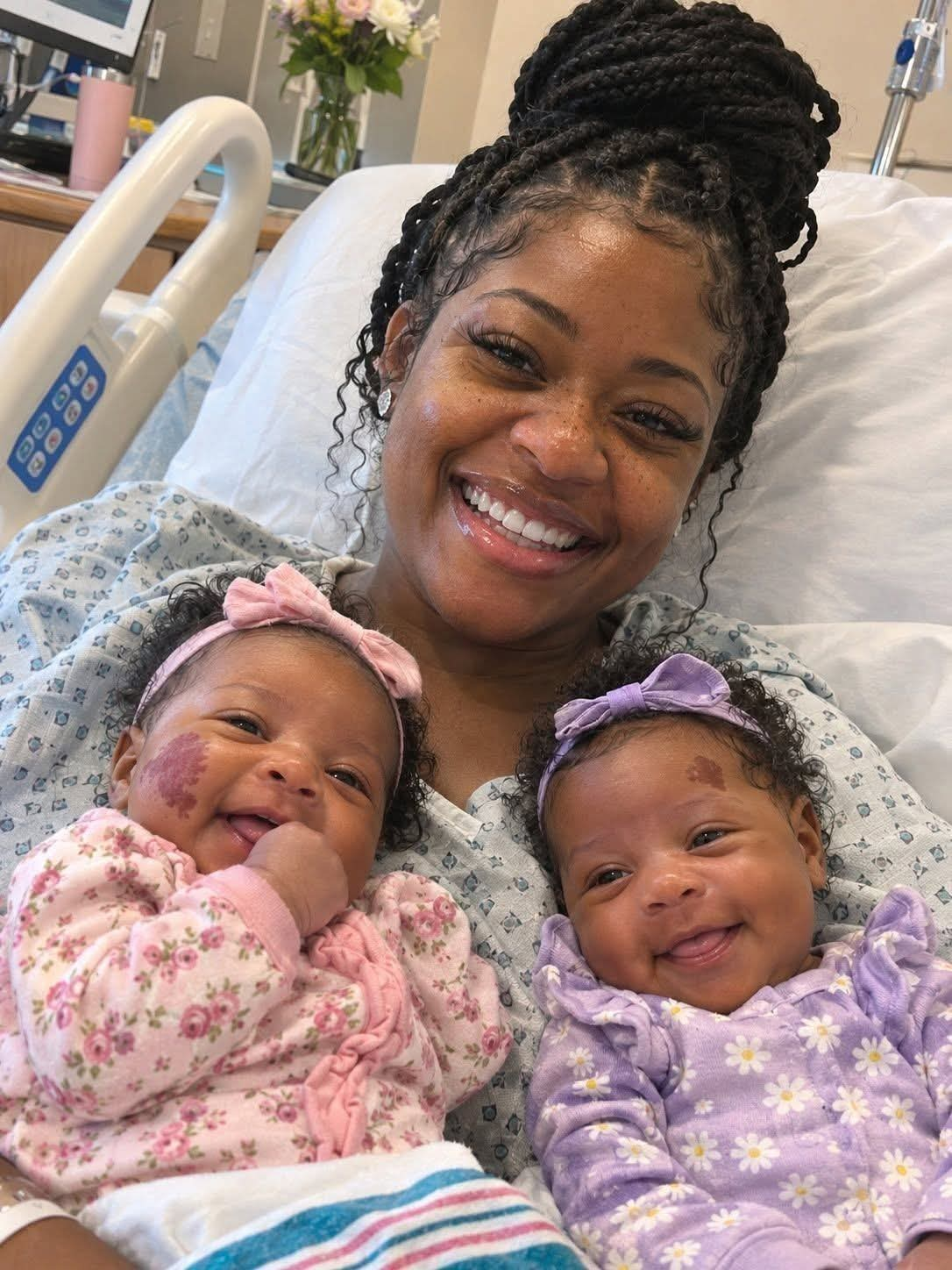
“They’re perfect,” she said, and her whole face softened. “Two girls. Seven pounds between them, loud as anything. They’re right down the hall.”
I started to cry, the ugly, grateful, shaking kind of crying.
Then I looked around the small bright room, and the crying stopped.
“Where’s Wes?” I asked. “Where’s my husband?”
Nurse Mendez’s hands went still on the blanket.
Something crossed her face that I would spend weeks trying to name, and the closest I ever got was shame — not hers, but shame she was carrying for someone else.
“Let me get Dr. Patel,” she said, and she was gone before I could ask again.
I lay there counting ceiling tiles and telling myself a hundred reasonable stories.
He went to call our families.
He went to find coffee.
He stepped out because the sight of me cut open frightened him, and he’d be back any second with that sheepish grin.
Dr. Patel came in a few minutes later.
She closed the door with a quietness that frightened me more than any alarm.
She pulled a chair all the way up to my bed and sat, which doctors do not do when the news is good.
“Holly,” she said. “I need you to stay calm, because you’re healing from major surgery. Can you do that for me?”
“Where is he,” I said.
“Your husband left the hospital about an hour ago,” she said, carefully. “He spoke with a staff member, he signed a form declining to be listed on the birth records, and he left the building. He isn’t answering the number we have.”
The machine beside me started to beep faster, matching my heart.
“That’s not possible,” I said. “He wouldn’t. We waited ten years for them. He was crying yesterday, he—”
“I believe you,” Dr. Patel said. “That’s exactly why I came myself.”
She looked at me for a long moment, like she was weighing how much a woman six hours out of surgery could carry.
Wes used to hold me in the dark and promise, “One day our dream is going to come true. Everything’s going to be okay.”
He was wrong about which dream, and wrong about his own part in it.
The dream came true the morning Willa and Cora were born.
It just didn’t need him to be okay.
My daughters are five now.
Willa is loud and fearless and will argue with a stop sign.
Cora is quiet and watchful and misses nothing, and sometimes she climbs into my lap and asks why her daddy lives far away, and I tell her the only true thing that a five-year-old can hold.
“Some grown-ups get scared of the best thing that ever happened to them,” I say, “and they run. That was never about you. You were never anything but wanted.”
And I mean it with my whole chest, the way I once meant that I believed him.
A doctor asked me, the worst morning of my life, “You really don’t know why he left?”
I know now.
He left over one number on a chart, a number that turned out to be the ordinary, hidden, beautiful proof that my bl*od was always a little unusual — unusual enough to make two perfect girls that a small man ran away from.
His loss.
My whole entire world.
THE END
