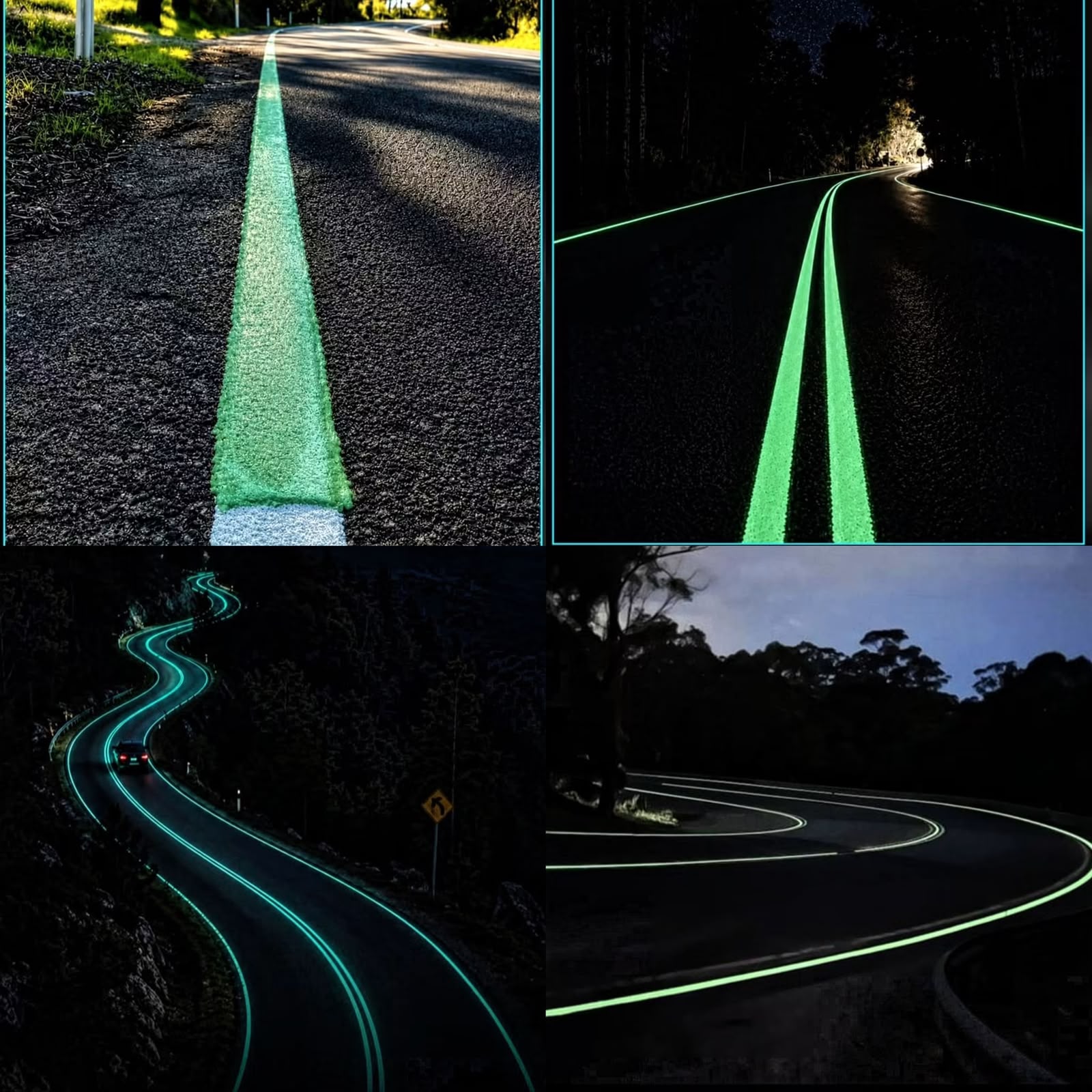
There are several potential advantages to using glowing road markings, particularly in areas where nighttime visibility is a serious concern.
Better Visibility on Dark Roads
One of the biggest advantages is that the markings can remain visible without depending entirely on vehicle headlights.
This could help drivers recognize road boundaries and upcoming curves earlier, giving them more time to respond.
Extra Help on Dangerous Curves
Sharp bends, steep hills, and winding rural roads can be difficult to navigate after dark.
Glowing markings could make the shape of the road easier to recognize, helping drivers maintain better awareness of their position.
Reduced Dependence on Streetlights
Installing conventional street lighting requires electricity, infrastructure, maintenance, and ongoing costs.
Photoluminescent markings could provide an additional visibility solution in places where installing streetlights is difficult or too expensive.
Potential Benefits for Motorcyclists
Motorcyclists can be particularly vulnerable on dark, winding roads.
Clearer road boundaries and more visible curves could help riders better understand the road ahead.
However, glowing markings should complement proper road lighting and other safety measures rather than replace them everywhere.
5. Could Glow-in-the-Dark Roads Help the Environment?
Another interesting advantage is the possibility of reducing light pollution.
Traditional streetlights illuminate large areas, sometimes affecting nearby wildlife and natural habitats.
On remote roads, photoluminescent markings could potentially provide additional guidance without requiring continuous artificial illumination.
Potential environmental advantages include:
- Reduced dependence on electrical lighting in selected locations.
- Less nighttime light pollution.
- Fewer lighting installations in sensitive natural areas.
- Potentially lower energy consumption.
However, the overall environmental impact depends on the materials used, their manufacturing process, durability, and maintenance requirements.
The technology could be particularly interesting in areas where protecting natural darkness is important.
6. Are There Any Disadvantages?
Although the idea sounds promising, glow-in-the-dark roads are not a perfect solution.
Several challenges still need to be considered.
Weather conditions: Photoluminescent materials depend on receiving sufficient light to recharge. Long periods of cloudy weather may reduce their brightness.
Rain and moisture: Wet road surfaces can affect visibility, so performance during heavy rain must be carefully evaluated.
Durability: Road markings experience constant pressure from vehicle tires, weather, sunlight, and temperature changes. The material must remain effective over time.
Maintenance costs: Even if installation is affordable, road authorities must consider cleaning, repairs, replacement, and long-term performance.
Limited brightness: These markings are not necessarily bright enough to replace conventional lighting in every location.
Research and field testing are therefore essential before introducing the technology on a large scale.
7. Could This Technology Be Used in Other Countries?
Absolutely. The concept could be particularly useful in countries with rural roads, mountainous routes, and areas where street lighting is limited.
Potential applications include:
- Mountain roads with sharp turns.
- Rural highways.
- Remote villages and connecting roads.
- Dangerous intersections.
- Tunnels and road approaches.
- Bicycle paths and pedestrian routes.
- Roads near natural parks and wildlife habitats.
Countries with extensive rural road networks could potentially benefit from additional visibility solutions.
However, each location would need to be assessed according to its climate, traffic conditions, road surface, and safety requirements.
8. Is This Technology Better Than Traditional Reflective Road Markings?
Not necessarily. The two technologies work differently and could complement one another.
| Feature | Traditional Reflective Markings | Photoluminescent Markings |
|---|---|---|
| How they work | Reflect vehicle headlights | Store light and release it later |
| Need vehicle headlights | Yes, for nighttime reflection | Not for their own glow |
| Need daylight | No | Generally need light to recharge |
| Nighttime visibility | Depends on reflected light | Depends on stored energy |
| Weather sensitivity | Can be affected by rain and dirt | Can be affected by weather and charging conditions |
| Main purpose | Help drivers see road markings | Provide additional visibility in darkness |
The most promising approach may be combining different visibility technologies according to the needs of each road.
In fact, conventional reflective markings remain an important part of road safety because they can provide visibility in conditions where photoluminescent materials may not perform as expected.
9. Could Glow-in-the-Dark Roads Become the Future of Road Safety?
The technology represents an interesting development in road engineering.
What makes it particularly exciting is its simplicity: instead of building an entirely new lighting system, engineers can potentially use specially designed markings to make existing roads easier to see after dark.
Australia’s trials demonstrate that this idea is moving beyond the experimental stage.
The Bulli Pass results are encouraging, and researchers continue to investigate other applications.
For example, a 2025 study from La Trobe University examined photoluminescent road markings and signs at rural railway crossings using a virtual-reality driving simulator.
Researchers found that certain designs reduced approach speeds and improved compliance among participants.
This suggests that the technology may have applications beyond ordinary roads, although simulator results still need to be supported by real-world safety evaluations. La Trobe University
The future will depend on whether these markings can deliver consistent visibility, withstand harsh weather, remain durable, and provide meaningful safety improvements at an affordable cost.
Frequently Asked Questions
Do glow-in-the-dark roads need electricity?
No. Photoluminescent markings absorb energy from sunlight or other light sources and release it gradually after dark. They do not require a continuous electrical connection to produce their glow.
Do these roads glow all night?
They can continue glowing after sunset, but brightness gradually decreases as stored energy is released. The duration and intensity depend on the material and how much light it absorbed.
Are glow-in-the-dark roads safe during rain?
Their performance needs to be evaluated under different weather conditions. Rain, water on the road surface, and reduced sunlight can influence visibility.
Can these markings replace streetlights?
Not completely. They may provide a useful alternative or supplement in selected locations, but busy intersections, urban streets, and particularly hazardous areas may still require conventional lighting.
Where has Australia tested this technology?
Trials have taken place in Victoria, including Metung Road, and in New South Wales at Bulli Pass.
Will other countries adopt this technology?
Potentially. Its suitability will depend on local road conditions, weather, installation costs, and demonstrated safety benefits.
Final Thoughts: Could Glowing Roads Save Lives?
Sometimes, the most interesting innovations aren’t complicated machines or expensive infrastructure projects.
Sometimes, they’re simple ideas that solve everyday problems in unexpected ways.
Glow-in-the-dark road markings are a fascinating example of how materials science could help make nighttime driving safer.
By absorbing light during the day and releasing it after sunset, these special markings could help drivers identify dangerous curves, road boundaries, and changes in direction.
Australia’s experiments have produced encouraging early results, particularly at locations where poor nighttime visibility creates additional risks.
But further research is needed to determine how well the technology performs over many years and in different weather conditions.
One thing is certain: improving road visibility is an important part of preventing accidents, and innovative solutions deserve serious consideration.
Imagine a future where even the darkest rural roads have clearly visible glowing lines guiding drivers safely home. That would be quite an achievement! 🚗✨
What Do You Think?
Could glow-in-the-dark roads become a practical solution for improving road safety around the world?
💡 A. Absolutely! This technology could save lives.
🚗 B. Yes, especially on dark rural and mountain roads.
🌧️ C. Interesting idea, but it needs more testing in different weather conditions.
🛣️ D. Traditional streetlights and reflective markings are still the better solution.
Share your opinion! Would you like to see glowing road markings introduced in your country?
