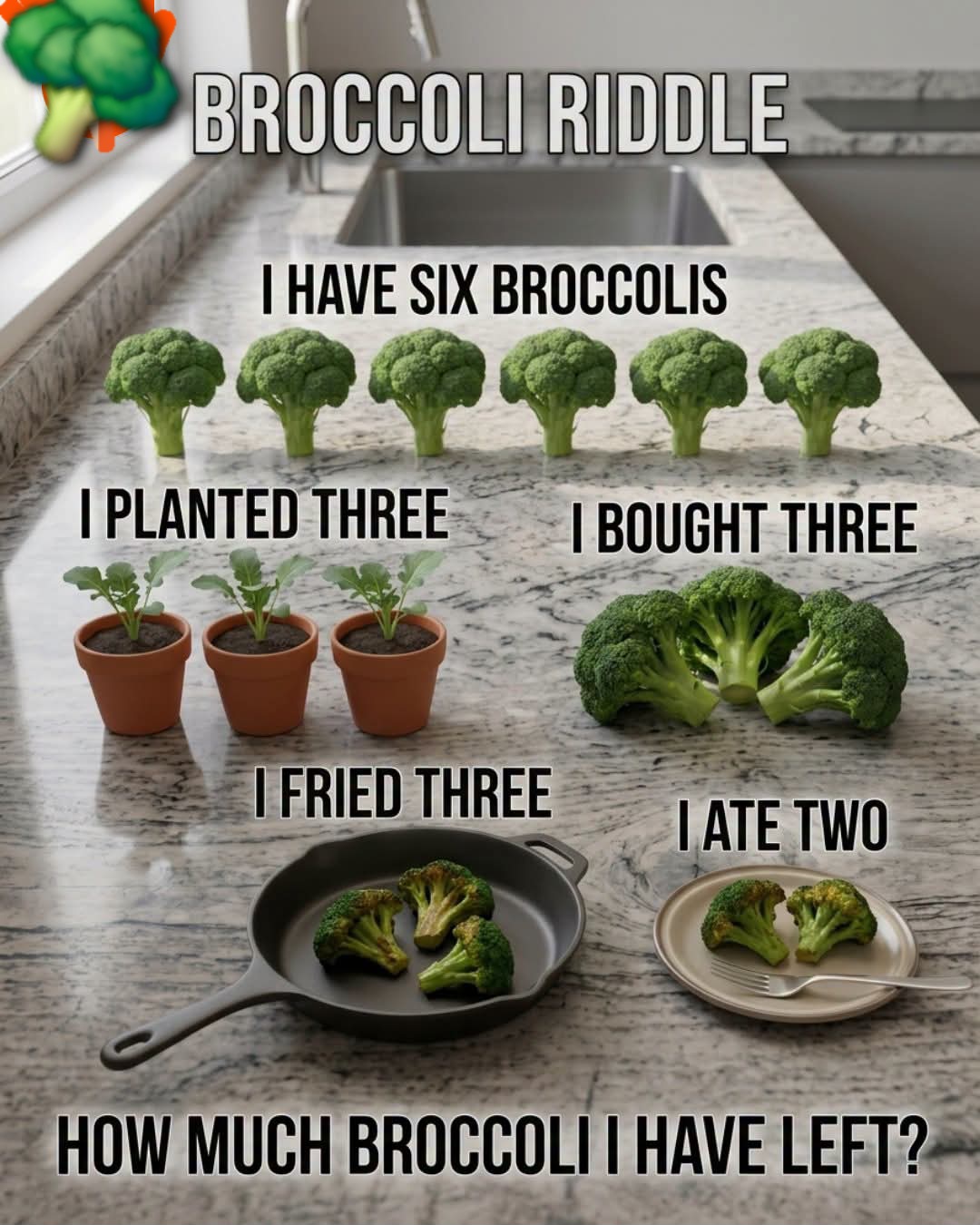
🥦 Can You Solve This Broccoli Riddle? It Isn’t As Obvious As You Think!
At first glance, this looks like one of those simple math puzzles that should take about two seconds to solve.
“I have six broccoli. I planted three. I bought three. I fried three. I ate two. How much broccoli do I have left?”
Easy, right?
Maybe… but there’s a little trick hiding in the wording. 🧐🥦
🥦 Let’s Read the Riddle Carefully
The picture gives us five pieces of information:
- I have six broccoli
- I planted three
- I bought three
- I fried three
- I ate two
- How many do I have left?
The first instinct is to do:
6 − 3 − 2 = 1
And interestingly, that gives the same answer—but the wording is important.
The three broccoli that were fried are not necessarily three additional broccoli being removed from the original six.
They are simply three of the six.
Then, out of those three fried broccoli, two were eaten.
That means one fried broccoli remains.
🥦 The answer is: 1 broccoli!
🤔 Why Is This Puzzle Tricky?
The trick is that “fried three” doesn’t mean “lost three.”
Cooking something doesn’t make it disappear.
If you have six pieces of broccoli and fry three of them, you still have six pieces of broccoli—three cooked and three uncooked.
Then you eat two of the fried pieces.
Now you’re left with:
3 uncooked + 1 fried = 4 pieces.
So wait… is the answer actually 4?
This is where the puzzle becomes more interesting!
🧠 The Correct Way to Think About It
If every statement refers to the same six broccoli, the sequence is:
Start with 6.
You plant 3 → those three are still yours.
You bought 3 → now you have 6 total.
You fried 3 → you still have 6. Cooking doesn’t remove them.
You ate 2 → 6 − 2 = 4.
✅ Therefore, the logical answer is 4 broccoli.
Three are still uncooked, and one is the fried broccoli that you didn’t eat.
🌱 But What About the Three You Planted?
That’s another part of the trick.
The wording says:
“I planted three.”
Planting broccoli doesn’t necessarily mean those three disappeared from your possession in the sense of the riddle. They are still broccoli you have planted and growing.
Likewise, the three you bought are the other three.
So the six can be divided like this:
🌱 3 planted + 🥦 3 bought = 6 total
Then:
🍳 3 fried → still 6 total
Then:
🍽️ 2 eaten → 4 remaining
That’s why simply subtracting every number you see doesn’t work.
🧩 The Lesson Behind the Riddle
This is a great example of why you shouldn’t automatically perform arithmetic just because a puzzle contains numbers.
The important question isn’t:
“Which numbers should I subtract?”
It’s:
“What actually happened to the broccoli?”
Planting doesn’t necessarily remove broccoli from the total.
Buying doesn’t remove broccoli either—it adds to the total.
Frying changes how the broccoli is prepared, but doesn’t make it disappear.
Eating is what actually removes broccoli from the count.
So only the two that were eaten should be subtracted.
6 − 2 = 4
🥦🥦🥦 Three fried?
🥦 One fried and eaten?
🥦🥦🥦 Three still planted/uncooked?
Four remain.
😂 Would You Have Fallen for It?
That’s what makes these little riddles so fun.
They look like basic subtraction problems, but they’re really testing whether you’re paying attention to the meaning of the words.
You might immediately say 1 because you see:
6 − 3 − 2 = 1
But that treats the three fried broccoli as if they were removed from the total.
They weren’t.
They were simply cooked.
And that’s the trick. 🧐
🥦 Final Answer
The answer is 4 broccoli.
You started with six.
Three were fried, but frying didn’t remove them.
Two of those were eaten.
So:
6 − 2 = 4 🥦🥦🥦🥦
Did you get 4, or did the puzzle trick you into answering 1? 😅
Tell us your answer before reading the explanation! 👀🥦 (pender.ces.ncsu.edu)
