🐘 ? Only One Looks Right!
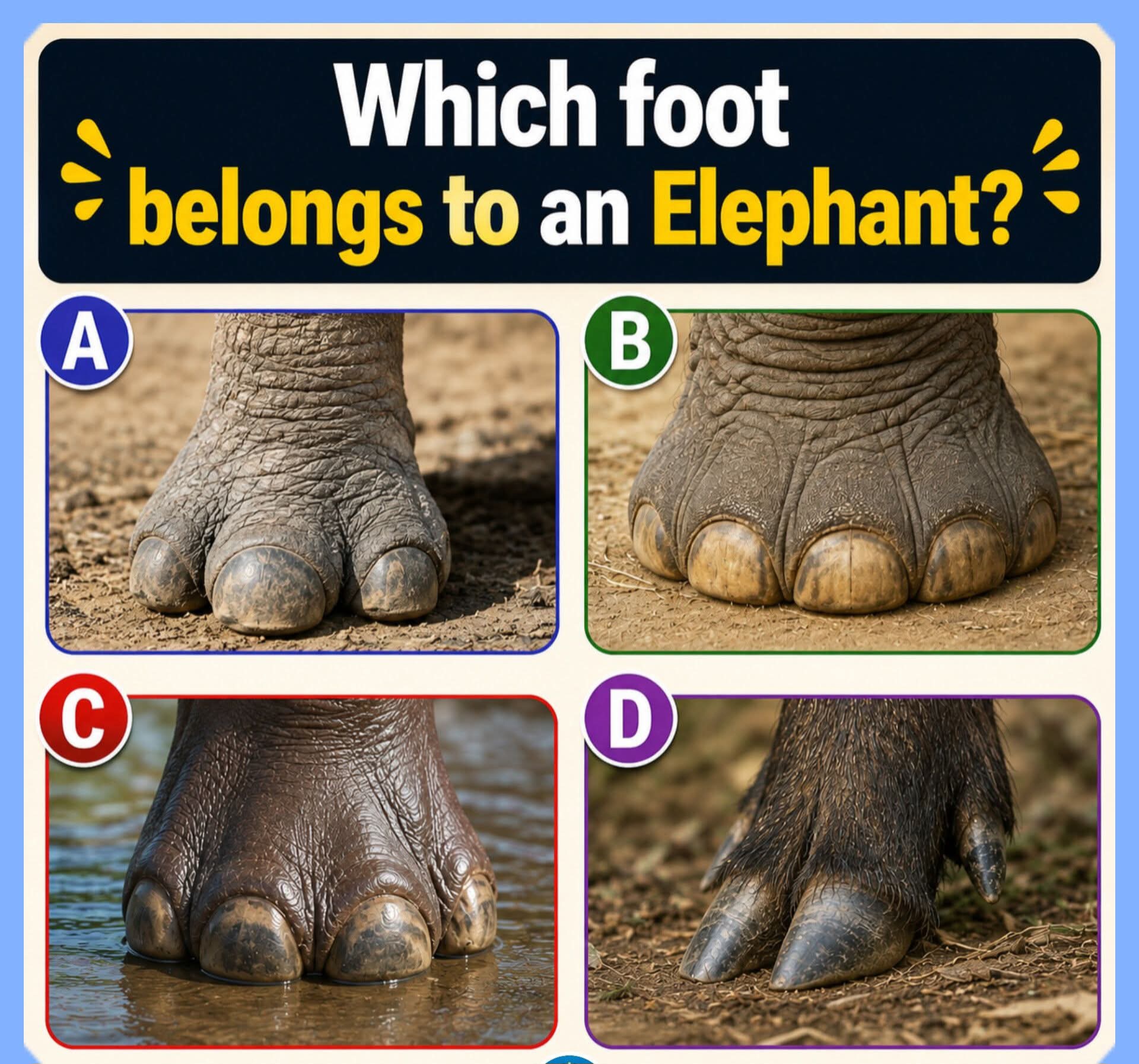
Look closely at the four pictures. Which foot actually belongs to an elephant?
A, B, C, or D?
At first glance, they may all look like unusual animal feet, but there are some important clues hidden in the details. Elephant feet are surprisingly different from the feet of most other mammals, and the toes are much less obvious than you might expect.
👀 Take a Good Look Before You Answer
The puzzle gives you four choices:
A — B — C — D
Don’t rush! Look at the shape of the foot, the toes, the nails, and especially the way the toes appear to be arranged.
🐘 The answer is: B!
B is the best match for an elephant’s foot.
The broad, rounded shape and the short, rounded toenails are important clues. Elephant toes are tucked inside a thick, flexible covering of tissue, so they don’t look like the clearly separated toes you see on many other animals.
Elephants actually have five skeletal digits in each foot, even though the number of visible toenails can vary between species and individual animals. (PubMed Central (PMC))
What Makes an Elephant’s Foot So Special?
An elephant’s foot is an incredible piece of natural engineering.
Underneath the visible sole is a thick digital cushion made from fibrous connective tissue and fatty tissue. This cushion helps distribute the elephant’s enormous weight and absorb mechanical forces every time the animal takes a step. (PubMed Central (PMC))
Instead of having five obvious toes sticking out like human fingers, an elephant’s toes are closely bound together and enclosed within the foot. This is why an elephant’s foot can look almost like one large rounded pad.
🦶 Five toes—but not always five nails
Here’s one of the most interesting facts about the puzzle.
The number of visible toenails doesn’t necessarily tell you how many toes an elephant has.
Both African and Asian elephants have five skeletal digits in each foot, but the number of visible toenails varies. For example, Asian elephants commonly have five toenails on their front feet and four on their hind feet, while African elephants generally have fewer visible nails on some feet. Individual variation also occurs. (Elephant Medicine)
So if you were trying to identify an elephant simply by counting the nails, the puzzle could easily trick you!
Why Do Elephant Feet Look So Round?
An elephant’s enormous body requires an exceptionally strong weight-bearing system.
The foot contains a large cushion beneath the bones. It is made up of compartments containing fatty tissue surrounded by collagen and other connective tissues. This structure helps spread forces across the foot rather than concentrating them in one small area. (PubMed Central (PMC))
Scientists studying elephant locomotion have found that the foot cushion plays an important role in reducing and distributing pressure as elephants walk. (PubMed)
It’s essentially a natural shock-absorbing system built into the foot.
🐘 Do Elephants Really Walk on Their Toes?
Yes—but not quite in the way you might imagine.
Elephant feet have a distinctive skeletal arrangement in which the toes are angled downward, while the large cushion beneath them helps support the animal. This gives the elephant a somewhat tiptoe-like stance despite the enormous size of its feet. (Elephant Aid International)
That unusual construction allows an elephant to carry its tremendous body weight while maintaining a relatively efficient walking motion.
What About Those “Sixth Toes”?
Here’s another amazing elephant-foot fact.
Elephants have specialized cartilaginous structures called the prepollex in the front foot and the prehallux in the hind foot. They’re sometimes informally described as “sixth toes” or predigits.
They don’t function like an ordinary visible toe, but they help support and stabilize the foot cushion. (PubMed Central (PMC))
So the anatomy of an elephant’s foot is even more complicated than what you can see from the outside!
👣 Why Elephant Foot Care Matters
Because elephant feet carry so much weight, keeping them healthy is extremely important, particularly for elephants under human care.
The foot contains sensitive tissues, bones, nails, connective tissue and the large cushioning structure. Problems affecting the sole, nails or surrounding tissue can interfere with normal movement and become serious if left untreated. (Elephant Medicine)
Veterinary teams can use techniques such as radiographs and other imaging methods to examine the internal structures of an elephant’s foot. (Disney Parks Blog)
🧠 Did You Guess B?
This puzzle is harder than it looks because an elephant’s foot doesn’t necessarily resemble what most people picture when they hear the word “foot.”
There aren’t five obvious toes lined up like a human hand. Instead, the digits are enclosed within a thick foot structure, with only some of the nails visible from the outside.
So, if you picked B, you got it! 🐘👏
🐾 Final Answer: B
Did you get it on your first try, or did one of the other choices fool you?
Tell us your answer before looking at the reveal: A, B, C, or D? 👀🐘
