🍊🍋 Can It Really Keep Flies and Mosquitoes Away?
There’s something wonderfully satisfying about turning simple kitchen ingredients into a homemade project.
A few pieces of citrus, some cloves, and a small candle can create a beautiful centerpiece that smells fresh and cozy. The viral version pictured here goes a step further, claiming that the citrus-and-clove setup can leave your home smelling wonderful “without flies, without mosquitoes, and spending almost nothing.”
But is it really an insect-repelling solution, or is it mostly a clever-smelling DIY?
The answer is a little more complicated—and that’s what makes this hack interesting. 🍊🍋
🍊 What Is the Citrus Candle Trick?
The idea is simple.
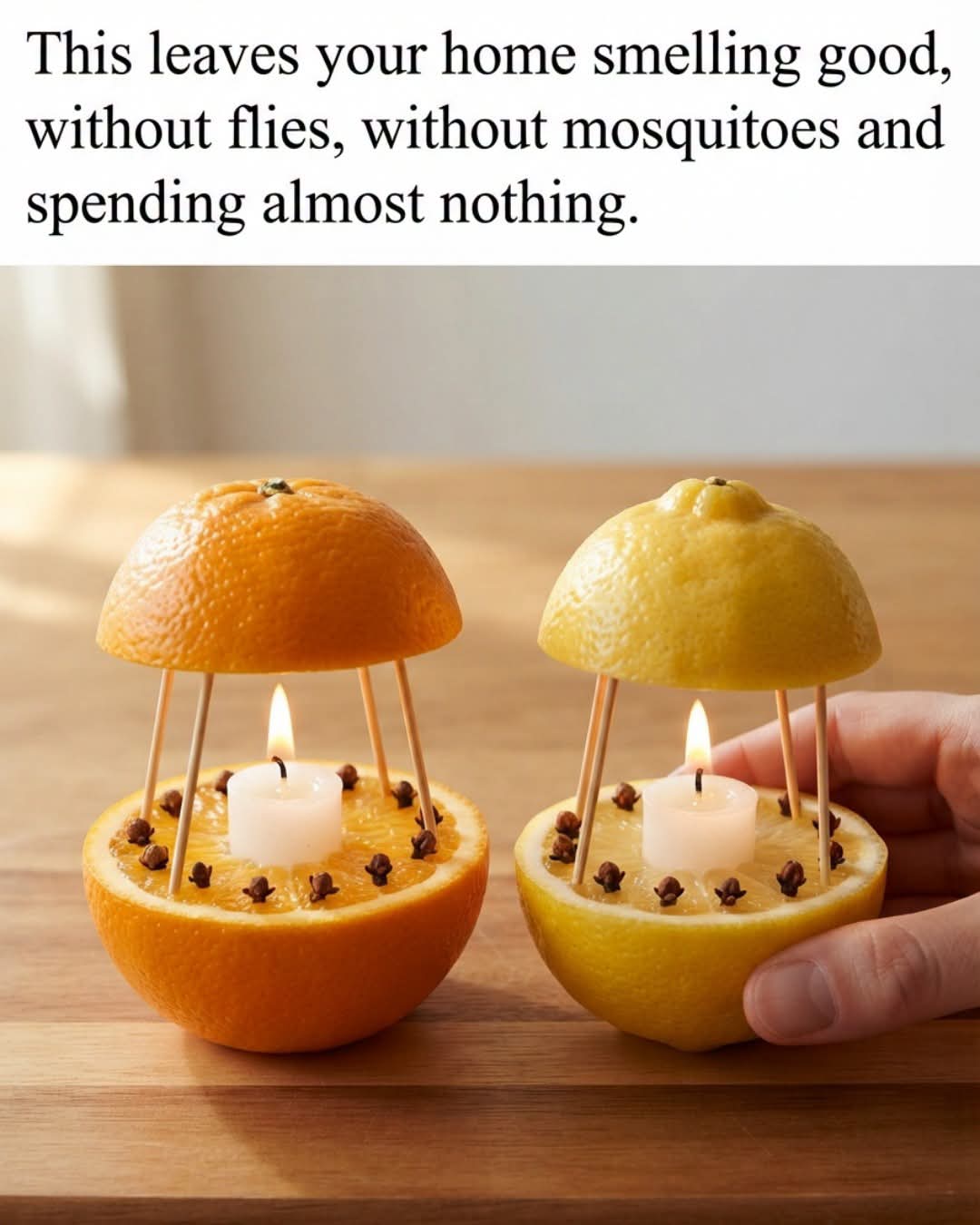
You cut an orange or lemon in half, hollow out or use the fruit as a little base, place a small candle inside, and surround it with cloves.
The upper half of the citrus can be elevated above the candle using small supports, creating the adorable little citrus “lantern” shown in the picture.
As the candle warms the fruit and cloves, their aromas fill the surrounding area.
It looks beautiful, smells fresh, and costs very little to make.
But there’s an important distinction:
A pleasant-smelling DIY isn’t automatically a proven insect repellent.
🌿 Why Orange, Lemon and Cloves?
Each ingredient brings something different to the project.
🍊 Orange
Orange peel contains aromatic compounds that give it its characteristic citrus scent.
When warmed, the fragrance can become more noticeable.
🍋 Lemon
Lemon peel has an especially bright, fresh aroma, which is one reason lemon is so popular in homemade cleaning and fragrance projects.
🌰 Cloves
Cloves contain aromatic compounds, including eugenol, that give them their distinctive spicy smell.
Cloves have also been studied in the context of insect repellency, but that doesn’t mean that simply sticking whole cloves into an orange provides the same level of protection as a tested insect-repellent product.
That’s an important difference.
🦟 Does It Actually Repel Mosquitoes?
This is where we should be careful about the viral claim.
Don’t rely on a citrus-and-clove candle as your primary mosquito protection.
The CDC recommends proven measures such as EPA-registered insect repellents, screens, protective clothing, and eliminating standing water around the home. (CDC)
The EPA also notes that certain spatial repellents—including candles and other devices—can be used outdoors when they’re specifically registered and labeled for that purpose. (US EPA)
A homemade orange-and-clove candle doesn’t have that same testing and registration behind it.
So while the aroma may be unpleasant to some insects, it’s not something you should count on to prevent mosquito bites.
🪰 What About Flies?
The same caution applies to flies.
A strong citrus or clove aroma may make an area smell less attractive to some insects, but that doesn’t mean the setup will create a reliable “fly-free zone.”
If you’re dealing with lots of flies indoors, it’s much more effective to address the source:
- Keep food covered.
- Clean spills quickly.
- Empty garbage regularly.
- Keep trash containers closed.
- Clean around pet food.
- Repair damaged window screens.
- Keep doors closed when possible.
A good-smelling room is wonderful.
A genuinely fly-free home requires dealing with why the flies are there in the first place.
💧 The Mosquito Step People Often Forget
If mosquitoes are the problem, fragrance isn’t the first place I’d start.
Look for standing water.
Mosquitoes need water to complete their life cycle, and the CDC recommends regularly emptying, scrubbing, turning over, covering, or removing items that collect water. (CDC)
Check places such as:
- Flowerpot saucers
- Buckets
- Children’s toys
- Birdbaths
- Rain barrels
- Outdoor containers
- Pool covers
- Tires
- Gutters and other areas where water collects
Even a surprisingly small amount of stagnant water can become a mosquito breeding site.
🕯️ How to Make the Citrus Candle
If you’re making this project primarily as a decorative, fragrant centerpiece, here’s a simple version.
Ingredients
- 1 orange
- 1 lemon
- Whole cloves
- 2 small tea lights
- Small skewers or sturdy wooden sticks for supports
Instructions
1. Wash the fruit.
Rinse and dry the orange and lemon.
2. Cut each fruit in half.
Choose halves that sit reasonably flat.
3. Prepare the citrus base.
The bottom half can serve as the base for the candle. Depending on the size of the fruit and candle, you may need to remove a small amount of pulp to create a stable place for the tea light.
4. Add cloves.
Push whole cloves into the citrus peel around the candle.
You can create a simple ring or make a decorative pattern.
5. Create the little “roof.”
Use short supports to elevate the other citrus half above the candle.
Make sure the upper piece is stable and cannot fall onto the flame.
6. Place on a heat-resistant surface.
Keep the arrangement away from curtains, paper, towels, cabinets, children, pets, and anything else that can catch fire.
7. Light the candle.
Never leave a burning candle unattended.
⚠️ Important: This Is Still an Open Flame
This is probably the most important part of the entire DIY.
Don’t let the cute appearance fool you into treating it casually.
You’re putting a flame inside or directly beneath dried plant material and wooden supports.
That means there’s a genuine fire risk.
Never leave it burning while you sleep or leave the room.
Keep it away from anything flammable.
And if the fruit becomes excessively hot, starts drying out, smoking, scorching, or shifting position, extinguish the candle immediately.
If you’re uncomfortable with an open flame, use a small LED tea light instead.
You won’t get the same warming effect, but you’ll still have the decorative citrus centerpiece without the flame.
🌸 Make It a Beautiful Table Centerpiece
Even if you completely ignore the insect-repelling claim, this DIY has another big advantage:
It looks gorgeous.
Imagine several citrus halves arranged on a wooden tray with:
- Fresh rosemary
- Cinnamon sticks
- Whole cloves
- Lemon slices
- Orange slices
- Small LED candles
- A few sprigs of fresh herbs
It can become an inexpensive centerpiece for a summer dinner, backyard gathering, brunch, or even a cozy evening at home.
🧡 A Better Way to Think About This Hack
Instead of saying:
“This will keep every mosquito and fly away.”
A more realistic description would be:
“This is an inexpensive citrus-and-clove fragrance project that may make the area less appealing to some insects, but it shouldn’t replace proven mosquito and fly-control methods.”
That’s still pretty good!
You get a fresh citrus scent, a beautiful decoration, and a fun little DIY project.
Just don’t depend on it for protection from mosquito bites.
🦟 What Actually Works Better for Mosquitoes?
If mosquitoes are bothering you, combine several strategies.
1. Eliminate Standing Water
This is one of the most important steps.
Empty water-holding containers regularly. (CDC)
2. Use Screens
Repair holes in window and door screens and keep doors closed when possible. (CDC)
3. Use a Proven Repellent
For personal protection, the CDC recommends EPA-registered repellents containing active ingredients such as DEET, picaridin, IR3535, OLE/PMD, or 2-undecanone, depending on the product and intended use. (CDC)
4. Dress for Protection
When mosquitoes are particularly bad, long sleeves and long pants provide another physical barrier. (CDC)
5. Use Appropriate Outdoor Products
If you want a candle, lantern, diffuser, or other spatial repellent specifically for mosquitoes, look for a product that’s registered and labeled for that purpose rather than assuming a homemade candle will provide equivalent protection. (US EPA)
🍊 So, Is the Viral Citrus Candle Worth Trying?
As a DIY fragrance project? Absolutely!
It’s inexpensive, attractive, easy to customize, and makes use of fruit peels that might otherwise end up in the trash.
As a guaranteed mosquito and fly repellent? No.
There’s a big difference between something that smells strongly of citrus and cloves and a product that’s been tested for its ability to repel mosquitoes.
And when mosquitoes are capable of transmitting diseases, that’s a distinction worth taking seriously. (CDC)
❤️ Final Thoughts
I actually love the idea behind this DIY—but I’d change the promise.
Don’t make it:
“A homemade candle that guarantees no flies or mosquitoes.”
Make it:
“A beautiful citrus-and-clove candle that makes your home smell amazing—and may help make the area less appealing to some insects.”
That’s still a pretty great little kitchen-to-home hack. 🍊🍋🌿
And if mosquitoes are your real problem, pair the pretty centerpiece with the things that actually make a difference: remove standing water, repair screens, and use a proven repellent when needed. (CDC)
🗣️ What do you think?
Would you try this citrus-and-clove DIY?
🍊 Orange
🍋 Lemon
🌿 Both
🕯️ Only with an LED candle
😂 I don’t trust anything that involves putting a candle inside fruit!
