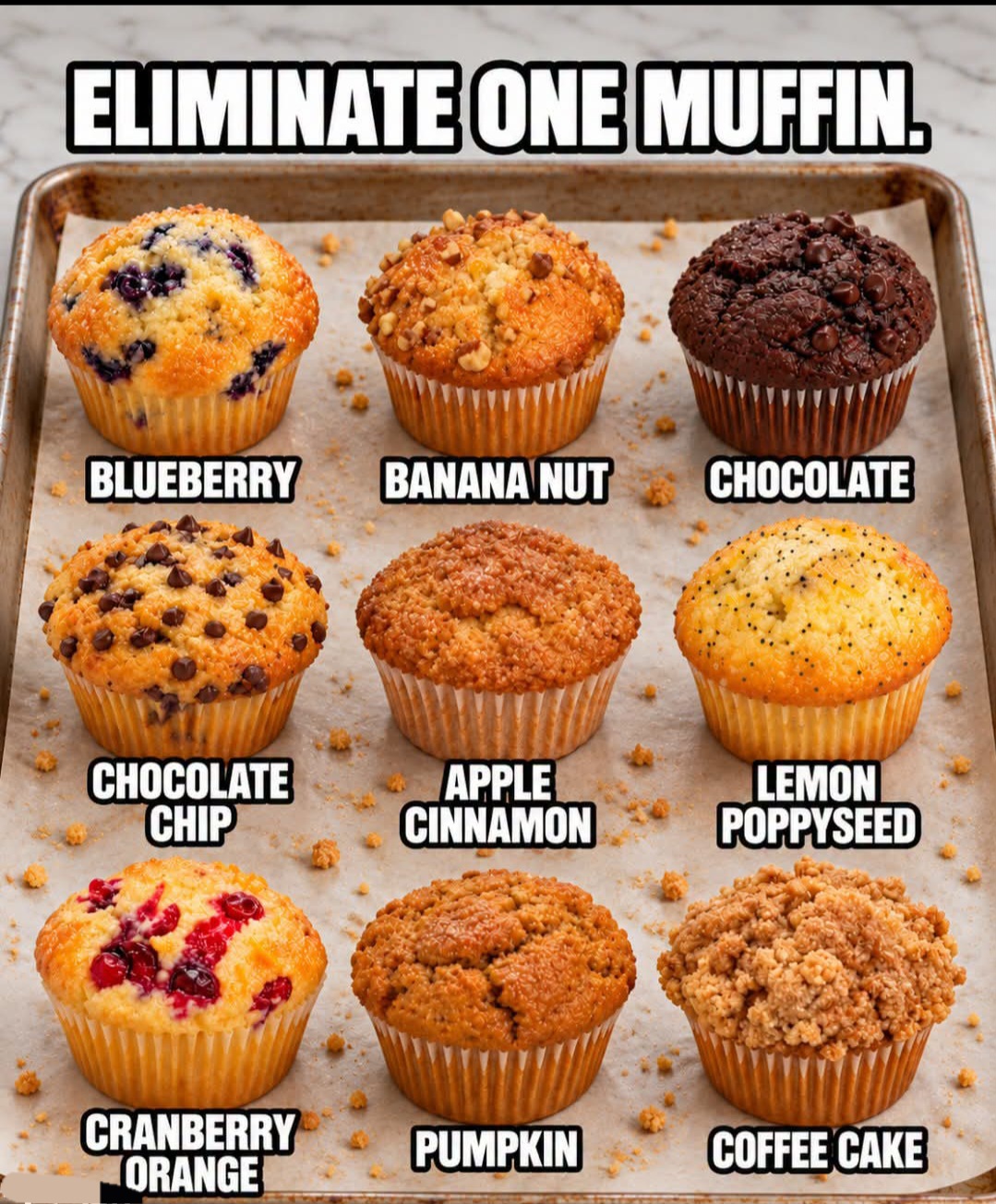
The image presents a delicious dilemma: if you had to eliminate one muffin flavor forever, which one would you choose? Nine popular muffins are arranged on a baking tray, each offering a different combination of sweetness, texture, and flavor. From fruity blueberry muffins to rich chocolate treats and warmly spiced pumpkin muffins, every option has its own appeal.
This kind of food challenge is a fun way to explore personal taste, compare classic bakery favorites, and spark debates among friends, family, and food lovers.
Let’s take a closer look at all nine muffins, what makes each one special, and which might be the easiest to eliminate.
1. Blueberry Muffin
The blueberry muffin is a timeless bakery classic. It features a soft, tender crumb filled with juicy blueberries that provide little bursts of sweetness and a mildly tangy flavor.
What makes it special?
- Flavor: Sweet, fruity, and slightly tangy.
- Texture: Moist and fluffy, with occasional juicy berries.
- Appearance: Golden on top, often with visible purple-blue berries.
- Best pairing: Coffee, tea, or a glass of milk.
Blueberry muffins are popular because they balance sweetness with the natural freshness of fruit. Some recipes also feature a crunchy sugar topping or a hint of lemon zest.
Why keep it? It’s a versatile breakfast option that works just as well as an afternoon snack or a simple dessert.
Potential drawback: People who dislike fruit in baked goods may prefer a more chocolatey or cake-like muffin.
2. Banana Nut Muffin
The banana nut muffin combines the natural sweetness of ripe bananas with the rich, earthy flavor of nuts. It is often made with walnuts or pecans, which add a satisfying crunch to the soft muffin.
What makes it special?
- Flavor: Sweet banana with a warm, nutty finish.
- Texture: Moist and tender inside, with crunchy nuts.
- Appearance: Golden-brown with chopped nuts on top.
- Best pairing: Black coffee, cappuccino, or warm milk.
Ripe bananas help keep the muffin moist while adding flavor without requiring as much additional sweetness. Cinnamon and vanilla are common ingredients that complement the banana.
Why keep it? Banana nut muffins are filling, comforting, and ideal for breakfast. They also offer a wonderful combination of soft fruit and crunchy nuts.
Potential drawback: People with nut allergies cannot safely enjoy a conventional version, and those who dislike the texture of nuts may find it less appealing.
Verdict: A strong contender for anyone who enjoys a hearty, naturally sweet muffin.
3. Chocolate Muffin
For chocolate lovers, the chocolate muffin is one of the most tempting options on the tray. Its dark appearance comes from cocoa powder and sometimes melted chocolate, creating a rich, dessert-like treat.
What makes it special?
- Flavor: Deep, rich chocolate with a sweet finish.
- Texture: Soft, moist, and sometimes slightly fudgy.
- Appearance: Dark brown with chocolate chips or chocolate shavings.
- Best pairing: Coffee, cold milk, or vanilla ice cream.
Chocolate muffins can range from lightly sweetened cocoa muffins to intensely rich varieties resembling chocolate cake.
Unlike a plain vanilla muffin, a chocolate muffin delivers a strong flavor in every bite. Some recipes include chocolate chips to create melted pockets of chocolate throughout the crumb.
Why keep it? It satisfies chocolate cravings and can double as a dessert.
Potential drawback: It may feel too rich or sweet for someone who prefers lighter breakfast foods.
Verdict: An excellent choice for chocolate enthusiasts, although people who prefer fruity flavors might eliminate it.
4. Chocolate Chip Muffin
Chocolate chip muffins combine a light, sweet muffin base with scattered chocolate chips. They offer the familiar comfort of chocolate chip cookies in a softer, cake-like form.
What makes it special?
- Flavor: Sweet vanilla or buttery cake with chocolate throughout.
- Texture: Fluffy, tender, and dotted with soft chocolate chips.
- Appearance: Golden muffin tops covered with chocolate pieces.
- Best pairing: Milk, coffee, or hot chocolate.
The chocolate chips provide bursts of sweetness without overwhelming the entire muffin. This makes the flavor more balanced than some double-chocolate varieties.
Chocolate chip muffins are also popular with children because they combine a familiar baked-good texture with a favorite ingredient.
Industry research has identified chocolate chip as one of the commonly enjoyed muffin varieties, alongside blueberry and banana. However, individual preferences differ considerably. Source: Prepared Foods
Why keep it? It is familiar, versatile, and appealing to people who enjoy chocolate without wanting an intensely chocolate-flavored cake.
Potential drawback: It may seem ordinary compared with distinctive flavors such as cranberry orange or lemon poppyseed.
Verdict: A reliable favorite that would be difficult for many chocolate lovers to eliminate.
5. Apple Cinnamon Muffin
The apple cinnamon muffin delivers the comforting flavors of baked apples and warm spices. It is particularly appealing during autumn and winter, although it can be enjoyed throughout the year.
What makes it special?
- Flavor: Sweet apples combined with aromatic cinnamon.
- Texture: Soft and moist, often with small pieces of apple.
- Appearance: Golden-brown, sometimes finished with cinnamon sugar or a crumb topping.
- Best pairing: Hot tea, coffee, or warm apple cider.
Apple and cinnamon complement each other beautifully. The apples contribute moisture and fruity sweetness, while cinnamon adds warmth and depth.
Some recipes resemble miniature apple pies, featuring diced apples and a buttery streusel topping. Others are simpler, with cinnamon mixed directly into the batter.
Why keep it? It provides a comforting alternative to chocolate-heavy muffins and works particularly well as a breakfast treat.
Potential drawback: It may taste less exciting to people who prefer intense chocolate flavors or sharp citrus notes.
Verdict: One of the best options for anyone who enjoys traditional homemade baking.
6. Lemon Poppyseed Muffin
The lemon poppyseed muffin stands out because of its bright citrus flavor and delicate crunch.
Unlike chocolate muffins, which emphasize richness, lemon poppyseed muffins focus on freshness, fragrance, and a balance between sweetness and acidity.
What makes it special?
- Flavor: Sweet lemon with a refreshing citrus tang.
- Texture: Soft and tender, with tiny crunchy poppy seeds.
- Appearance: Pale golden-yellow with small black seeds.
- Best pairing: Green tea, Earl Grey tea, or black coffee.
Lemon zest provides much of the distinctive aroma, while lemon juice adds acidity. Poppy seeds contribute a subtle nutty character and a delicate crunch.
Some recipes include a lemon glaze that intensifies the citrus flavor and creates a sweeter finish.
Why keep it? It offers something different from the richer, heavier muffins on the tray. Its bright flavor can be particularly enjoyable in the morning or during warmer weather.
Potential drawback: People who dislike citrus desserts or the texture of poppy seeds may not enjoy it.
Verdict: A refreshing option that deserves a place among the nine, especially for fans of lemon desserts.
7. Cranberry Orange Muffin
The cranberry orange muffin combines tart cranberries with the fragrant sweetness of orange.
This pairing creates a more complex flavor than a conventional fruit muffin. Cranberries provide sharp, tangy notes, while orange zest and juice add citrus sweetness.
What makes it special?
- Flavor: Tangy cranberry balanced by sweet, fragrant orange.
- Texture: Soft muffin crumb with juicy or chewy pieces of cranberry.
- Appearance: Golden-orange muffin tops with bright red cranberry accents.
- Best pairing: Black tea, coffee, or freshly squeezed orange juice.
Fresh cranberries tend to be particularly tart, while dried cranberries produce a sweeter, chewier result.
Orange zest is an important ingredient because it contributes an aromatic citrus flavor that complements the cranberries without requiring excessive sweetness.
This combination is especially popular in autumn and winter baking, when cranberries frequently appear in seasonal recipes.
Why keep it? It offers a distinctive sweet-and-tart flavor that is difficult to reproduce with chocolate, banana, or cinnamon alone.
Potential drawback: People who prefer very sweet desserts may find the cranberry flavor too sharp.
Verdict: A great choice for people who appreciate fruit-forward baked goods with a little acidity.
8. Pumpkin Muffin
The pumpkin muffin is another seasonal favorite, especially during autumn.
It typically combines pumpkin purée with warming spices such as cinnamon, nutmeg, ginger, and cloves. The result is a moist, aromatic muffin with a comforting flavor.
What makes it special?
- Flavor: Mild pumpkin with warm, sweet spices.
- Texture: Moist, tender, and sometimes slightly dense.
- Appearance: Golden-orange or brown, often with a cracked muffin top.
- Best pairing: Coffee, chai tea, or a pumpkin-spice latte.
Pumpkin purée adds moisture and a subtle earthy sweetness. The spices create much of the familiar flavor associated with pumpkin baked goods.
Some recipes include chocolate chips, cream cheese filling, or a crunchy streusel topping.
Pumpkin muffins can also be adapted to different preferences. For example, using whole-wheat flour or reducing the sugar can change their nutritional profile, although the final result depends on the complete recipe.
Why keep it? It offers a distinctive seasonal taste and a soft texture that makes it particularly satisfying.
Potential drawback: People who dislike pumpkin or warming spices may find it less appealing than simpler flavors.
Verdict: A comforting muffin that is especially difficult to replace during pumpkin season.
9. Coffee Cake Muffin
The coffee cake muffin is the final contender and arguably one of the most indulgent-looking options in the image.
Despite its name, a traditional coffee cake muffin does not necessarily contain coffee. The name refers to its association with coffee breaks and its resemblance to the crumb-topped cakes often served alongside coffee.
What makes it special?
- Flavor: Buttery sweetness, brown sugar, and cinnamon.
- Texture: Soft muffin interior with a crunchy, crumbly topping.
- Appearance: A golden muffin covered in a generous streusel layer.
- Best pairing: Freshly brewed coffee, cappuccino, or black tea.
The defining feature is the crumb topping, typically made from flour, butter, sugar, and sometimes cinnamon.
As the muffin bakes, the topping develops a crumbly texture that contrasts with the soft interior. Some recipes include a cinnamon-sugar swirl through the middle for an extra layer of flavor.
Why keep it? It delivers the satisfying combination of cake and crunchy topping in a convenient individual portion.
Potential drawback: The streusel can make it sweeter and richer than a simple fruit muffin.
Verdict: An excellent choice for anyone who enjoys buttery cakes and cinnamon-sugar desserts.
Comparing All Nine Muffins
Here’s a quick comparison of the nine varieties shown in the image.
| Muffin flavor | Main attraction | Best suited for |
|---|---|---|
| Blueberry | Juicy fruit and a soft crumb | Fruit lovers |
| Banana Nut | Sweet banana and crunchy nuts | Hearty breakfast fans |
| Chocolate | Rich cocoa flavor | Chocolate enthusiasts |
| Chocolate Chip | Sweet muffin with chocolate pieces | Classic dessert lovers |
| Apple Cinnamon | Fruity sweetness and warm spice | Fans of traditional baking |
| Lemon Poppyseed | Bright citrus and delicate crunch | People who prefer refreshing flavors |
| Cranberry Orange | Tangy fruit and fragrant citrus | Fans of sweet-and-sour combinations |
| Pumpkin | Moist texture and warming spices | Autumn baking enthusiasts |
| Coffee Cake | Buttery crumb and cinnamon-sugar topping | Lovers of rich, crumb-topped cakes |
These descriptions reflect typical versions of each flavor. Actual sweetness, texture, and nutritional content depend on the recipe and serving size.
Which Muffin Should Be Eliminated?
Now comes the real question.
If you had to remove one muffin from the tray permanently, there are several ways to approach the decision.
Option 1: Eliminate the chocolate muffin
The chocolate muffin is a reasonable choice if you want to keep the chocolate chip muffin.
Both varieties offer chocolate flavor, but chocolate chip muffins generally provide a contrast between a lighter cake-like base and individual pieces of chocolate.
A traditional chocolate muffin, by comparison, relies more heavily on cocoa for its overall flavor.
The argument: Keep chocolate chip for variety and eliminate chocolate because the two overlap.
However, this reasoning may not convince someone who loves the intense flavor of double chocolate.
Option 2: Eliminate the pumpkin muffin
Pumpkin muffins are wonderful for people who enjoy autumn spices, but they can be polarizing.
Some people love the combination of pumpkin, cinnamon, and nutmeg. Others find the flavor less appealing than chocolate, berries, or citrus.
The argument: Pumpkin is more seasonal, while the other flavors may feel more appropriate throughout the year.
Still, pumpkin enthusiasts would strongly disagree.
Option 3: Eliminate the banana nut muffin
Banana nut muffins offer a delicious combination of fruit and nuts, but their flavor is relatively specific.
People who dislike bananas in baked goods or prefer smooth textures without nuts may not choose this variety.
The argument: The blueberry and apple cinnamon muffins already provide fruity alternatives, while the remaining options offer greater flavor contrast.
Nevertheless, banana nut remains a classic bakery favorite.
Option 4: Eliminate the coffee cake muffin
The coffee cake muffin is rich, sweet, and covered with a crumb topping.
Its main appeal comes from the combination of cake and streusel rather than a distinctive fruit or chocolate flavor.
The argument: If you prefer muffins with a clear primary flavor, coffee cake may be less exciting than cranberry orange, lemon poppyseed, or chocolate.
On the other hand, its crunchy topping gives it a texture that none of the other options fully replicates.
Option 5: Eliminate the cranberry orange muffin
Cranberry orange is one of the more distinctive flavor combinations in the group, but its tartness may not appeal to everyone.
The argument: Blueberry muffins offer a familiar fruity alternative, while chocolate and cinnamon flavors appeal to people who prefer sweeter baked goods.
However, cranberry orange brings a bright, tangy character that would be missing if it disappeared.
My Choice: Eliminate the Chocolate Muffin
If I had to eliminate one muffin from this particular selection, I would eliminate the chocolate muffin while keeping the chocolate chip muffin.
Here’s why:
- Flavor overlap: Both offer a chocolate-centered experience.
- Variety: Keeping chocolate chip preserves the chocolate option while retaining a different texture and flavor balance.
- Versatility: The remaining muffins cover fruit, nuts, citrus, warm spices, and crumb toppings.
- Balance: Removing one chocolate-heavy option leaves a wider range of distinct flavors.
This is a subjective choice, not an objective ranking. Someone who loves rich cocoa desserts might reasonably eliminate a completely different muffin.
What Popularity Tells Us About the Choices
Although the challenge is ultimately about personal preference, consumer research offers some interesting context.
A survey of muffin consumers published by Prepared Foods reported that blueberry was consumed by 66% of respondents, chocolate chip by 53%, banana by 48%, chocolate by 44%, and coffee crumb by 42%. These figures come from a particular study and should not be interpreted as a current, universal ranking of muffin preferences. Source: Prepared Foods
Blueberry and chocolate chip also appear frequently in collections of popular homemade muffin recipes, alongside varieties such as apple and lemon poppyseed. Source: The Kitchn
This suggests that familiar flavors have broad appeal, but popularity does not necessarily determine which muffin an individual enjoys most.
A person who loves tart fruit may prefer cranberry orange over chocolate chip. Someone who values texture may choose coffee cake for its crunchy topping. Another person may consider banana nut indispensable because of its hearty flavor.
The best choice depends on what you value most: sweetness, richness, freshness, texture, or variety.
Bonus: How to Make the Perfect Muffin at Home
If this image has inspired you to bake, the good news is that most of these muffins share a similar basic method.
You can start with a simple muffin batter and adjust the ingredients to create different flavors.
Basic ingredients
For approximately 12 standard muffins, you will generally need:
- 2 cups (250 g) all-purpose flour
- ¾ cup (150 g) granulated sugar
- 2 teaspoons baking powder
- ¼ teaspoon baking soda
- ¼ teaspoon salt
- 2 large eggs
- ½ cup (120 ml) milk
- ½ cup (120 ml) neutral oil or melted butter
- 1 teaspoon vanilla extract
The precise quantities and any additional ingredients will depend on the chosen recipe.
Basic preparation method
- Preheat the oven. Set it to 375°F (190°C).
- Combine the dry ingredients. Mix the flour, sugar, baking powder, baking soda, and salt in a large bowl.
- Mix the wet ingredients. Whisk together the eggs, milk, oil or melted butter, and vanilla.
- Combine the mixtures. Add the wet ingredients to the dry ingredients and stir gently until just combined. Avoid overmixing.
- Add your chosen flavor. Fold in blueberries, chocolate chips, chopped nuts, or another suitable ingredient.
- Fill the muffin cups. Divide the batter among 12 lined or lightly greased muffin wells.
- Bake until done. Begin checking after approximately 18–22 minutes. Baking time varies with the recipe, oven, and muffin size.
- Check for doneness. A toothpick inserted into the center should come out clean or with a few moist crumbs, depending on the ingredients.
- Cool before serving. Let the muffins rest in the pan briefly before transferring them to a cooling rack.
How to adapt the batter for each flavor
- Blueberry: Fold in fresh or frozen blueberries.
- Banana nut: Add mashed ripe banana and chopped walnuts, adjusting the wet ingredients as needed.
- Chocolate: Replace some of the flour with unsweetened cocoa powder and adjust the liquid and sugar to suit the recipe.
- Chocolate chip: Fold chocolate chips into the batter.
- Apple cinnamon: Add finely diced apple and ground cinnamon.
- Lemon poppyseed: Add lemon zest, a suitable amount of lemon juice, and poppy seeds.
- Cranberry orange: Add cranberries and orange zest.
- Pumpkin: Incorporate pumpkin purée and warming spices, adjusting the liquid and dry ingredients.
- Coffee cake: Add a cinnamon-sugar swirl or a buttery streusel topping.
For reliable results, it is best to follow a tested recipe for each variation rather than adding large quantities of fruit or purée to the same base without adjusting the other ingredients.
You can find additional tested muffin recipes in Serious Eats’ muffin recipe collection.
Final Verdict: One Muffin Has to Go!
The image gives us nine tempting choices:
- Blueberry
- Banana Nut
- Chocolate
- Chocolate Chip
- Apple Cinnamon
- Lemon Poppyseed
- Cranberry Orange
- Pumpkin
- Coffee Cake
Every muffin has a reason to stay. Some provide fruity freshness, others offer rich chocolate, and the rest bring comforting spices or satisfying textures.
My choice would be chocolate, because chocolate chip provides a similar flavor while leaving room for more variety across the remaining eight muffins.
But there’s no universally correct answer. If you’re playing this challenge with friends, the fun lies in discovering which flavors people value most and hearing the arguments behind their choices.
Now it’s your turn!
Which ONE muffin would you eliminate forever?
🫐 Blueberry 🍌 Banana Nut 🍫 Chocolate 🍪 Chocolate Chip 🍎 Apple Cinnamon 🍋 Lemon Poppyseed 🍊 Cranberry Orange 🎃 Pumpkin ☕ Coffee Cake
Choose carefully—you can keep eight, but one has to go!
