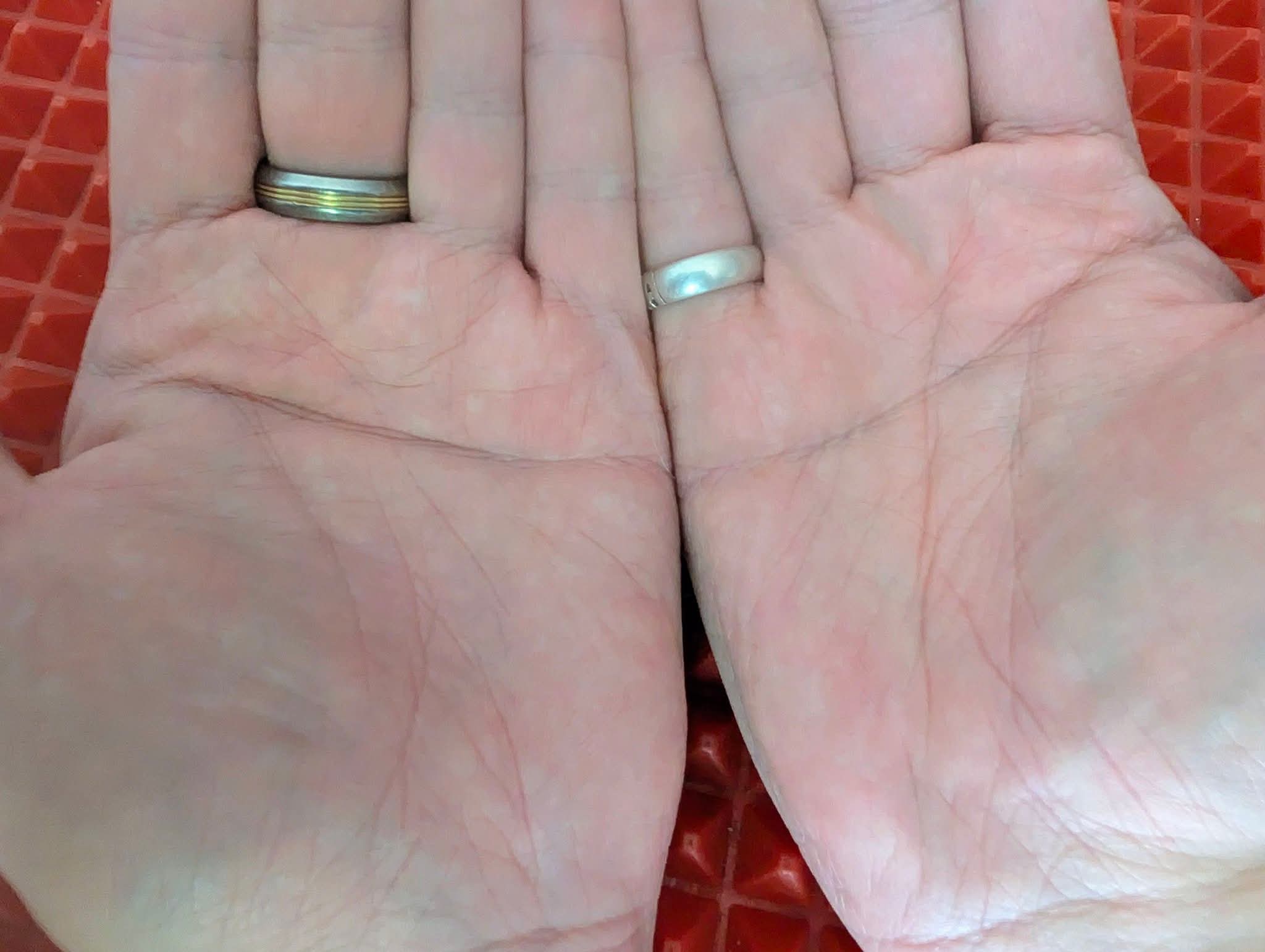
✋ Hand Check: Do Your Palms Look Like This? Understanding the Single Transverse Palmar Crease
Take a look at the palm of your hand.
Most people have two main creases running across each palm. But for a small number of people, those lines are replaced by one single line that stretches across the palm.
If your hands look like that, you’re not alone!
This feature is known as a Single Transverse Palmar Crease (STPC), and while it often catches people’s attention, it’s usually just a normal variation in how the hand developed before birth.
What Is a Single Transverse Palmar Crease?
A Single Transverse Palmar Crease (STPC) is a single crease that extends across the palm instead of the two separate major creases seen in most people.
This crease forms very early in fetal development, while the hands are developing in the womb.
Years ago, it was commonly referred to as a “simian crease.” Today, healthcare professionals generally avoid that term because it is outdated and considered inappropriate. Single Transverse Palmar Crease (STPC) is the preferred medical term.
How Common Is It?
An STPC is not extremely rare, but it is uncommon.
- Around 3–4% of people have a single transverse palmar crease on at least one hand.
- Having it on both hands (bilateral STPC) is much less common, occurring in roughly 1% of the population, although estimates vary among different populations and studies.
Many people with this trait discover it only after someone points it out.
Does It Mean Something Is Wrong?
For most people, no.
A single transverse palmar crease is often simply a natural variation of human anatomy.
Many healthy children and adults have one on one or both hands and never experience any problems because of it.
Why Do Doctors Sometimes Mention It?
Doctors may note an STPC during a newborn examination because it can sometimes occur alongside certain genetic or developmental conditions.
However, the crease by itself does not diagnose any medical condition.
Healthcare providers look at the whole person—including growth, development, medical history, physical examination, and any other findings—not just one line on the palm.
If an otherwise healthy person has an STPC and no other concerning features, it is usually considered a normal anatomical variation.
Does It Affect How Your Hand Works?
No.
A single transverse palmar crease does not affect:
- Grip strength
- Finger movement
- Hand function
- Dexterity
- Daily activities
Your hands work just like anyone else’s.
Is It Inherited?
Sometimes.
An STPC can run in families, meaning several relatives may share the same palm crease.
In other cases, it appears in someone with no known family history.
Researchers believe both genetics and normal developmental variation can play a role.
Palm Lines and Personality
You may have seen claims online that palm lines reveal intelligence, personality, luck, or the future.
These ideas come from palmistry, a traditional practice rather than a scientifically supported method.
There is no scientific evidence that the number or shape of the creases on your palm can predict your personality, abilities, or future.
A Unique Feature
Just like freckles, dimples, attached or detached earlobes, or different eye colors, a single transverse palmar crease is simply one of the many ways human bodies naturally vary.
For many people, it’s an interesting conversation starter—and nothing more.
✋ Hand Check!
Take a look at your palms.
Do you have:
✋ Two main creases on both hands
✋ A single transverse palmar crease on one hand
✋ A single transverse palmar crease on both hands
Tell us in the comments! It’s always fascinating to see how unique our hands can be. Just remember: a single transverse palmar crease is usually just one of many normal variations that make each of us a little different. 😊
