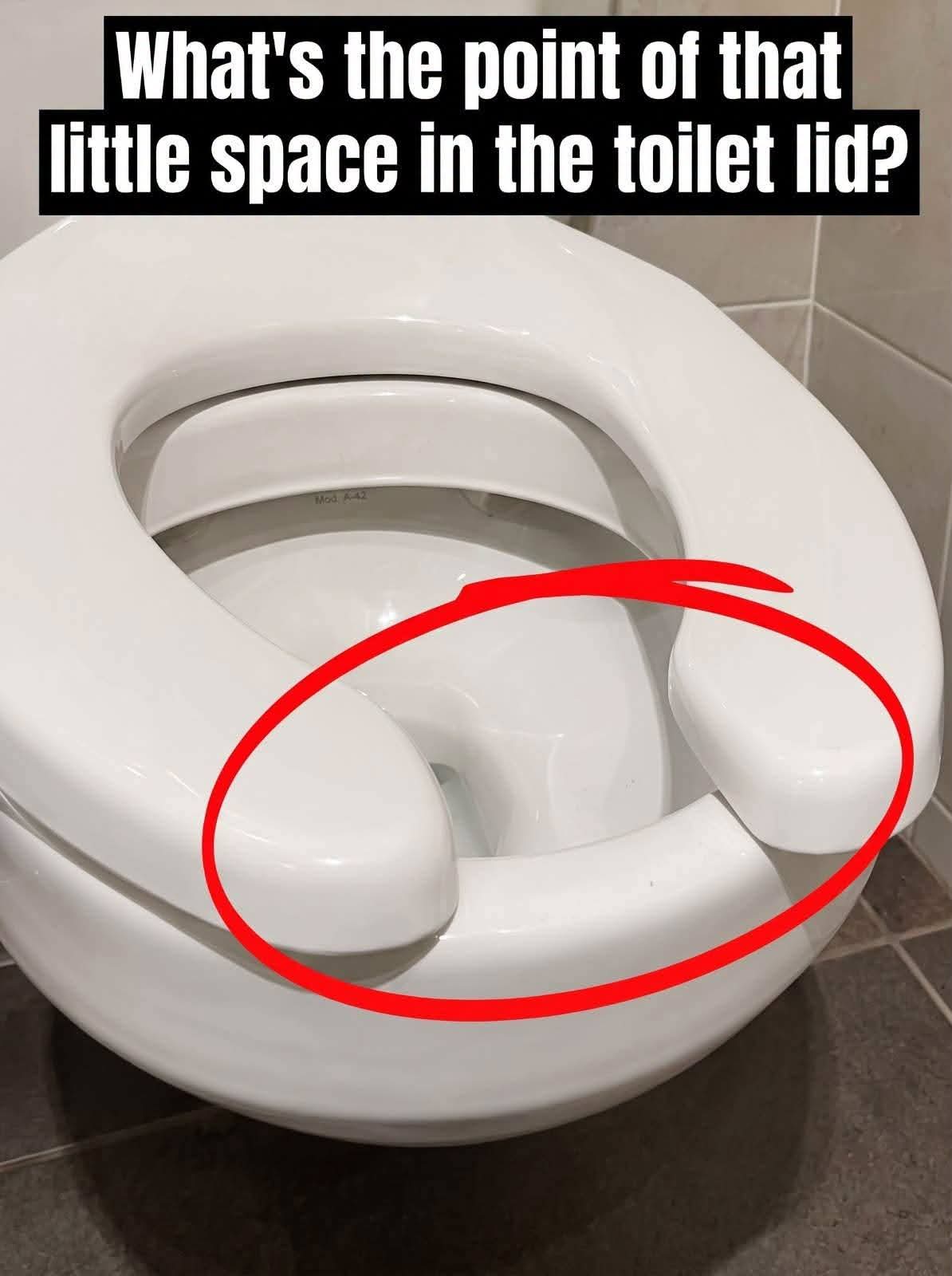
Think about what a public restroom has to deal with.
A family bathroom might be used by a handful of people each day.
ADVERTISEMENT
A busy airport bathroom could be used by an enormous number of travelers.
A restaurant bathroom might see constant use during dinner service.
A school restroom may need to withstand years of heavy use.
That means public fixtures are designed with durability, maintenance, sanitation, and standardized replacement in mind.
The open-front toilet seat fits naturally into that environment.
ADVERTISEMENT
It’s a small design choice, but small design choices can become incredibly important when something is used thousands of times.
The U-Shape Isn’t Actually About Plumbing
Despite how closely the seat is associated with public bathrooms, the shape isn’t primarily a plumbing feature.
The toilet bowl underneath can generally be the same basic type you’d see with a conventional seat.
The difference is the seat design.
So if you see a U-shaped seat, don’t imagine that the toilet itself has some special plumbing system hidden underneath.
The opening is primarily about the seat and how people interact with it.
What About Germs?
This is where it’s easy for internet explanations to get exaggerated.
You may hear claims that the open-front seat was specifically designed to prevent sexually transmitted infections, eliminate bacteria, or stop germs from spreading.
Those claims are generally much stronger than the evidence supports.
An open-front seat can have practical hygiene advantages, but it does not make a public toilet germ-proof.
And the biggest protection after using a public restroom is still wonderfully simple:
Wash your hands thoroughly with soap and water.
The seat shape is only one small part of restroom hygiene.
Does the Opening Keep You From Touching the Toilet?
Not necessarily.
Your body can still come into contact with the seat.
The open front simply changes the geometry of the surface.
It’s designed to leave a gap rather than providing a continuous ring.
So don’t think of the U-shape as creating a protective force field around you.
It doesn’t.
Instead, it’s a practical design that can offer easier cleaning and clearance while fitting the needs of public and institutional facilities.
Why Do Some Public Toilets Have Closed Seats?
If open-front seats are so common, why do some public bathrooms use fully closed seats?
Because there isn’t one universal rule for every restroom.
Design choices can depend on:
- Local regulations
- Facility type
- Toilet manufacturer
- Accessibility requirements
- Maintenance preferences
- Existing plumbing fixtures
- Renovation choices
- Owner preferences
You may walk into two public bathrooms in the same city and see completely different toilet-seat designs.
That’s perfectly possible.
The History Behind the Open-Front Seat
The open-front seat isn’t a brand-new invention.
The design became associated with public and institutional sanitation practices as restroom standards developed and facilities became increasingly focused on cleanability, hygiene, durability, and accessibility.
Over time, open-front seats became especially familiar in commercial and public settings.
And once a particular fixture design becomes standardized, it tends to stick around.
Think about other things you see in public bathrooms:
The automatic faucets.
The paper-towel dispensers.
The grab bars.
The wall-mounted soap dispensers.
The commercial hand dryers.
None of these details happened by accident.
Public restrooms are essentially an exercise in designing a space that can survive constant use by people you don’t know.
The toilet seat is just another example.
Why the Design Makes Sense in Busy Facilities
Imagine being responsible for cleaning a large public restroom.
You want fixtures that are:
- Durable
- Easy to inspect
- Easy to wipe down
- Easy to replace
- Familiar to users
- Compatible with common commercial installations
An open-front toilet seat checks several of those boxes.
That’s one reason this seemingly strange shape became so recognizable.
It’s not there to look unusual.
It’s there because somebody, somewhere, looked at a conventional design and thought:
“How can we make this work better in a busy public environment?”
Are Open-Front Seats More Hygienic?
It’s better to think of them as designed with hygiene and maintenance considerations in mind, rather than saying they’re automatically more hygienic.
The seat opening can reduce material at the front and make cleaning easier.
But hygiene depends on the entire restroom environment.
A dirty open-front seat is still dirty.
A well-maintained closed-front seat can still be perfectly usable.
Regular cleaning and disinfection are far more important than the shape alone.
What About Toilet Seat Covers?
Disposable toilet-seat covers are another feature you may encounter in public bathrooms.
These are designed as an additional barrier between the user and the seat surface.
But they aren’t required for every restroom, and their availability varies.
If you use one, remember that proper handwashing afterward is still the important habit.
And yes, the eternal public-restroom question remains:
Which way is that little paper flap supposed to go?
That’s a whole different rabbit hole!
The Open-Front Seat and Accessibility
Accessibility deserves special attention because public restrooms need to accommodate people with different mobility needs.
Open-front seats can be useful in certain institutional or accessible settings, but the seat shape alone does not determine whether a toilet is accessible.
An accessible restroom generally involves a combination of features, such as:
- Appropriate toilet height
- Adequate clear floor space
- Properly positioned grab bars
- Accessible controls
- Sufficient maneuvering space
- Appropriate door clearance
- Fixtures positioned according to applicable standards
So if you’ve ever wondered why certain public restrooms look different from your bathroom at home, accessibility is part of the answer.
The entire room may have been designed around a broader set of requirements.
Frequently Asked Questions
Why are public toilet seats U-shaped?
They’re usually called open-front toilet seats. They’re commonly used in public and institutional settings because the design can support easier cleaning, hygiene practices, clearance, and certain accessibility considerations.
Are U-shaped toilet seats more hygienic?
They can have practical hygiene and cleaning advantages, but the shape doesn’t make a toilet automatically sanitary. Regular cleaning and good hand hygiene remain essential.
Are U-shaped toilet seats required?
Requirements vary by jurisdiction and facility type. Some standards or codes may specify open-front seats in particular settings, but there isn’t one universal requirement that applies to every public toilet everywhere.
Why don’t people usually have U-shaped toilet seats at home?
Residential bathrooms typically have fewer users, and homeowners generally choose seats based on comfort, appearance, price, and personal preference.
Are U-shaped toilet seats designed for men?
Additional front clearance can be useful for male users, but that isn’t the only reason for the design. Hygiene, cleaning, institutional use, and accessibility considerations also play roles.
Does a U-shaped toilet seat prevent germs?
No. It may have some practical sanitation advantages, but it doesn’t prevent germs from being present on a toilet or in a public restroom.
Are open-front toilet seats only found in public bathrooms?
No. They’re also used in healthcare facilities, schools, workplaces, and private bathrooms.
Is the toilet itself different when it has a U-shaped seat?
Not necessarily. The U-shape generally refers to the seat rather than a special type of toilet bowl or plumbing system.
Should I be worried about sitting on a public toilet seat?
The most important precautions are ordinary hygiene practices. If the seat is visibly soiled, use another stall if possible or clean the surface appropriately. Most importantly, wash your hands thoroughly after using the restroom.
The Next Time You See One…
The next time you walk into a public restroom and see that familiar gap at the front of the toilet seat, you’ll know there’s more going on than meets the eye.
That little opening isn’t just a strange design choice.
It’s part of a long history of designing public fixtures around cleaning, maintenance, user needs, durability, and sanitation.
And that’s one of the things I love about everyday objects.
We see them hundreds of times without ever asking why they’re shaped the way they are.
Then one day, you notice something.
And suddenly, you can’t stop wondering.
Why is the seat shaped like that?
Why are public bathroom sinks so shallow?
Why do automatic faucets turn off so quickly?
Why is the toilet paper sometimes folded into a little point?
There are reasons behind so many of these tiny details.
And the humble U-shaped toilet seat turns out to be one of them.
Final Thoughts
So, why do public restrooms have those U-shaped toilet seats?
The short answer is that they’re open-front toilet seats, and their design has practical advantages in public and institutional environments.
They can make certain areas easier to clean, provide additional front clearance, and fit into broader hygiene, maintenance, and accessibility considerations.
But there’s no single universal explanation—and claims that the design exists solely to prevent germs or for one particular type of user oversimplify the story.
The next time you see one, take a second look.
That little gap may seem insignificant.
But like so many ordinary things around us, there’s a surprisingly practical reason it’s there.
And honestly?
I don’t think I’ll ever look at a public restroom toilet seat quite the same way again!
