🥩 Pick Your Favorite! A–J
There are few foods that can start a debate at the dinner table quite like ham. Some people want it soft, juicy, and barely browned. Others want crispy edges, a deep smoky flavor, and plenty of caramelization.
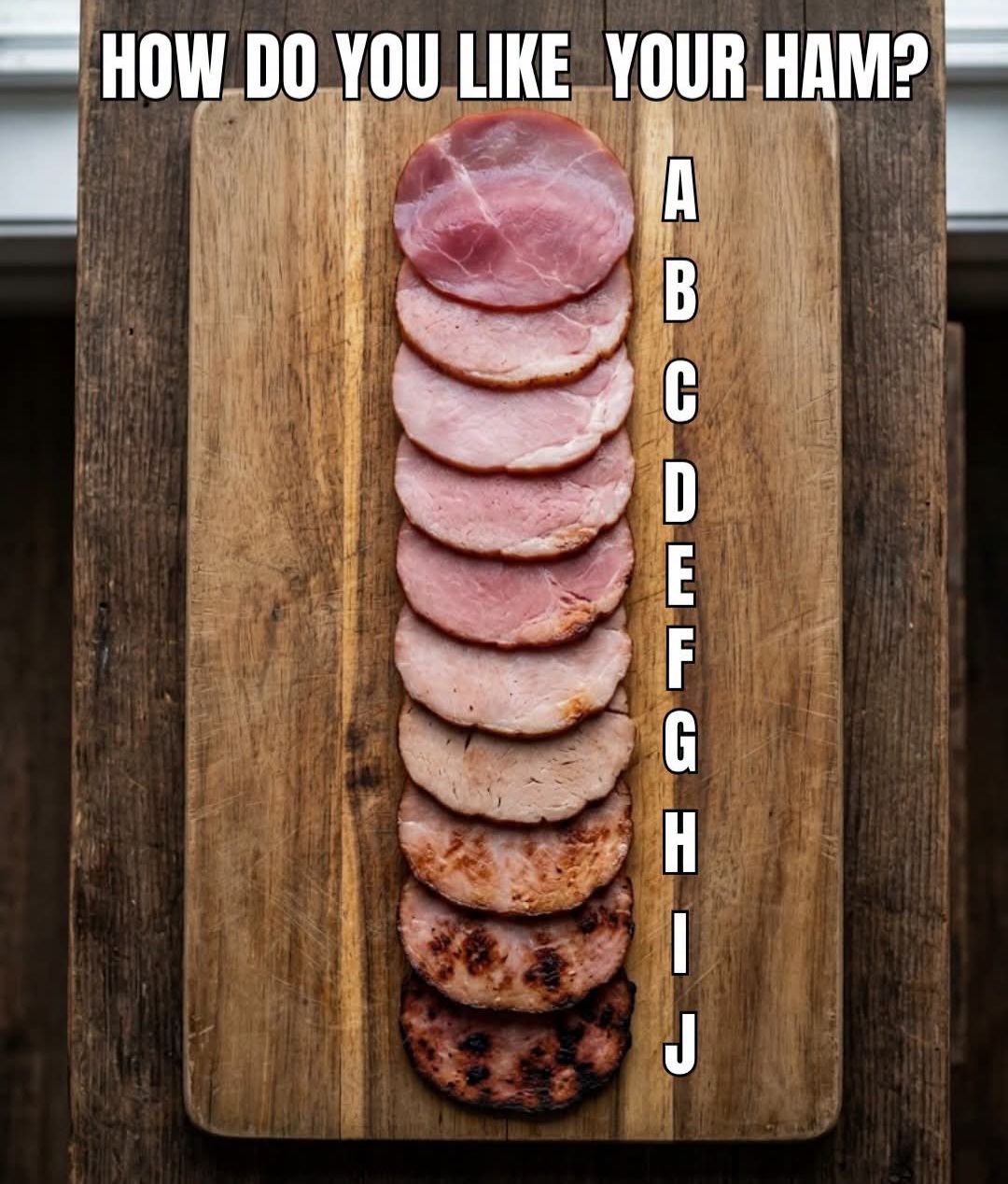
This fun A–J ham chart shows just how dramatically the appearance of a ham slice can change depending on how much it has been heated or browned.
So… which one are you choosing? A, B, C, D, E, F, G, H, I, or J? 👀


🥓 From Soft and Pink to Deeply Browned
Looking at the slices from top to bottom, you can see a progression from a very lightly heated-looking slice to one with a much darker, heavily browned exterior.
🅰️ Ham A — Soft & Light
This is for the person who wants ham that looks moist, tender, and minimally browned.
It’s soft-looking with little crust and plenty of that familiar pink ham color.
Perfect for: sandwiches, breakfast plates, cold ham, or anyone who doesn’t care for crispy edges.
🅱️ Ham B — Just a Little Heat
A little more color begins to appear around the outside.
This is a good middle ground if you like your ham warm but still tender and juicy.
Perfect for: a quick skillet warm-up or serving alongside eggs.
🅲️ Ham C — Lightly Browned
Now we’re getting into the territory of people who want a little texture.
The outside has some browning while the center remains soft.
Perfect for: breakfast, ham sandwiches, biscuits, or a simple dinner plate.
🅳️ Ham D — Golden Edges
This one has noticeably more browning around the edges.
The extra cooking gives the exterior a slightly firmer texture while adding that delicious roasted flavor.
This is where many people start saying, “Yep, that’s my ham.” 😋
🅴️ Ham E — Crispy Bits
Now we’re talking!
The browned areas are more pronounced, giving the slice a combination of tender center + crispy edges.
If you love the little caramelized pieces left in the skillet after cooking ham, this may be your winner.
🅵️ Ham F — Well Browned
This slice has considerably more color and a firmer exterior.
It’s especially appealing if you’re the kind of person who thinks browning equals flavor.
🅶️ Ham G — Deeply Browned
We’re getting into serious skillet-ham territory.
The surface is darker and the edges have more texture.
This can be delicious when the browning comes from controlled cooking or a glaze—but you don’t necessarily want to take it all the way to burning.
🅷️ Ham H — Crispy & Caramelized
Now we’re firmly in the crispy ham camp.
The darker exterior provides plenty of roasted flavor and texture.
This is fantastic with a sweet glaze because sugars can caramelize beautifully as the ham browns.
🅸️ Ham I — Very Dark
This is for people who really want that deeply browned, almost charred-looking exterior.
There’s a huge difference between pleasantly caramelized and actually burned, though. Once food starts blackening, the flavor can quickly become bitter.
🅹️ Ham J — Extra Crispy
And finally… J!
This is the choice for someone who wants their ham with lots of dark, crispy spots.
Some people will look at this slice and say, “Perfect!”
Others will immediately say, “You burned it!” 😂
And that’s exactly why the A–J question is so much fun.
❤️ Why Does Ham Change Color When Heated?
Ham can change considerably during cooking because heat affects the meat’s surface, moisture, fat, and any sugars or glaze that may be present.
As the surface gets hotter and drier, browning reactions create the darker color and roasted flavors we associate with cooked foods.
A ham that is simply warmed may remain relatively light, while a slice cooked longer in a skillet can develop a much darker, crispier exterior.
🍯 Glazed Ham Takes It Even Further
If your ham has a glaze containing ingredients such as:
- Brown sugar
- Honey
- Maple syrup
- Pineapple juice
- Mustard
- Molasses
…the surface can brown much more dramatically.
That’s why holiday ham can develop those gorgeous sticky, caramelized edges that everyone fights over.
Those crispy pieces around the outside? They may be the first things to disappear from the serving platter!
🍳 How to Get Your Favorite Ham Texture
For soft, tender ham
Warm slices gently over medium-low heat.
Avoid cooking them longer than necessary.
For golden-brown edges
Use a skillet over medium heat and cook the slices until lightly browned on both sides.
For crispy ham
Use a little higher heat and allow the edges to brown, watching carefully so they don’t burn.
For glazed, caramelized ham
Brush with glaze near the end of cooking. Sugary glazes can burn quickly, so keep a close eye on them.
⚠️ One Important Thing About Ham Safety
The appearance of a ham slice isn’t a reliable way to determine whether it’s safe to eat.
Many hams sold today are already fully cooked and can be eaten cold if the packaging indicates they are ready-to-eat. USDA guidance says federally inspected, vacuum-packaged fully cooked ham can be eaten cold; if reheated, the target is 140°F (60°C) for qualifying commercially packaged cooked ham. Leftover or otherwise repackaged cooked ham should be reheated to 165°F (73.9°C). (FSIS)
If you’re dealing with fresh or cook-before-eating ham, that’s different: USDA recommends cooking it to 145°F (62.8°C) and allowing at least a three-minute rest. (FSIS)
So don’t use the A–J chart as a food-safety temperature guide. Use the package directions and a food thermometer when necessary.
🧊 What About Leftover Ham?
After your meal, refrigerate leftover ham promptly rather than leaving it sitting out.
USDA recommends refrigerating perishable food within 2 hours at room temperature, or within 1 hour if the temperature is above 90°F (32°C). Most cooked leftovers should be used within 3–4 days when refrigerated properly. (FSIS)
Leftover ham is wonderful for:
- 🥚 Scrambled eggs
- 🧀 Ham and cheese sandwiches
- 🥔 Scalloped potatoes
- 🍝 Pasta
- 🥣 Bean or pea dishes
- 🥪 Grilled ham and cheese
- 🍳 Omelets
- 🧀 Ham casseroles
- 🥗 Chef salads
- 🥐 Breakfast biscuits
And don’t forget the bone if you have one—it can add incredible flavor to beans, peas, greens, and soups.
🥓 The Great Ham Debate
Ultimately, there’s no universal “best” ham texture.
Some people love ham soft and juicy.
Some want golden edges.
Some want it crispy.
And some people will happily eat the darkest, crispiest piece on the entire platter. 😂
That’s what makes food preferences so much fun.
👇 So, Be Honest…
How do YOU like your ham?
🥩 A — Soft & barely browned
🥩 B — Lightly warmed
🥩 C — A little browning
🥩 D — Golden edges
🥩 E — Crispy bits
🥩 F — Well browned
🥩 G — Deeply browned
🥩 H — Crispy & caramelized
🥩 I — Very dark
🥩 J — Extra crispy
Drop your letter in the comments! 👇🥓
And don’t judge the person who chooses a completely different one—that’s how family arguments over the holiday ham begin! 😂
