🥚
Here’s a little egg puzzle that looks like simple subtraction—but there’s a clever trick hiding in the wording.
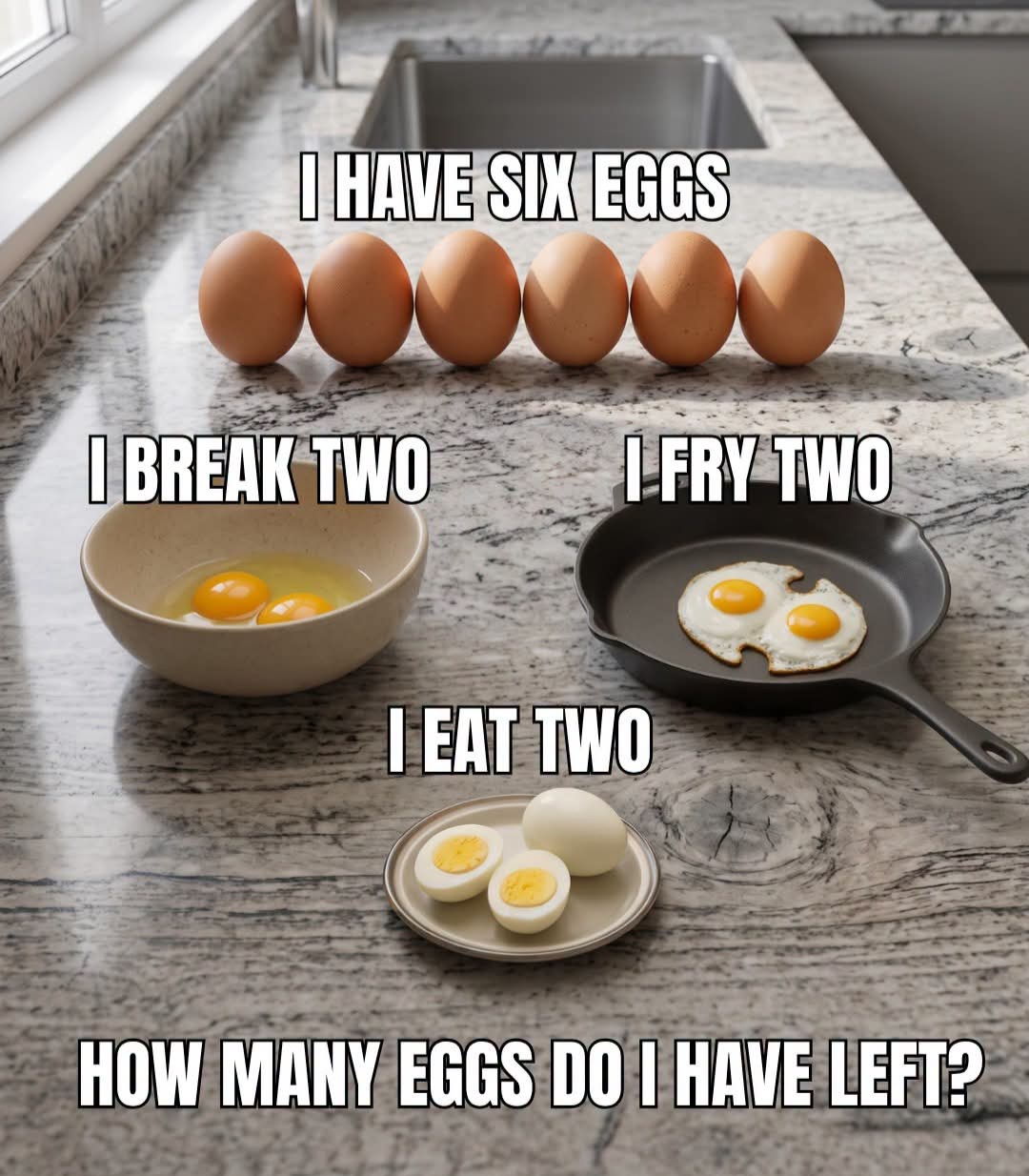
The picture says:
“I have six eggs.
I break two.
I fry two.
I eat two.
How many eggs do I have left?”
So… what’s your answer?
🥚 0?
🥚 2?
🥚 4?
🥚 6?
Don’t answer too quickly!
🤔 Think About What Actually Happened
At first glance, you might think:
6 − 2 − 2 − 2 = 0
You started with six eggs, broke two, fried two, and then ate two.
But there’s a problem with that reasoning.
The puzzle never says that six different eggs were used.
In fact, the most natural interpretation is that the same two eggs were involved in every step.
You break two eggs.
Then you fry those same two eggs.
Then you eat those same two eggs.
So you only used two eggs altogether. The remaining four eggs were never touched.
🎯 The Most Common Answer: 4 Eggs
The usual intended answer is:
🥚🥚🥚🥚 4 EGGS LEFT!
The two eggs you broke were the same two eggs you fried, and those same two eggs were the ones you ate. (Riddles)
Here’s the sequence:
Start: 6 eggs
⬇️
Break 2: 4 whole eggs remain
⬇️
Fry those same 2: Still 4 unused eggs
⬇️
Eat those same 2: Still 4 eggs remain
Final answer: 4 eggs. 🥚🥚🥚🥚
😂 Why Does This Puzzle Fool So Many People?
Because our brains naturally treat each sentence as a new action involving new eggs.
When we see:
Break 2 → Fry 2 → Eat 2
we may automatically imagine three separate groups.
But cooking doesn’t work that way.
You don’t normally break two eggs, fry two completely different eggs, and then eat another two eggs.
The actions form a sequence:
Break → Fry → Eat
The same eggs can go through all three steps.
That’s what makes this little puzzle so sneaky.
🧠 It’s Not Really a Math Problem
This is more about reading carefully than doing complicated arithmetic.
If the puzzle had said:
“I break two eggs, fry two different eggs, and eat another two eggs…”
then you would have used six eggs.
But it doesn’t say that.
The missing word is essentially “different.”
Without that word, there’s no reason to assume each action involved a new pair of eggs.
🥚 BUT THERE’S ANOTHER INTERPRETATION!
And this is where the comment section can get interesting. 😂
Some people argue that the wording allows for another answer because the puzzle begins with:
“I have six eggs.”
That’s present tense.
Then it says:
“I broke two, I fried two, I ate two.”
Those actions are described in the past tense.
Under a very literal reading, the six eggs you currently have could be different from the eggs you broke and ate earlier. In that interpretation, six could be argued as an answer. This alternate interpretation has been discussed in coverage of the riddle. (Parade)
However, that’s generally not the intended answer of the classic puzzle.
For the normal version, 4 is the answer most people are looking for.
🍳 Let’s Make the Puzzle Even Trickier
Imagine you have six eggs sitting in a carton.
You take out two.
You crack those two into a bowl.
You cook those two eggs.
You put them on a plate.
You eat them.
How many eggs are still in the carton?
Obviously…
🥚🥚🥚🥚 FOUR!
The trick is that breaking, frying, and eating aren’t three separate egg-consuming events.
They’re three steps involving the same two eggs.
💬 WHAT DID YOU GUESS?
Before reading the answer, what number popped into your head?
🅰️ 0
🅱️ 2
🅲 4
🅳 6
If you guessed 4, you caught the trick! 👏🥚
If you guessed something else, don’t worry—this puzzle is specifically designed to make you rush into the obvious calculation.
🏆 THE FINAL ANSWER
4 EGGS ARE LEFT! 🥚🥚🥚🥚
You started with six.
You broke two.
Those same two were fried.
Those same two were eaten.
So only two eggs were actually used, leaving four eggs.
And that’s why you should always read a riddle twice before doing the math. Sometimes the answer isn’t hiding in the numbers—it’s hiding in the wording. 🧠🥚
👇 NOW BE HONEST…
What was your first answer—0, 2, 4, or 6?
