🌊 If Humans Disappeared Tomorrow, What Would We Leave Behind in the Ocean?
Imagine waking up one morning and discovering that every human being had simply vanished.
No fishing boats.
No cargo ships.
No beachgoers.
No plastic bottles being tossed away.
No one adding another piece of trash to the water.
At first, the ocean might seem like it had finally been given a chance to breathe.
But the strange truth is that the ocean would not instantly become clean.
Our absence would stop new pollution from being created, but everything we had already left behind would remain.
And some of that waste could continue affecting marine life for years.
🌊 Nature Would Begin Reclaiming the Coast
Without people maintaining cities, roads, ports and coastal infrastructure, nature would slowly begin taking over.
Buildings would deteriorate.
Plants would grow through cracks.
Rivers would carry debris toward the coast.
Storms would scatter human-made materials.
Eventually, many places we built would become increasingly difficult to recognize.
The ocean itself would continue doing what it has always done: moving, mixing, breaking down and transporting material around the planet.
But our garbage wouldn’t simply disappear.
🥤 Plastic Would Be One of Our Biggest Legacies
Plastic is particularly troublesome because it doesn’t simply vanish when it enters the ocean.
Instead, larger plastic items can gradually fragment into smaller pieces, including microplastics.
The United Nations Environment Programme notes that plastic can break down into increasingly smaller pieces rather than biodegrading in the conventional sense. (UNEP – UN Environment Programme)
That means bottles, packaging, fishing equipment and other plastic objects left behind could become part of the marine environment long after the people who produced them were gone.
And eventually, some of those fragments could become so small that they would be difficult to see.
🎣 The Most Haunting Legacy: Ghost Gear
Perhaps one of the most disturbing things humans could leave behind would be lost fishing gear.
Fishing nets, lines, traps and other equipment can remain in the ocean after they have been lost or abandoned.
And they can continue doing exactly what they were designed to do.
Catch animals.
This is known as ghost fishing.
NOAA explains that derelict fishing gear can continue trapping fish, crustaceans, marine mammals, sea turtles and seabirds even after it is no longer under a fisher’s control. (Débris Marins NOAA)
So imagine a fishing net drifting through the ocean with nobody around to retrieve it.
An animal encounters it.
It becomes tangled.
Another animal may approach.
The cycle can continue.
That’s what makes ghost gear particularly frightening: the equipment doesn’t know that the humans are gone.
🐢 Sea Turtles, Birds and Marine Mammals Would Still Face the Consequences
Marine debris doesn’t affect just one type of animal.
Animals can become entangled in nets, ropes, plastic straps and other debris, making it difficult to swim, feed or breathe.
NOAA reports that marine debris has been documented affecting more than 700 species, including fish, invertebrates, sea turtles, seabirds, whales and dolphins. (Débris Marins NOAA)
Some animals can also mistake debris for food.
A piece of plastic floating in the water may look like something edible.
Once swallowed, debris can cause internal injury, block the digestive system or create a false feeling of fullness. (Débris Marins NOAA)
So even if humans disappeared tomorrow, animals would still encounter some of the consequences of what we left behind.
🪢 Fishing Line Can Be Almost Invisible
One of the most dangerous things about marine debris is that it doesn’t have to be enormous to cause serious problems.
A discarded or lost length of fishing line can become wrapped around an animal.
A net can drift through the water like a nearly invisible wall.
A loop of plastic can catch around a body part.
And because some fishing equipment is made from durable synthetic materials, it can remain in the environment for a long time. (Débris Marins NOAA)
The ocean doesn’t have a garbage collector waiting to pick these things up.
Unless someone removes them, they’re simply part of the environment.
🗑️ What About the Famous “Garbage Patches”?
You’ve probably heard of the Great Pacific Garbage Patch.
The name can create a misleading mental picture—a giant floating island of trash that you could practically walk across.
That’s not what it is.
NOAA explains that garbage patches are areas where marine debris becomes concentrated by rotating ocean currents called gyres. The debris can range from large fishing nets to tiny microplastics and can occur from the surface down toward the seafloor. (Débris Marins NOAA)
So if humanity disappeared, these currents wouldn’t stop.
The ocean would continue moving our discarded materials around.
Some debris would wash ashore.
Some would sink.
Some would remain suspended.
Some would break into smaller pieces.
And some would continue circulating for years.
🌎 But Nature Would Also Begin Recovering
It’s important not to make the story entirely hopeless.
If humans suddenly disappeared, one enormous change would happen immediately:
We would stop producing new pollution.
No new fishing gear would be lost.
No new plastic bottles would enter the water.
No new shipping activity would add additional waste.
No new coastal development would disturb habitats.
Over time, many ecosystems would have an opportunity to recover from some of the pressures caused by human activity.
But recovery wouldn’t mean instant perfection.
The ocean is enormous, and the pollution already present would not disappear simply because we did.
🐠 The Ocean Doesn’t Know What “Trash” Means
This may be the saddest part.
A turtle doesn’t know that a plastic bag is garbage.
A fish doesn’t know that a piece of fishing line was accidentally lost.
A seabird doesn’t know that a floating object was manufactured thousands of miles away.
To them, it’s simply something in their environment.
And that is why our waste can become so dangerous.
We know what it is. They don’t.
🌊 What Would We Really Leave Behind?
If humans disappeared tomorrow, we’d leave behind much more than buildings and roads.
We would leave evidence of ourselves scattered across the planet.
Plastic.
Glass.
Metal.
Synthetic fibers.
Fishing nets.
Ropes.
Bottles.
Containers.
Abandoned equipment.
And countless tiny fragments of things that once belonged to our everyday lives.
Some would eventually be buried, weathered or broken down.
Some would become incorporated into ecosystems.
Some might remain for extraordinarily long periods.
And some could continue harming wildlife.
💙 The Good News Is That We Don’t Have to Disappear
The thought experiment is powerful because it asks a simple question:
What would happen if we suddenly stopped adding to the problem?
But we don’t have to disappear to make that happen.
We can reduce the amount of waste entering waterways.
We can properly dispose of fishing line and gear.
We can participate in beach and shoreline cleanups.
We can reduce unnecessary single-use plastics.
We can support efforts to recover lost fishing gear.
And we can simply remember that what we throw away doesn’t necessarily go away.
NOAA programs, for example, support efforts to remove derelict fishing gear and prevent more gear from entering the ocean. (Débris Marins NOAA)
🌊 The Ocean Remembers
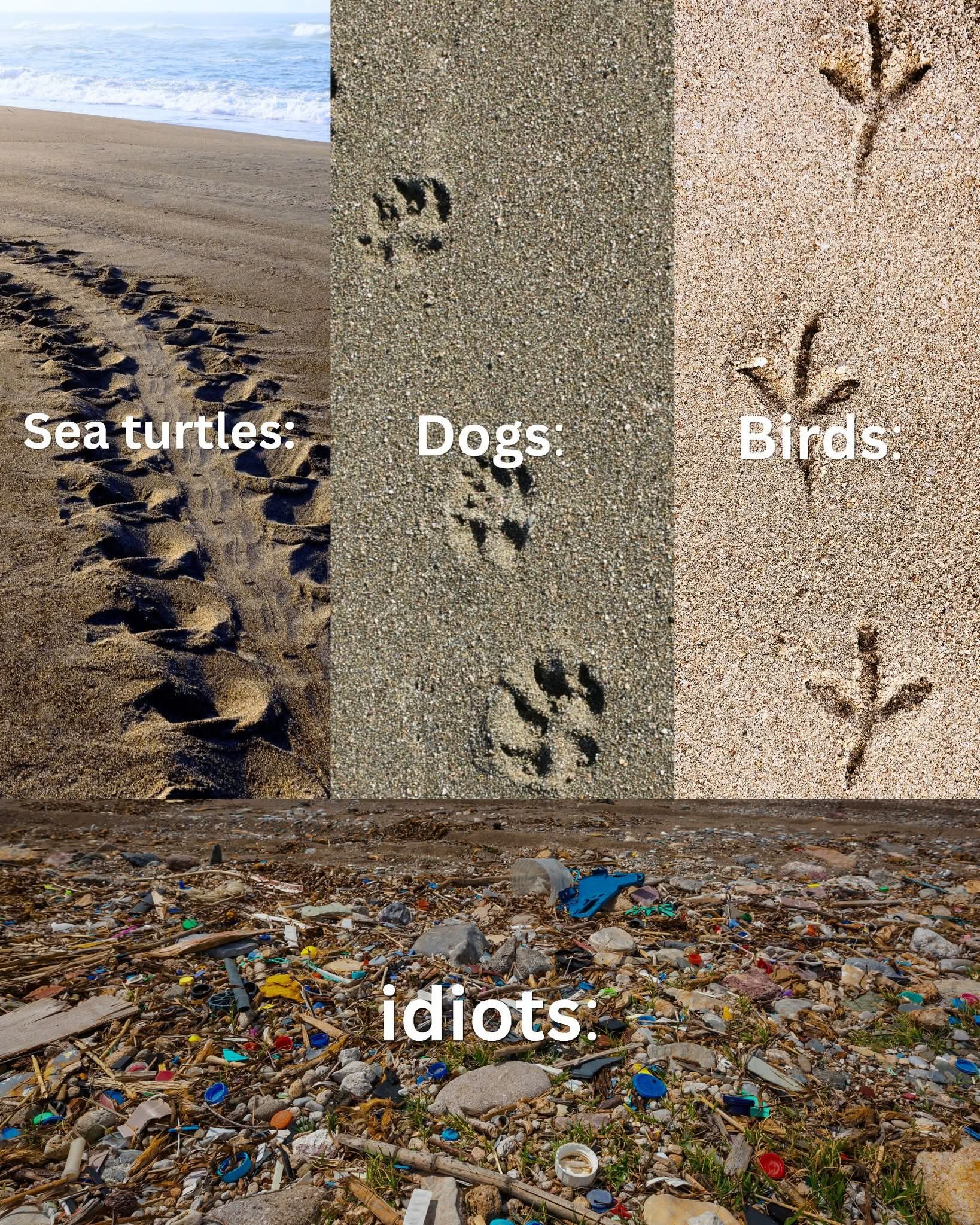
The picture accompanying this discussion makes a powerful comparison: beautiful traces left by animals on a beach versus the enormous amount of human debris that can accumulate there.
Sea turtles leave tracks.
Birds leave footprints.
Dogs leave paw prints.
And humans?
We leave plastic.
We leave fishing line.
We leave bottles.
We leave nets.
We leave things that can remain long after we’ve walked away.
Perhaps that’s the real message behind this thought experiment.
The ocean doesn’t forget what we leave behind.
Every bottle has a destination.
Every piece of fishing line has consequences.
Every abandoned net can become a hazard.
Every piece of plastic that reaches the water becomes someone else’s problem—or an animal’s problem.
🌊 So What Would Be Our Biggest Legacy?
If humanity vanished tomorrow, what do you think would be the most significant thing we’d leave behind in the ocean?
Plastic? 🎒
Fishing nets? 🎣
Fishing line? 🪢
Microplastics? 🧴
Abandoned boats and equipment? 🚢
Or something else?
Tell us what you think. 👇🌊
The ocean has survived enormous changes throughout Earth’s history. The question is whether we will choose to leave behind a legacy of pollution—or make sure the legacy we leave is one of restoration and protection.
