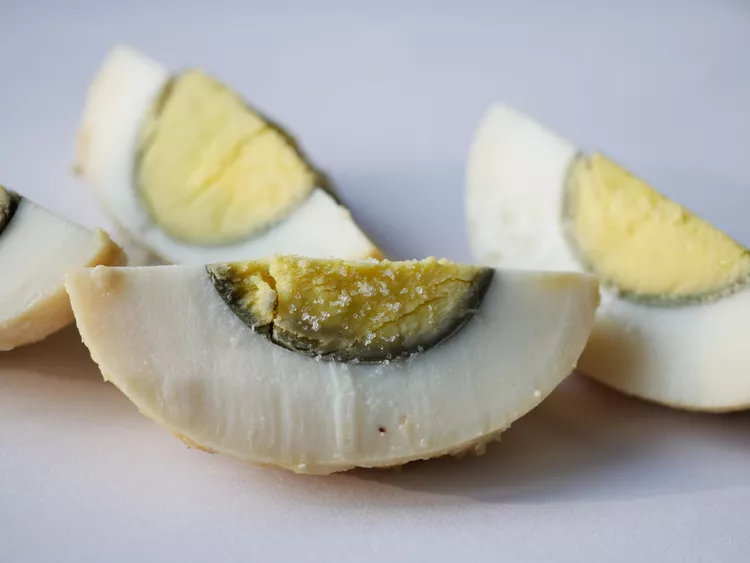
If you’ve ever made hard-boiled eggs for salads, sandwiches, and (of course) deviled eggs, you’ve likely cut into one and discovered that the outer yolk has turned slightly green. It has nothing to do with the egg itself—no need to blame the chicken here!—and everything to do with how you cooked the egg. Read on to learn more about what makes hard-boiled eggs go green, if these eggs are safe to eat, and how to boil eggs perfectly every time.
Amazon Prime Day Is Here! Save Up to 60% on Kitchen Gear From Ninja, Le Creuset, and More
Why Do Boiled Eggs Turn Green Around the Yolk?
At some point during boiling, the natural iron in the yolk reacts with the natural sulfur in the white. The reaction produces hydrogen sulfide, a harmless, greenish-gray colored mineral that appears right where the yolk meets the white. Since the eggs have usually cooked through when the reaction happens, the green color is a visual cue that they’ve been overcooked—think slightly chalky yolks and rubbery whites. It is also possible that the water itself has a high iron content that is reacting with the egg white, though this is less likely.
:max_bytes(150000):strip_icc():format(webp)/8660093_Creamy-Dill-German-Potato-Salad_Pat-Bernitt_4x3-a3eb6117fca54f2b96f436d618cf52da.jpg)
Are Green Yolks Safe To Eat?
Boiled eggs with some green around the yolk are perfectly safe to eat. In fact, the same amino acids that make the green-causing hydrogen sulfide in eggs are also what keep our skin, hair, and nails healthy. The green color and slightly overcooked texture just won’t give you a picture-perfect deviled egg or egg salad. They can also look a little less appetizing—not ideal if they are the star of a Cobb salad or a tuna Niçoise.
How To Prevent Yolks From Turning Green
The easiest way to prevent yolks from turning green is to stop cooking before the eggs overcook (when the sulfur and iron reaction occurs). As soon as the eggs are done, transfer them to a bowl of ice water to cool them as quickly as possible. Doing this will also make them easier to peel. What you’re looking for is a fully set white that isn’t rubbery and a fully cooked yolk (no underdone center) that is creamy, not chalky.
Our method for perfectly hard-boiled eggs adds another helpful step: Gentle cooking. Start with the eggs in cold water, then remove them from the heat as soon as the water reaches a boil. Allow them to sit in the hot water for 10 minutes before placing them in an ice bath. Doing this gradually cooks the eggs from the outside in, ensuring that neither the delicate white nor the dense yolk cooks unevenly. Many even refer to hard-boiled eggs as hard-cooked eggs for this reason, since they don’t actually boil much.
