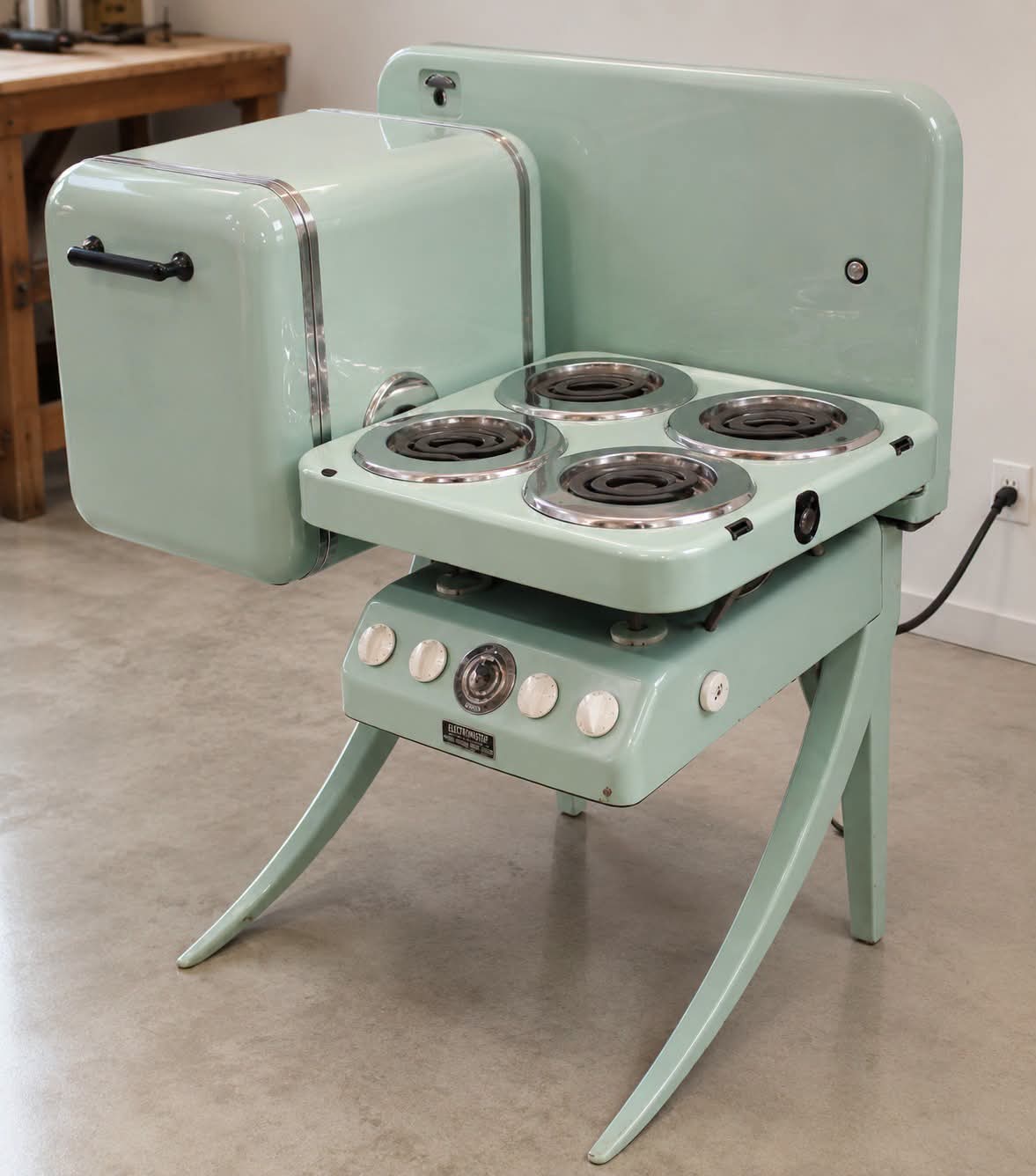
! 😍 A Beautiful 1930s Jadite Enamel Electric Kitchen Stove
There are vintage appliances, and then there are pieces that make you stop scrolling and stare.
This beautiful 1930s-style green enamel electric kitchen stove is one of those pieces.
With its soft green finish, rounded vintage details, sturdy construction, and unmistakable old-fashioned character, it looks like something that could have come straight out of a kitchen from another era.
Today, we’re surrounded by stainless steel appliances, touchscreens, induction cooktops, air fryers, and smart ovens that can practically tell us when dinner is ready.
But decades ago, a stove like this represented something completely different.
It represented modernity, convenience, cleanliness, and the exciting arrival of electricity in the home.
And honestly, that green enamel is gorgeous. 💚
💚 What Makes a Stove Like This So Special?
The first thing that catches your eye is the color.
Green enamel became an important part of vintage kitchen design during the early and mid-20th century. Enamel finishes weren’t simply decorative. They also created smooth surfaces that were easier to clean than many earlier stove designs.
By the 1930s, enamel-covered ranges were becoming increasingly sophisticated, and colorful finishes helped turn the kitchen appliance into part of the overall design of the room.
Historical appliance collections show just how much green and cream enamel was associated with this period. A 1930s General Electric Hotpoint range, for example, featured a porcelain-enamel body in cream and light green with chrome accents. (adams-county-museum)
Another museum collection describes the popularity of colored enamel ranges during the 1930s and 1940s, when coordinated kitchen colors became fashionable. (Western Australian Museum)
So that beautiful green isn’t just a random color choice.
It belongs to an important chapter in kitchen design history.
⚡ Electric Cooking Was Still a Modern Idea
It’s easy to forget just how revolutionary an electric stove would have seemed nearly a century ago.
Early electric ranges had plenty of limitations. Electricity was not universally available, heating elements could be unreliable, and electric cooking could be expensive compared with established fuel sources.
But by the 1930s, electric cooking technology had improved considerably.
As electricity became more widely available and appliance manufacturers refined their designs, electric ranges became increasingly attractive to homeowners.
A 1931 article in The American Home described electric cooking as increasingly appealing because of its clean operation and noted that electric ranges were already incorporating features such as multiple heat settings, clocks, insulated ovens, and automatic controls. (USModernist)
In other words, an electric stove in the 1930s wasn’t simply an old-fashioned version of today’s stove.
It was cutting-edge kitchen technology for its time.
🏠 The Kitchen Was Changing
The 1930s were an important period in the development of the modern kitchen.
Electricity was bringing a growing collection of appliances into American homes, while manufacturers were trying to make cooking and cleaning easier.
The Oklahoma History Center’s reconstruction of a late-1930s kitchen notes how electricity and modern appliances were changing everyday domestic life during this period. (Oklahoma Historical Society)
Stoves were part of that transformation.
Instead of relying entirely on wood or coal, families increasingly had access to gas or electric cooking.
And manufacturers weren’t just thinking about how a stove cooked food.
They were thinking about how it looked, how easily it could be cleaned, how efficiently it could fit into the kitchen, and how modern it made the home feel.
✨ Enamel Was More Than Decoration
That beautiful glossy finish wasn’t just there to make the stove pretty.
Enamel provided a smooth, durable surface that was much easier to wipe clean than rougher exposed metal or cast iron.
Historical appliance research describes the development of porcelain enamel as an important step in making stove surfaces easier to clean. By the 1930s, enclosed cabinet-style designs were also helping hide many of the components and reduce the cleaning burden. (ANA Educational Foundation)
That’s one reason these old appliances can still look so striking today.
When properly cared for, enamel can remain beautiful for generations.
🟢 Why Green?
Green kitchens have gone in and out of fashion many times.
But during the 1930s and 1940s, green was one of the colors that could give a kitchen a cheerful, coordinated appearance.
Vintage appliances weren’t always plain white or stainless steel.
Manufacturers experimented with cream, green, gray, black, and combinations of contrasting colors.
A 1930s Quick Meal stove documented in Old House Journal is described as using green and white enamel during a period when those combinations were becoming fashionable. (USModernist)
That’s part of what makes a stove like this so visually appealing today.
It doesn’t look like every other appliance.
It has personality.
🍳 Imagine Cooking on One
Just imagine stepping into a kitchen in the 1930s.
There’s no microwave.
No digital display.
No Wi-Fi.
No convection setting.
No smartphone telling you how many minutes remain on your roast.
Instead, you have a sturdy electric range, a few simple controls, an oven, pots and pans, and the ingredients needed to make dinner.
And yet, the basic goal hasn’t changed.
Someone still has to decide what’s for dinner.
Someone still has to stir the pot.
Someone still has to bake the bread.
Someone still has to wash the dishes afterward.
That is part of the charm of vintage kitchen appliances.
They connect us to ordinary moments that happened in kitchens decades before our own.
🔧 Built for a Different Era
Many vintage ranges were substantial pieces of equipment.
They were made with metal, enamel, glass, cast components, mechanical controls, and replaceable parts rather than the electronics and touch-sensitive controls found in many modern appliances.
That doesn’t mean every old stove was indestructible.
They still wore out, needed repairs, and could develop electrical or mechanical problems.
But their construction gives them a completely different feel from many modern appliances.
A museum example of a circa-1937 electric stove, for instance, has a green-and-cream enamel body, multiple ovens, controls, fuses, removable shelves, and other mechanical components. (Musées Victoria Collections)
🕰️ A Stove Could Tell the Story of a Family
Imagine a stove like this being purchased when it was new.
Maybe a family had finally gotten electricity in their home.
Maybe the stove replaced an older gas or wood-burning range.
Maybe a young couple bought it for their first house.
Maybe someone saved for months to afford what was advertised as the modern way to cook.
Then years passed.
Children grew up around it.
Family dinners were prepared on it.
Bread was baked in its oven.
Holiday meals came together on its burners.
Eventually, the kitchen changed.
New appliances arrived.
Cabinets were remodeled.
And somehow, this old stove survived.
That’s what makes vintage appliances so much more than household objects.
They can be pieces of family history.
📻 The 1930s Were Full of Kitchen Innovation
The electric stove was only one part of a much larger transformation.
Refrigerators were becoming increasingly common.
Electric mixers, toasters, irons, washing machines, and other appliances were changing household routines.
Manufacturers were competing to convince consumers that electricity could make everyday life easier.
Even contemporary advertising reflected the excitement surrounding these new appliances.
By the 1930s, electric ranges were being promoted with increasingly sophisticated features. Contemporary publications described innovations including insulated ovens, automatic controls, clocks, and specialized cooking functions. (USModernist)
The kitchen was becoming a showcase for modern technology.
🧽 And Yes, People Still Had to Clean It!
One thing definitely hasn’t changed.
Nobody escapes kitchen cleanup. 😂
The smooth enamel surfaces of vintage ranges were actually part of the appeal because they could be wiped down more easily.
Imagine advertising from the era promising a cleaner, more convenient kitchen.
Today we have self-cleaning ovens and specialty cleaners.
Back then, the promise of a smooth enamel surface was already a major selling point.
💚 Why We Still Love These Stoves Today
There’s something wonderfully nostalgic about vintage appliances.
Maybe it’s the colors.
Maybe it’s the mechanical knobs.
Maybe it’s the chrome trim.
Maybe it’s the rounded corners.
Or maybe it’s simply because they remind us of a time when household appliances were designed to be beautiful as well as functional.
Modern kitchens tend to favor clean lines and neutral colors.
A vintage green enamel stove doesn’t disappear into the kitchen.
It becomes the kitchen’s focal point.
🏡 Could You Actually Use One Today?
Some vintage ranges are restored and used in modern kitchens, but an appliance from the 1930s should never simply be plugged in and used without inspection.
Electrical wiring, insulation, heating elements, grounding, switches, plugs, and other components can deteriorate over many decades.
If someone owns a vintage electric stove and wants to use it rather than display it, it should be inspected by a qualified appliance technician or electrician familiar with older equipment.
The fact that an old appliance still looks beautiful doesn’t necessarily mean that its electrical components are safe.
Sometimes the best way to preserve a piece of history is simply to admire it.
🕵️ Is It Really From the 1930s?
This is where vintage appliance identification gets interesting.
A photograph alone usually isn’t enough to establish an exact manufacturing year or manufacturer.
Collectors may look for:
- Manufacturer name
- Model number
- Serial number
- Patent dates
- Control-panel design
- Burner configuration
- Oven arrangement
- Enamel colors
- Knob style
- Door handles
- Construction details
- Original advertisements or catalogs
A museum collection can sometimes provide an excellent comparison.
For example, the Smithsonian has a documented 1930s enameled range, while The Henry Ford has a 1935–1945 Norge cookstove whose smooth porcelain-enamel cabinet reflects the changing kitchen designs of the era. (Smithsonian)
So if you ever come across an old stove like this, look for the identification plate before assuming its age.
That little plate can tell you a lot.
🌟 Vintage Kitchen Appliances Are Having a Moment
There is something fascinating about seeing an appliance that was once considered modern technology become a historical artifact.
A stove that may have once been the pride of someone’s brand-new kitchen can eventually become a collectible.
And perhaps that’s the most interesting part.
When this stove was new, nobody thought of it as “vintage.”
It was simply the new stove.
It represented progress.
It represented electricity.
It represented convenience.
It represented a modern kitchen.
Nearly a century later, we look at it and see something completely different.
We see history.
💚 A Beautiful Piece of Kitchen History
A 1930s green enamel electric stove is more than an appliance.
It’s a snapshot of a time when kitchens were rapidly changing and electricity was transforming everyday life.
The glossy enamel, vintage controls, sturdy construction, and beautiful green finish capture an era when manufacturers were learning how to combine technology, practicality, and style.
And that’s why seeing one today can feel so special.
You aren’t just looking at an old stove.
You’re looking at a piece of the story of how the modern kitchen came to be.
I’ve never seen anything like this before! 😍
Would you keep a beautiful vintage green enamel stove like this in your kitchen—or would you preserve it as a piece of history? 💚🍳
