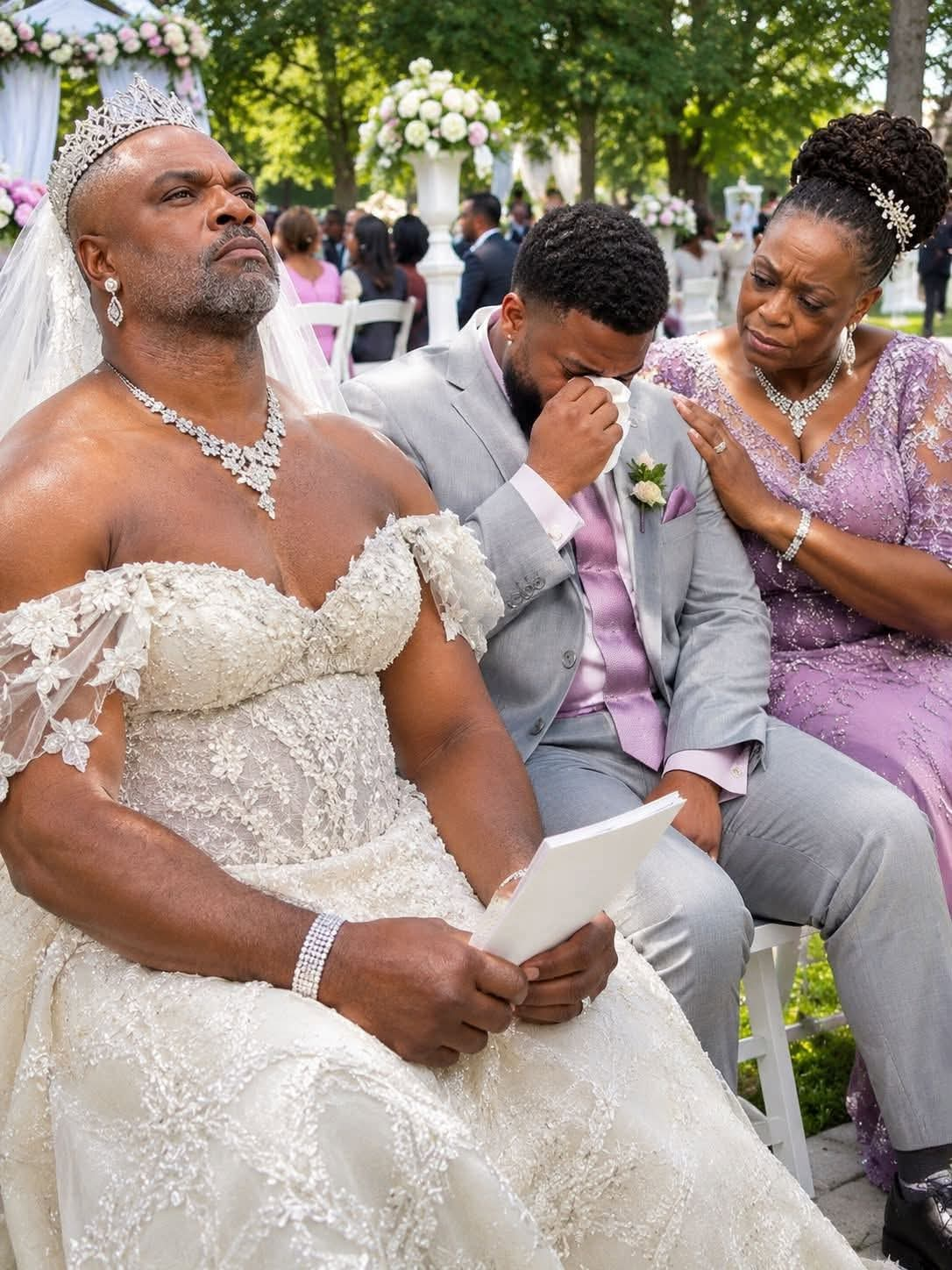
She was that good. For three years I’d watched her make Harold feel foolish for every single question he asked, with nothing but a laugh and a tilt of her head.
So my husband, the most dignified man I know, did the math the way he used to read a blueprint. The failure point wasn’t the evidence. The failure point was that she could make him vanish before anyone heard it.
A spectacle can’t vanish.
A sixty-year-old man in a wedding dress at the altar is not a thing you can quietly escort out “to calm down.” Everyone was already looking. Everyone had their phones up. She had lost, before he said a word, the one advantage she’d used on him for three years — the ability to make him small and make it disappear.
He made himself the most ridiculous person in the room on purpose, so that the truth would have nowhere to hide.
And then he opened the envelope.
Chapter 3: The Envelope
Inside were photographs.
Whitney, last Thursday, at the Hollis Hotel downtown — the same week she was telling me which shade of ivory to use on the napkins. Walking in with a man. His arm around her. A second photo of them at the hotel bar, close, unhurried, comfortable in the way that tells you everything.
That alone would have been enough to stop a wedding. But Harold, being Harold, hadn’t stopped at the surface. Inspectors never do.
The man in the photos was named Dylan. And Dylan was not a new aff*ir.
Dylan was Whitney’s partner — in every sense. The two of them had been together for years, and they had a system. Whitney would find a generous, stable, trusting man — a man exactly like my son, who was “generous to a fault,” as I’d always said with a worried little laugh. She’d become whatever he needed. She’d marry him. And over the following couple of years, she and Dylan would quietly drain him — joint accounts, “investments,” a business loan Dylan would structure, a home refinance — and then she’d leave, and they’d move to the next one.
You didn’t make me do anything,” Harold said. “I’d have worn it down Main Street.”
Here is what I keep from all of it.
For three years I had gently sided against my own husband. I’d called his caution suspicion. I’d told him he was being unfair to a nice young woman. I’d made him feel, in small ways, like the difficult one — exactly the way Whitney wanted me to.
And that quiet, careful man never once got angry with me for it. He just went and did the work, alone, for three days, with an envelope he wouldn’t show me because he wasn’t sure yet and he would not accuse a person until he was. And when he was sure, he didn’t come to me to say “I told you so.” He put on my wedding dress and he saved our son, and he was willing to be laughed at by everyone we know to do it.
That is the man I married thirty-four years ago. I’d forgotten, a little, under three decades of ordinary life, exactly what he was made of.
Grant is okay now. Slower to trust, which isn’t the worst thing. He takes his father fishing on Sundays, and sometimes, when Harold says something careful and understated, Grant catches my eye and smiles, because we both know now what’s underneath it.
“Dad, have you completely lost your mind?” my son shouted, when his father walked in wearing my gown.
No. He’d found it, and sharpened it, and aimed it at the one person trying to ruin his boy’s life.
My husband wore a wedding dress to a wedding and let a hundred people laugh at him.
