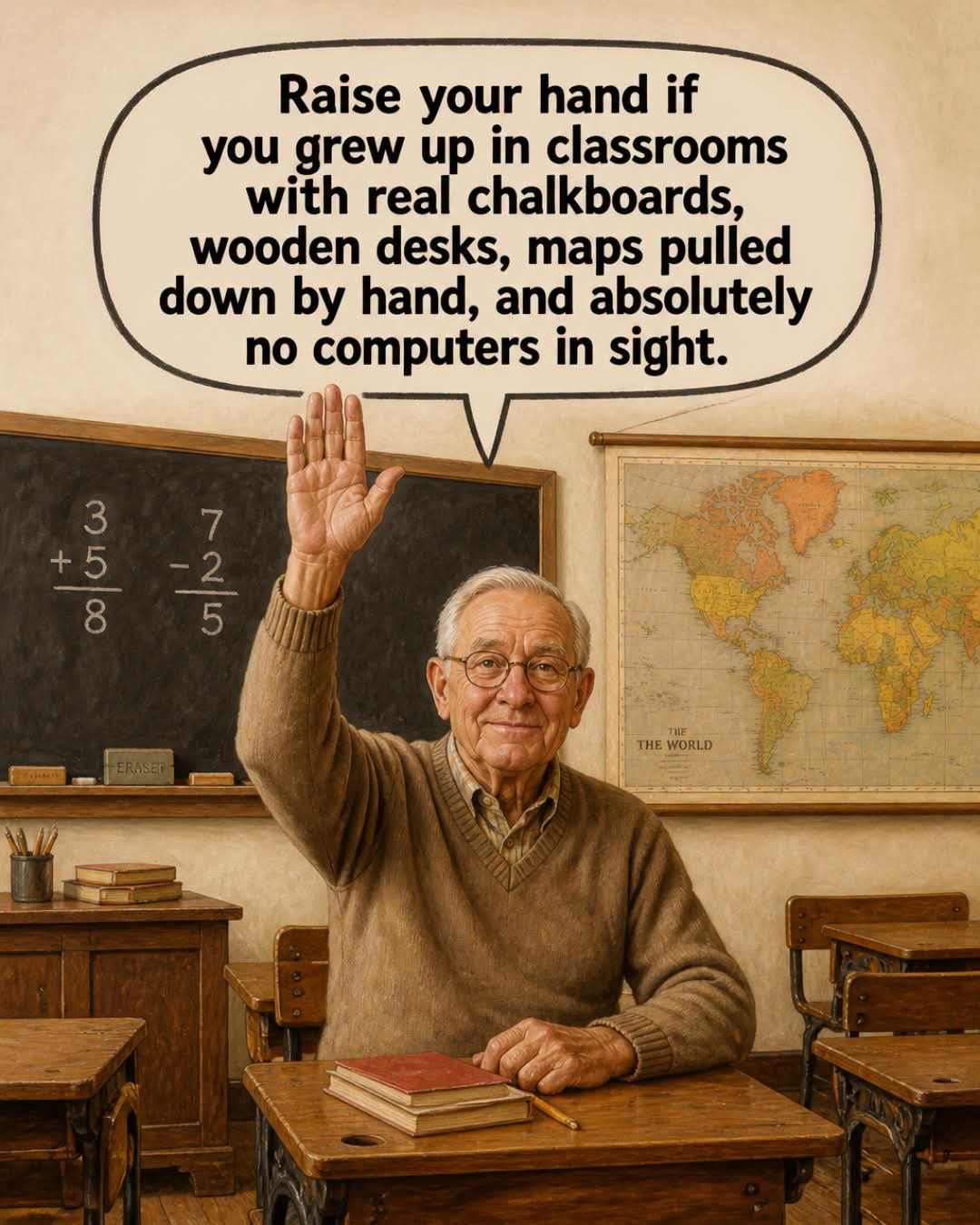
The chalk dust hung in the air every single afternoon, settling on the ledge below the blackboard in little white drifts. You could hear that map crackle as the teacher pulled it down by the handle, unrolling continents that had been rolled up tight since the last time you needed them.
The desks were bolted to the floor and carved with initials from kids who sat there years before you did, and the only screen in that whole building was the one they wheeled in on a cart maybe twice a year. Everything else you learned by hand, by chalk, by paying attention.
Nobody needed a computer to teach us how to think.
Nobody Needed a Computer to Teach Us How to Think
There was a time when a classroom didn’t need a screen on every wall, a tablet on every desk, or a computer for every student.
There was a blackboard.
There was a piece of chalk.
There was a teacher standing at the front of the room, and there were students expected to listen, watch, write, remember, question, and think.
And somehow, those simple things gave many of us some of our most lasting memories of school.
The Sound of Chalk on the Blackboard
You could hear it before you even looked up.
Scratch. Scratch. Scratch.
The chalk moved across the board as the teacher wrote the day’s lesson. Sometimes the letters were perfectly formed. Sometimes they got bigger as the teacher ran out of room. And sometimes there was that unmistakable squeak that made everyone cringe.
By the afternoon, chalk dust seemed to be everywhere.
It settled along the bottom ledge of the blackboard. It clung to the erasers. It floated through the sunlight coming in through the windows.
Nobody thought much about it at the time.
It was simply part of school.
And the blackboard itself was much more than decoration. Historically, large reusable boards transformed classroom teaching because a teacher could demonstrate something to an entire group at once rather than writing separately on individual slates. (Taylor & Francis Online)
🗺️ Remember the Big Classroom Maps?
There was something special about those enormous maps.
The teacher would reach for the handle and pull one down.
Rrrrrrip…
The rolled-up map would slowly unroll, revealing oceans, countries, cities, mountain ranges, and borders.
Suddenly, geography wasn’t just words in a textbook.
You could see it.
You might have been sitting in a classroom hundreds or thousands of miles away from another country, but that map made the world feel a little smaller.
And when the teacher pointed to a place you’d never heard of, you knew exactly where it was because you had seen it there.
✏️ We Learned by Doing
There weren’t endless digital distractions.
You couldn’t open another tab when the lesson became boring.
You couldn’t reach for a phone and scroll through videos.
You had your notebook.
Your pencil.
Your textbook.
And your own thoughts.
If the teacher wrote a math problem on the board, you copied it.
If the teacher asked a question, you had to think about the answer.
If you made a mistake, you erased it or crossed it out and tried again.
That process could be slower, but it also required participation.
You weren’t simply watching information appear on a screen.
You were physically involved in learning.
🪑 And Those Desks Had Stories
Remember those old school desks?
Some were heavy enough that they seemed like they would never move.
Many classrooms had desks arranged in rows, all facing the same direction.
And some desks carried evidence of generations of students.
Initials.
Names.
Little drawings.
Random scratches.
Someone had been sitting there before you.
And someone else would probably sit there after you.
Those marks were tiny reminders that the classroom had a history long before you walked through its doors.
📺 The Screen Was an Event
Today, technology is everywhere in education.
But for many generations, seeing a screen in the classroom was unusual.
Maybe a television was rolled in on a cart.
Maybe there was a projector.
Maybe a special educational film was shown.
And when that happened, everyone knew it was different.
The room changed.
The lights might go down.
Students suddenly became very interested.
The screen felt like an event.
That contrast is hard to imagine today, when digital technology can be a routine part of classroom life.
🧠 “Nobody Needed a Computer to Teach Us How to Think”
That’s really what this memory is about.
It’s not necessarily about saying that modern technology is bad.
Computers, tablets, projectors, interactive boards, and the internet can be incredibly useful educational tools.
The point is that technology was never the teacher.
The teacher was.
The tools simply helped.
A good teacher could take a piece of chalk and turn a blank blackboard into a lesson about mathematics, history, science, language, or geography.
The blackboard gave teachers a shared space where ideas could be made visible to the entire class. Historians of education have noted that the board wasn’t merely a writing surface—it became an important part of classroom teaching and the way teachers made students’ thinking visible. (Cambridge University Press)
📚 We Had to Pay Attention
Maybe one of the biggest differences was that there were fewer places for our attention to go.
You listened because the teacher was talking.
You looked at the board because that was where the information was.
You wrote because that was how you recorded the lesson.
And if you missed something, you couldn’t necessarily rewind it.
You had to ask.
You had to catch up.
You had to listen more carefully the next time.
That doesn’t mean students today can’t concentrate or think deeply. They absolutely can.
But many of us remember an educational environment where patience was part of the process.
❤️ The Things We Remember Aren’t Always the Things We Expected
Funny thing about childhood memories…
We may not remember every lesson we were taught.
We may forget the exact homework assignment.
We may not remember every test question.
But we remember the classroom.
We remember the smell of old books.
The sound of chalk.
The squeak of an eraser.
The sunlight coming through the windows.
The teacher’s handwriting.
The sound of the school bell.
The desks.
The maps.
The notebooks.
The friends sitting beside us.
Those ordinary details become extraordinary years later.
A Simpler Classroom, Not Necessarily a Simpler Education
The old classroom wasn’t perfect.
Teachers had fewer resources.
Students didn’t have instant access to information.
Research could mean spending hours in a library instead of typing a question into a search engine.
And many educational technologies we take for granted today simply didn’t exist.
But there was something beautiful about the simplicity.
A teacher could walk into a room with a box of chalk and a lesson plan and still have everything needed to begin.
The classroom didn’t need to be impressive.
The learning was the important part.
🌟 What We Can Still Learn From Those Classrooms
Perhaps the lesson isn’t that we should go backward.
It’s that we shouldn’t forget what technology cannot replace.
Curiosity.
Patience.
Attention.
Conversation.
Writing by hand.
Making mistakes.
Asking questions.
Listening to someone who knows more than we do.
Thinking through a problem instead of immediately looking for the answer.
Those skills matter regardless of whether the classroom has a blackboard or a smart board.
Technology can give us information.
But learning what to do with that information still requires a human mind.
🏫 A Little Piece of the Past
Maybe that’s why the old blackboard still makes so many people nostalgic.
It represents more than chalk.
It represents a particular kind of childhood.
A time when the teacher stood at the front of the room, the map hung on the wall, notebooks filled our desks, and the day’s lesson unfolded one line at a time.
No notifications.
No endless scrolling.
No search bar waiting to answer every question.
Just a teacher, a classroom, a piece of chalk—and a room full of young minds learning how to make sense of the world.
And perhaps that’s why this sentence still feels so powerful:
Nobody needed a computer to teach us how to think.
💭 What Do You Remember Most?
Did your classroom have a blackboard?
Do you remember the chalk dust, old desks, classroom maps, school bells, or those rare days when a television or projector was rolled into the room?
What is one thing from your childhood classroom that you can still picture perfectly today? ❤️
Share your memory in the comments. Sometimes the smallest details are the memories we never really forget.
