🧵 Remember When Sewing Machines Were Controlled With a Knee Instead of a Foot Pedal?
There was a time when sewing wasn’t just about sitting down and pressing a button.
It was about rhythm.
It was about knowing exactly how much pressure to apply, guiding fabric carefully beneath the needle, and developing a natural relationship with the machine.
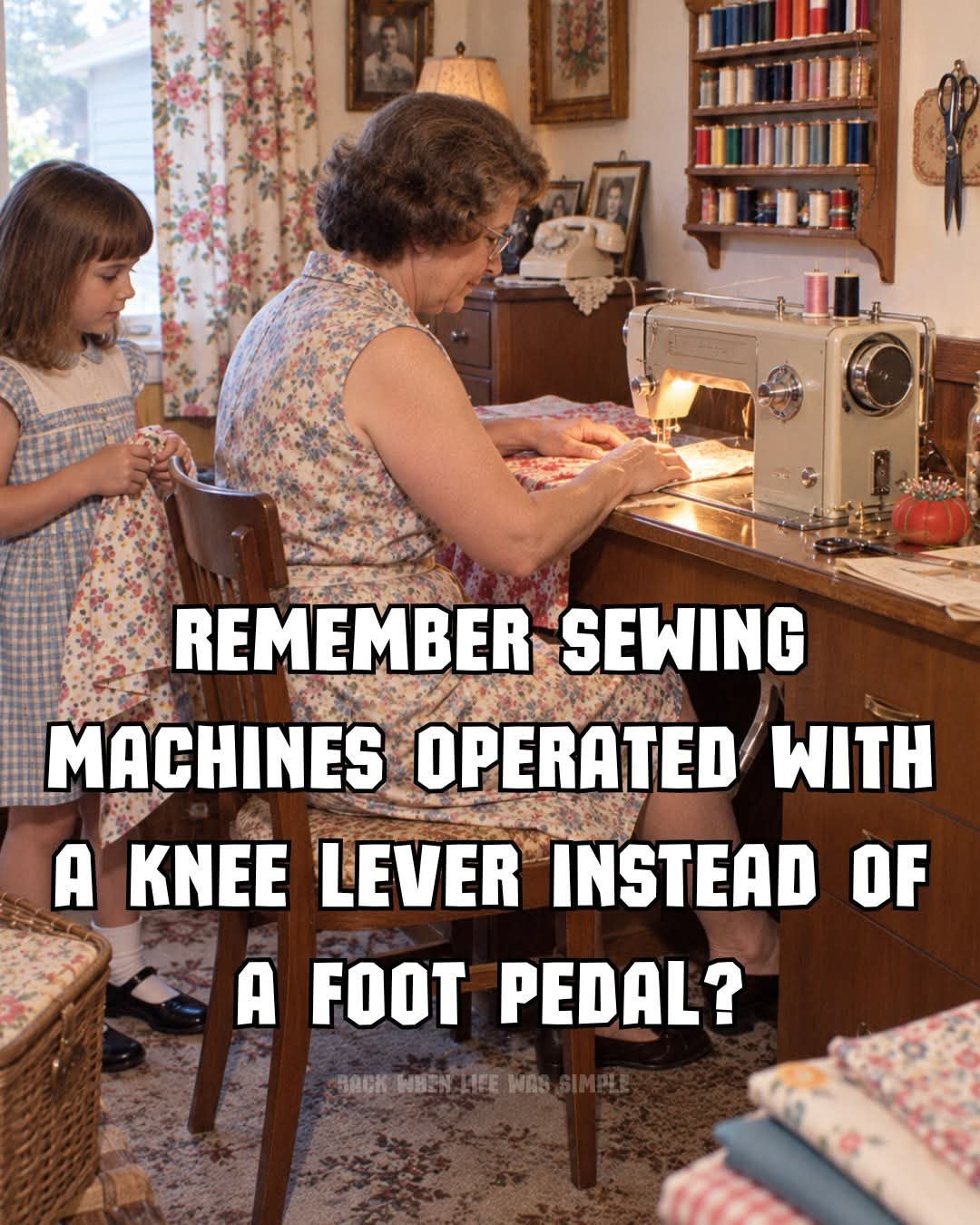
And if you look closely at the machine in this nostalgic image, you’ll notice something that younger generations might find surprising:
There doesn’t appear to be a traditional foot pedal.
Instead, some vintage electric sewing machines could be operated with a knee control—a lever positioned so the operator could press it sideways with their knee. Historical Singer designs included knee-control mechanisms for regulating sewing-machine speed, including a patented mechanism from the early 1930s. (Brevets Google)
For many people, that little detail brings back an entirely different era of sewing. 🧵❤️
🪡 How Did a Knee-Control Sewing Machine Work?
Instead of placing your foot on a pedal underneath the table, a knee-controlled machine had a lever mounted near the front or side of the cabinet.
The operator could sit normally, position their knee against the lever, and move it to control the machine.
The basic idea was simple:
Knee moves → control responds → machine speed changes.
It allowed both feet to remain on the floor while the hands concentrated on guiding the fabric.
That might sound strange today, but once someone became accustomed to it, the movement could become second nature.
And knee controls weren’t merely a fictional feature from old photographs. They were genuinely used on electric sewing machines, with documented designs specifically intended to regulate machine speed. (Brevets Google)
👵🧵 Sewing Was Once a Part of Everyday Home Life
The image captures something bigger than an old machine.
It shows a child watching an older woman sew.
That scene represents something that was once common in many households: learning practical skills by watching someone who already knew how to do them.
A child might sit nearby while a mother, grandmother, aunt, or neighbor worked.
There wasn’t necessarily a formal lesson.
You simply watched.
You noticed how the thread was placed.
You learned how fabric was held.
You watched the needle move.
You heard the machine.
And eventually someone might say:
“Here, let me show you.”
That’s how practical knowledge was often passed from one generation to another.
🧶 Before Fast Fashion, Repairing Clothes Mattered
Sewing machines weren’t simply hobbies.
For many households, they were practical tools.
People could make garments, alter clothing, repair damaged seams, and adapt existing fabric instead of immediately replacing an item.
A historic sewing machine preserved by the State Historical Society of Iowa, for example, was used in a home for decades, illustrating how domestic sewing machines could help people make and repair clothing. (State Historical Society of Iowa)
A sewing machine could therefore represent much more than craftsmanship.
It could represent self-reliance.
If a shirt ripped, you could repair it.
If trousers needed shortening, you could alter them.
If a child outgrew something, fabric could sometimes be transformed into something new.
And if you knew how to sew well, that knowledge itself had value.
⚙️ From Treadles to Electric Machines
The history of sewing-machine controls is fascinating.
Before electric motors became commonplace, many sewing machines were powered mechanically.
Treadle machines used foot-powered mechanisms connected to a flywheel, allowing the operator to generate the movement needed to run the machine. Historical examples of treadle-operated machines date back to the 19th century. (RCP Museum)
The operator’s feet provided the power while the hands remained free to guide the material.
Eventually, electric motors changed the experience.
Instead of physically powering the machine with a treadle, the operator could control an electric motor with a pedal—or, on some models, a knee lever.
That transition made sewing considerably different.
The machine did the heavy mechanical work.
The operator concentrated on speed and fabric control.
🦵 Why Use a Knee Instead of a Foot?
At first, the idea sounds awkward.
But there was a practical advantage.
When you’re sewing, your hands are extremely important.
They need to guide the fabric, maintain alignment, manipulate corners, and keep the material moving in the desired direction.
A knee control gave the operator another way to regulate the machine without taking their hands away from the fabric.
And unlike a traditional foot pedal, the control wasn’t underneath the table.
Some vintage sewing enthusiasts still appreciate this arrangement today, and knee-control machines continued to appear on various models well into the 20th century. (Quilting Board)
🏠 The Sewing Room Was More Than a Workspace
Look at the room in the picture.
The sewing machine isn’t sitting in an anonymous modern workshop.
It’s part of the home.
There are shelves of colorful thread.
Scissors hang nearby.
Fabric is within reach.
A telephone sits in the background.
Family photographs decorate the room.
Floral curtains frame the window.
The whole space feels personal.
That’s one reason old sewing photographs can be so nostalgic.
They don’t just show an appliance.
They show a place where everyday life happened.
🧵 A Sewing Machine Could Be a Family Heirloom
Vintage sewing machines were often built with substantial metal components and sturdy cabinets.
Some were designed to be pieces of furniture as well as machines.
A cabinet could provide storage for thread, needles, scissors, bobbins, and other sewing supplies.
When the machine wasn’t being used, the furniture could blend into the room.
And because these machines could remain useful for decades, they sometimes stayed in families for generations.
A grandmother’s sewing machine might eventually become a daughter’s.
Then a granddaughter’s.
Even when the machine itself stopped being used regularly, it could still carry memories.
👧 Learning by Watching
Perhaps the sweetest part of the photograph is the child standing beside the woman.
She’s not holding a smartphone.
She’s not watching a tutorial.
She’s watching someone she knows.
There is something special about learning a skill this way.
You get to see mistakes.
You hear the machine.
You ask questions.
You watch how someone handles difficult fabric.
You discover little tricks that might never appear in a textbook.
And eventually, the student becomes the person teaching someone else.
That’s how traditions survive.
📱 What Changed?
Today, learning to sew can be easier in some ways.
There are online tutorials, digital patterns, computerized machines, automatic needle threaders, speed controls, specialized presser feet, and countless instructional resources.
You can learn a technique without ever having met the person who invented it.
But something has been lost too.
The old-fashioned sewing room was often a place where people learned together.
A child watched.
An adult demonstrated.
Someone shared a story.
Someone else brought over a piece of fabric.
The machine hummed in the background.
It wasn’t just about making clothing.
It was about spending time together.
❤️ The Machine Was Never Really the Most Important Part
That’s what makes photographs like this so powerful.
The sewing machine is fascinating.
The knee control is fascinating.
The vintage thread collection is fascinating.
But the real story is the relationship between the generations.
One person knows how to do something.
Another person wants to learn.
And for a moment, they share the same space.
Years later, the child may not remember every stitch.
She may not remember exactly what fabric was being sewn.
She may not even remember what the finished garment looked like.
But she might remember sitting beside someone she loved while that old machine hummed away.
And sometimes, that’s the part worth preserving.
🕰️ A Different Kind of Technology
Today, technology often means faster, smaller, smarter, and more automated.
But vintage sewing machines remind us that technology doesn’t always have to be complicated.
A mechanical machine, a needle, some thread, a piece of fabric, and a skilled pair of hands could accomplish something remarkable.
And whether the machine was powered by a treadle, a foot controller, or a knee lever, the fundamental goal remained the same:
Turn thread and fabric into something useful. 🧵✨
🥰 Do You Remember These?
Maybe your family had one of these machines.
Maybe you remember a grandmother or mother sewing clothes.
Maybe you remember the sound of the needle moving up and down.
Maybe you remember a wooden cabinet full of mysterious drawers containing buttons, thread, needles, and things nobody was allowed to throw away. 😂
Or perhaps you have never seen a knee-controlled sewing machine in real life.
Either way, this image is a wonderful reminder of how quickly everyday technology changes—and how the skills connected to that technology can become treasured memories.
💬 Tell us:
Did your family ever have a sewing machine with a knee control instead of a foot pedal? 🧵🦵
And if you learned to sew from someone in your family, who taught you? ❤️
