🌎🎶
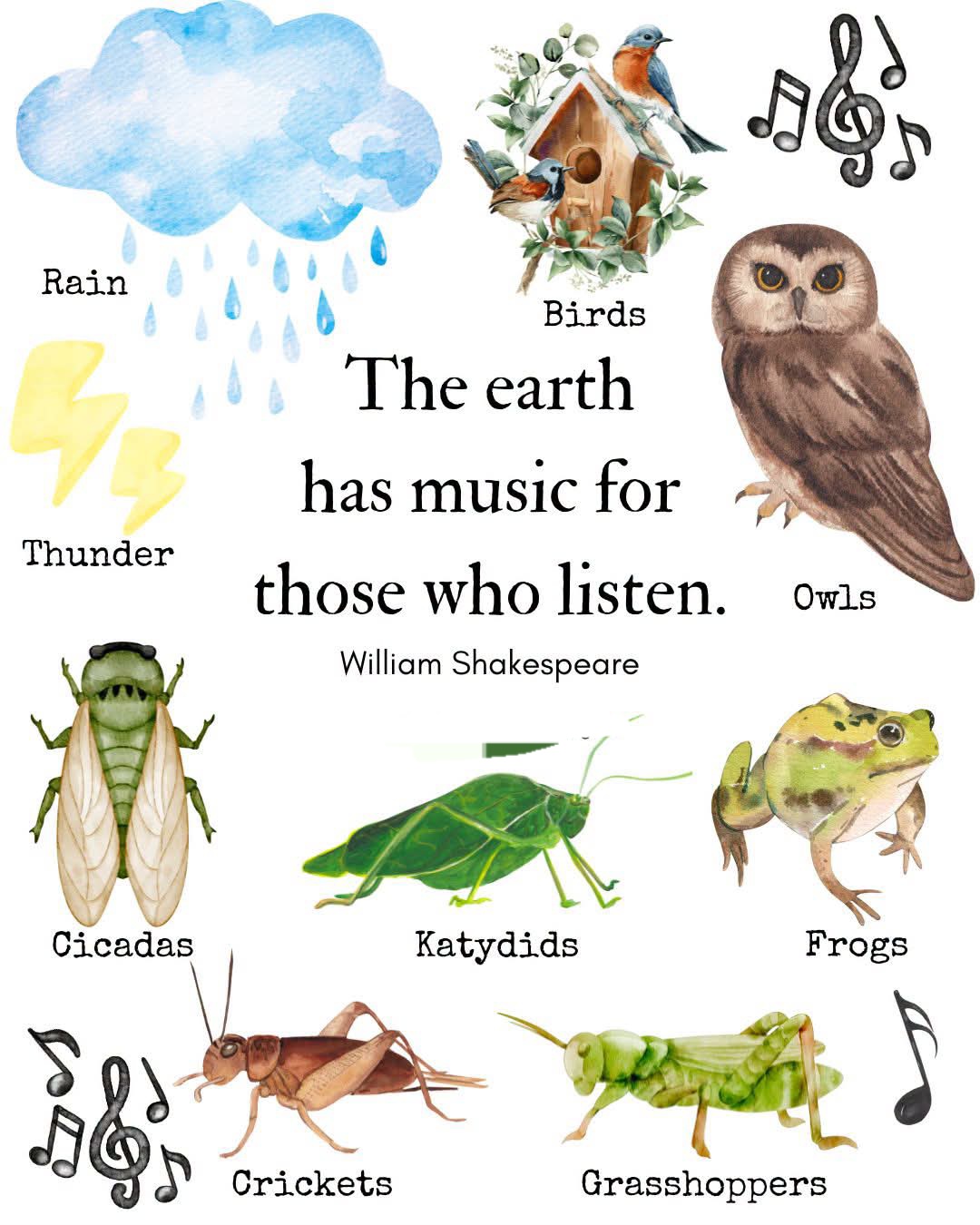
There is a beautiful idea hidden in the picture above: nature is constantly making music, but you have to slow down enough to hear it.
Rain tapping against the roof. Thunder rolling across the sky. Birds calling from the trees. Frogs singing near the water. Crickets chirping after sunset. Katydids buzzing in the darkness. Cicadas filling a summer afternoon with their unmistakable hum.
None of it was written by a composer, yet together it can sound like an orchestra.
The image captures that feeling perfectly with the words, “The earth has music for those who listen.”
There is one important detail, though: although the picture attributes the quote to William Shakespeare, there is no reliable evidence that Shakespeare wrote this exact sentence. It does not appear in his known plays or poems. The wording is often attributed to Shakespeare or George Santayana, while a related version appears in Reginald Vincent Holmes’s poem The Magic of Sound. (Shakespeare Geek)
And honestly, the message doesn’t need a famous name attached to it to be beautiful.
🌧️ Rain Has Its Own Rhythm
One of the easiest sounds to overlook is rain.
At first, you might hear only a soft tapping. But listen carefully and there are layers everywhere—the gentle patter on leaves, drops hitting windows, water running through gutters and the occasional heavier splash when rain lands on a puddle.
A rainy day can completely change the sound of a familiar garden.
Instead of birds dominating the background, you may hear water everywhere.
And when the rain finally stops, the world often seems unusually quiet for a moment.
⛈️ Thunder Is Nature’s Deepest Drum
Thunder doesn’t sound the same twice.
Sometimes it is one enormous crack that makes the windows seem to shake. Other times it rolls slowly across the sky, rumbling for several seconds.
It is easy to think of thunder as simply noise, but when you stop and listen, it has rhythm, volume and movement—almost like an enormous drum being played somewhere beyond the horizon.
🐦 Birds Provide the Morning Concert
For many people, birds are the first musicians they hear each day.
A garden can have several different bird calls happening at once. Some are short and sharp. Others are long, melodic songs.
The fascinating thing is that birds aren’t simply making random sounds. Their vocalizations can be used for communication, territory, courtship and warnings.
Early morning is often one of the best times to notice them.
Before traffic, appliances and everyday activity become loud, even a small garden can suddenly sound alive.
🦉 The Night Has a Different Sound
When the sun goes down, the orchestra doesn’t disappear.
It changes.
Owls may call from trees or other elevated locations. Frogs become more noticeable around ponds and damp areas. Crickets begin their evening chorus, while katydids add their distinctive nighttime sounds.
The result can be surprisingly peaceful.
You may not see many of the creatures making the sounds, but their presence is unmistakable.
🐸 Frogs Sing From the Water
A pond, ditch, wetland or even a temporary puddle can become a nighttime concert hall for frogs.
Different frog species have different calls, and some can be surprisingly loud for such small animals.
During warm evenings, their calls can overlap until it seems as though the entire landscape is participating.
Frogs are also a wonderful reminder that a healthy outdoor space isn’t necessarily a silent or perfectly manicured one.
Sometimes a little wildness makes a garden more alive.
🦗 Crickets Are the Sound of Summer
Few sounds are more strongly associated with warm evenings than crickets.
Their steady chirping can make an ordinary backyard feel peaceful and nostalgic.
Cricket sounds are produced through a process called stridulation, in which insects rub body parts together to create sound. Katydids use a similar general mechanism. (john-muresianu.medium.com)
And once you notice the sound, you may suddenly realize just how many crickets are around you.
🌿 Katydids Add Their Own Voice
Katydids are another nighttime musician.
Their calls can be surprisingly loud, especially considering how difficult the insects can be to locate.
They often remain hidden among vegetation, meaning you may hear one repeatedly without ever seeing it.
That is part of the magic.
Nature doesn’t always show you the musician.
Sometimes you only get the song.
☀️ Cicadas Bring the Summer Volume
Then there are cicadas—the loud ones.
When cicadas become active, they can completely transform the soundscape.
Their buzzing can seem almost overwhelming when you’re standing beneath a tree filled with them.
But that sound is also temporary. Eventually the season changes, the cicadas quiet down, and another group of sounds takes their place.
Nature has a soundtrack that changes throughout the year.
🎵 Every Season Has Its Own Song
Spring might bring rain, frogs and returning birds.
Summer can bring cicadas, katydids, crickets and evening bird calls.
Autumn has wind through dry leaves, migrating birds and cooler nighttime sounds.
Winter can be surprisingly quiet, with wind, falling snow in some regions and the occasional call of a winter bird.
The soundtrack is never exactly the same.
Even the same backyard can sound completely different from one month to the next.
👂 The Problem Is That We Don’t Always Listen
Modern life gives us an enormous amount of noise.
Cars.
Televisions.
Phones.
Notifications.
Air conditioners.
Vacuum cleaners.
Music.
Traffic.
Conversations.
Sometimes we become so accustomed to artificial sound that we forget how much is happening outside.
That’s why sitting quietly outdoors for even ten minutes can feel different.
You begin noticing things that were there all along.
A bird calling from a distant tree.
Leaves moving in the breeze.
An insect buzzing nearby.
Water dripping from a plant after rain.
A frog calling from somewhere you can’t see.
Suddenly, the garden doesn’t feel silent at all.
🌳 You Don’t Need a Huge Garden
You don’t need to live in the countryside to experience nature’s soundtrack.
A balcony can have birds.
A small backyard can have insects.
A neighborhood tree can attract songbirds.
A nearby park can provide dozens of natural sounds.
Even an open window can be enough.
The trick isn’t finding a perfect location.
It’s paying attention.
📵 Try a “Listening Walk”
The next time you go outside, try something simple.
Leave your phone in your pocket.
Don’t play music.
Don’t talk for a few minutes.
Just walk slowly and listen.
How many different sounds can you identify?
Can you hear birds?
Wind?
Insects?
Water?
Leaves?
Distant traffic?
Perhaps you’ll hear something you can’t identify at all.
That’s okay.
You don’t have to know the name of every sound to appreciate it.
❤️ Sometimes the Best Things Are Free
One of the most beautiful things about nature’s music is that there is no admission fee.
You don’t need expensive equipment.
You don’t need a concert ticket.
You don’t even need to leave home.
Sometimes the best seat in the house is a chair in the backyard after sunset.
Sit down.
Take a breath.
Listen.
The world has been making this music all along.
We just don’t always stop long enough to hear it.
🌎 What Does Nature Sound Like Where You Live?
Is it birds in the morning, rain on the roof, frogs at night, crickets in the garden, cicadas in summer—or something completely different?
What’s your favorite sound from nature? 🐦🌧️🐸🦗🌿🎶
One small note for accuracy: the quote in the image is widely attributed to Shakespeare, but that attribution isn’t supported by Shakespeare’s surviving works. The exact origin remains uncertain, with Reginald Vincent Holmes’s related poem The Magic of Sound being one proposed source. (Literature Stack Exchange)
