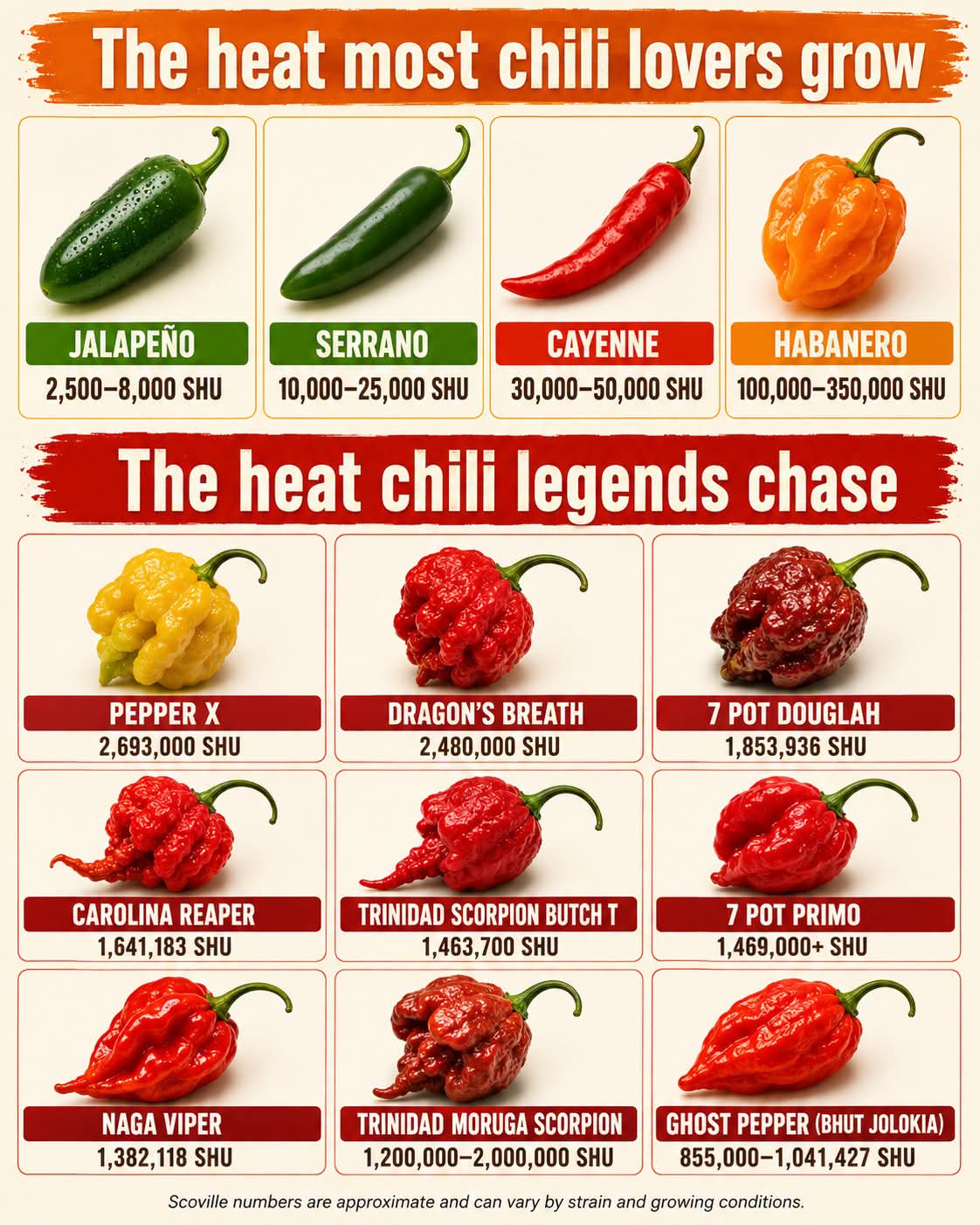
The Hottest Chili Peppers Many Chili Lovers Grow 🌶️🔥
For some gardeners, growing peppers is about having a few jalapeños ready for salsa.
For others, that’s nowhere near hot enough. 😂
There is a whole world of superhot chili peppers grown by gardeners who love the challenge of producing peppers with incredible heat. These peppers can reach hundreds of thousands—or even millions—of Scoville Heat Units.
But which peppers are the serious chili lovers growing?
And just how hot can a homegrown pepper actually get?
🌶️ What Makes a Chili Pepper Hot?
The heat in chili peppers comes primarily from capsaicin and related capsaicinoids.
Capsaicin activates receptors that create the sensation of burning. The amount of these compounds is what determines how intensely hot a pepper feels.
The traditional way of expressing pepper heat is the Scoville Heat Unit (SHU) scale. Modern laboratory testing measures capsaicinoid concentrations and converts the results into SHU. (Guinness World Records)
For comparison, a typical jalapeño is only around 3,000–8,000 SHU.
That sounds hot—until you put it next to a superhot pepper.
🔥 Pepper X: The Current Record Holder
If you’re talking about the officially recognized hottest chili pepper, Pepper X currently holds the Guinness World Records title.
Pepper X has an average rating of approximately 2,693,000 Scoville Heat Units. Guinness World Records recognized it in 2023, when it surpassed the Carolina Reaper. (Guinness World Records)
And yes…
That’s more than 300 times the heat of a typical jalapeño. (Guinness World Records)
Pepper X was developed by pepper breeder Ed Currie, who also created the Carolina Reaper.
The pepper is a Capsicum chinense cultivar and is known for its extremely wrinkled appearance.
For most people, this isn’t an everyday cooking pepper.
It’s an extreme superhot.
🌶️ Carolina Reaper
Before Pepper X took the title, the Carolina Reaper ruled the world of superhot peppers.
The Reaper was officially recognized as the world’s hottest chili pepper in 2013 and held that title until 2023.
Its certified average was about 1.64 million SHU, with individual peppers capable of testing considerably higher. (Wikipédia)
Despite the frightening heat, Carolina Reapers are also known for having a fruity character.
The pepper has a distinctive wrinkled appearance and a little tail at the end that gives it its famous name.
For gardeners who love growing superhots, the Carolina Reaper remains one of the most recognizable varieties.
👻 Ghost Pepper
The Ghost Pepper, also known as Bhut Jolokia, was another landmark in the history of superhot peppers.
It became the first pepper to officially push past the one-million-SHU range when it was recognized by Guinness in 2007. (Beaufort County Center)
Ghost peppers originated in northeastern India and became famous around the world for their intense heat.
Today, they don’t hold the record—but they’re still extremely hot.
For many chili enthusiasts, the Ghost Pepper is a classic superhot that deserves a place in the garden.
🦂 Trinidad Scorpion
The Trinidad Scorpion family includes some seriously powerful peppers.
The Trinidad Moruga Scorpion has been measured at around 1.2 million SHU in recognized testing, putting it firmly into superhot territory. (Wikipédia)
These peppers are particularly popular among people who enjoy making extremely hot sauces.
They’re also visually interesting, with wrinkled pods that look almost as intimidating as they taste.
🌶️ Habanero
Compared with Pepper X or a Carolina Reaper, a habanero might seem almost tame.
It isn’t.
Habaneros typically fall around 100,000–350,000 SHU, depending on variety and growing conditions. (Wikipédia)
They’re intensely hot but also wonderfully fruity and aromatic.
That’s one reason habaneros remain so popular in home gardens.
You don’t need a pepper measured in the millions to make an incredibly spicy sauce.
A few habaneros can transform a recipe.
🌱 Why Do Gardeners Grow Such Hot Peppers?
The obvious question is:
Why would anyone deliberately grow something this hot? 😂
For many gardeners, it’s about the challenge.
Growing superhot peppers can be surprisingly rewarding because you’re not simply planting a seed and waiting for a pepper to appear.
You’re watching a plant develop over a long growing season, waiting for the pods to mature, and seeing whether the fruit develops the characteristics you’re looking for.
There’s also the culinary side.
A single superhot pepper can provide enough heat for a large batch of hot sauce.
🧑🌾 Growing Superhot Peppers Takes Patience
Many of the hottest peppers belong to Capsicum chinense, and they can take considerably longer to mature than common garden peppers.
They generally appreciate:
- Plenty of sunlight
- Warm temperatures
- Consistent moisture
- Well-drained soil
- Adequate nutrition
- A long growing season
Starting seeds indoors can be particularly helpful in regions where the outdoor growing season isn’t long enough for the peppers to fully mature.
The exact growing requirements vary by cultivar.
🌡️ Does Growing a Pepper Make It Hotter?
This is where things get interesting.
A pepper’s genetics establish much of its potential heat, but growing conditions can influence the actual amount of capsaicinoids produced.
Factors such as plant stress, temperature, water availability, maturity, and growing conditions can affect individual pods.
That’s why you shouldn’t assume every pepper of a particular variety will have exactly the same Scoville rating.
Even within the same variety, heat can vary.
🌶️ Why Homegrown Peppers Can Be So Different
Two peppers from the same plant may not taste exactly alike.
One might be noticeably hotter than another.
Another might have more fruity flavor.
And one might have thicker walls or a different texture.
That’s part of the fun of growing your own.
You get to see what your particular plants produce.
🧤 Be Careful When Handling Superhots
This part is important.
Superhot peppers aren’t just “really spicy.”
Their capsaicin content can be high enough to cause significant irritation.
When handling very hot peppers, especially when cutting large quantities, wear gloves and avoid touching your eyes, nose, mouth, or other sensitive areas.
Capsaicin can remain on your hands even after you think you’ve washed them.
If you’re making hot sauce or processing a large number of superhot peppers, good ventilation can also be helpful because airborne pepper compounds can irritate the eyes and respiratory system.
🍳 How Do Chili Lovers Actually Use Them?
Most people aren’t eating a Pepper X or Carolina Reaper like an apple.
Instead, superhot peppers are generally used in very small quantities.
A tiny amount can add tremendous heat to:
- Hot sauce
- Salsa
- Chili
- Marinades
- BBQ sauces
- Pickles
- Spicy jams
- Seasoning blends
- Homemade pepper powders
You can also preserve peppers by drying them and grinding them into powder.
That makes it much easier to add tiny amounts to recipes.
🥵 You Don’t Need the World’s Hottest Pepper
There’s a tendency among chili enthusiasts to keep asking:
“What’s hotter?”
But hotter doesn’t always mean better.
A habanero may provide a wonderful fruity flavor.
A jalapeño can give you a fresh, grassy heat.
A cayenne can add straightforward warmth.
And a superhot can provide extreme intensity—but it can also overwhelm the other flavors in a dish.
The best pepper is often the one that gives you the right combination of flavor and heat for what you’re cooking.
🌶️ A Quick Heat Comparison
| Chili Pepper | Approximate Heat |
|---|---|
| Jalapeño | 3,000–8,000 SHU |
| Habanero | 100,000–350,000 SHU |
| Ghost Pepper | Around 1 million SHU |
| Trinidad Moruga Scorpion | Around 1.2 million SHU |
| Carolina Reaper | About 1.64 million SHU average |
| Pepper X | About 2.693 million SHU average |
The exact heat of individual peppers can vary, so these numbers are best viewed as general comparisons rather than guarantees. (Guinness World Records)
🌱 Would You Grow One?
There’s something almost addictive about growing hot peppers.
You plant a tiny seed.
Weeks later, you have a little green plant.
Then flowers appear.
Then tiny peppers.
And eventually those tiny peppers turn into some of the hottest fruits on Earth.
For gardeners who love a challenge, that’s pretty exciting.
But when you’re dealing with peppers measured in millions of Scoville Heat Units, it’s definitely a hobby that deserves some respect. 🌶️🔥
🌶️ What’s Your Favorite Hot Pepper?
Would you rather grow:
🌶️ Jalapeños — flavorful and manageable
🔥 Habaneros — fruity and seriously hot
👻 Ghost Peppers — superhot classic
🦂 Trinidad Scorpions — extreme heat
☠️ Carolina Reapers — seriously intense
🔥 Pepper X — the current Guinness record holder
Or are you the type of gardener who says:
