🌲 The Hidden Forest Internet: How Trees Communicate Beneath Our Feet
When we walk through a forest, it’s easy to focus on what we can see—the towering trunks, rustling leaves, birds singing in the canopy, and sunlight filtering through the branches.
But beneath the forest floor lies a hidden world that is every bit as fascinating as the trees above.
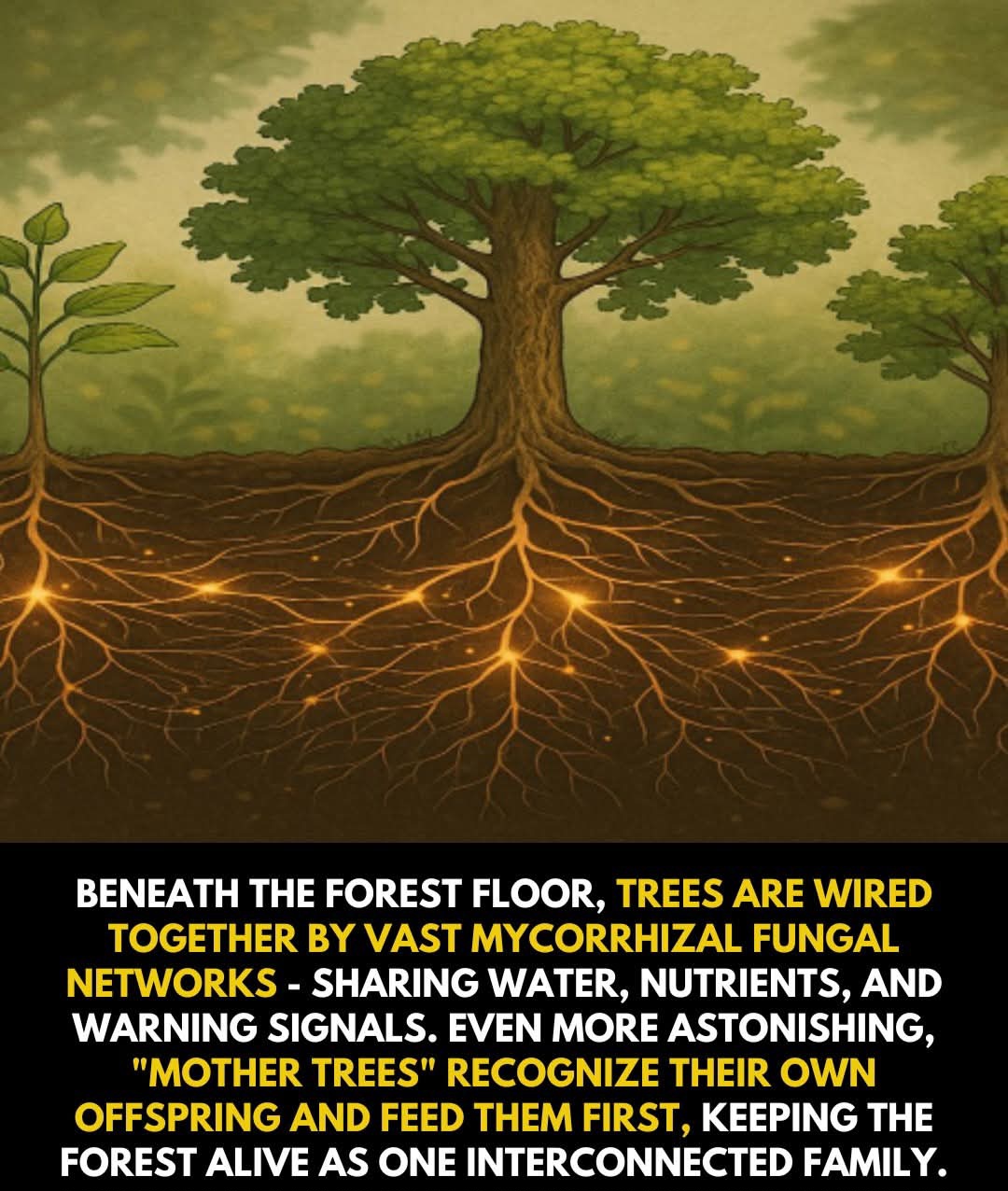
Hidden underground is a vast network of fungal threads connecting plants and trees in ways that scientists are still working to fully understand. This remarkable system, known as the mycorrhizal network, has transformed our understanding of forests and revealed that nature is far more interconnected than we once believed.
🍄 What Is the Mycorrhizal Network?
The word “mycorrhiza” comes from Greek words meaning “fungus root.”
It describes a partnership between fungi and plant roots.
Tiny fungal filaments spread through the soil, attaching themselves to tree roots and extending far beyond what roots alone could reach. These microscopic threads create a sprawling underground network that links multiple plants and trees together.
Some researchers have compared it to an underground internet because it allows resources and chemical signals to move through the forest ecosystem.
🌳 A Partnership Millions of Years Old
This relationship isn’t new.
Scientists believe mycorrhizal partnerships have existed for hundreds of millions of years and played a major role in helping plants colonize land.
The arrangement benefits both sides:
🍄 Fungi receive sugars produced by trees through photosynthesis.
🌳 Trees gain improved access to water and nutrients such as phosphorus and nitrogen.
This mutual partnership helps entire ecosystems thrive.
💧 Sharing Water and Nutrients
One of the most fascinating discoveries is that connected trees may exchange resources through these underground fungal networks.
Research suggests that carbon, water, and nutrients can move between connected plants under certain conditions.
For example:
- Larger trees may support younger seedlings.
- Trees growing in sunny areas may share carbon with shaded neighbors.
- Nutrients can sometimes move toward plants that need them most.
Rather than functioning as isolated individuals, forests often behave more like interconnected communities.
👵 The Mystery of “Mother Trees”
Some of the most intriguing research involves large, mature trees sometimes referred to as “mother trees.”
These ancient giants often occupy central positions within forest networks and maintain extensive underground connections.
Studies have suggested that mature trees can transfer carbon and nutrients to nearby seedlings, particularly those that are genetically related.
This support may help young trees survive in shaded conditions where sunlight is limited.
The idea has captured public imagination because it suggests forests possess levels of cooperation that many people never expected.
🚨 Warning Signals Underground
Trees also communicate through chemical signals.
When a tree experiences stress from drought, disease, or insect attacks, chemical messages may travel through roots, fungal networks, or airborne compounds.
Neighboring trees can sometimes respond by activating defensive mechanisms before the threat reaches them.
While trees don’t “talk” in the human sense, they do exchange information in sophisticated biological ways.
🌲 The Stumps That Refuse to Die
Perhaps one of the most astonishing discoveries involves old tree stumps.
In several forests, researchers have found stumps that remain alive long after their trunks have been cut down or damaged.
Without leaves, these stumps cannot photosynthesize enough to sustain themselves.
Yet some continue to survive because connected trees appear to provide resources through shared root systems and fungal networks.
It’s a striking reminder that life in the forest is often more cooperative than it appears.
🤝 Competition and Cooperation
For many years, forests were viewed primarily through the lens of competition.
Trees compete for:
☀️ Sunlight
💧 Water
🌱 Nutrients
🏞 Space
While competition certainly exists, modern research shows that cooperation also plays an important role.
Forests are dynamic systems where both competition and mutual support occur simultaneously.
The result is a resilient ecosystem capable of adapting to changing conditions.
🔬 What Scientists Are Still Learning
Although discoveries about mycorrhizal networks have generated excitement, scientists continue to study exactly how these systems function.
Researchers are exploring questions such as:
- How much resource sharing occurs?
- Which fungi are involved?
- How do different tree species interact?
- What role do networks play in forest recovery?
As new studies emerge, our understanding of forest ecology continues to evolve.
🌎 Why This Matters
Understanding underground forest networks may help us:
🌲 Protect forests
🌱 Improve reforestation efforts
🍄 Preserve biodiversity
🌍 Better understand ecosystem resilience
Healthy forests provide countless benefits, including clean air, water regulation, wildlife habitat, and carbon storage.
The more we learn about their hidden connections, the better equipped we are to protect them.
✨ Nature’s Silent Conversation
Standing in a forest can feel peaceful and quiet.
But beneath every step, an extraordinary world is at work.
Fungal threads weave through the soil.
Roots connect with neighboring plants.
Nutrients move from one organism to another.
Signals travel through unseen pathways.
Life supports life in ways that often go unnoticed.
The forest may seem silent, but beneath the ground, a complex and ancient conversation never stops.
The Bottom Line
The mycorrhizal network reveals a side of nature that many people never see—a hidden world of cooperation, communication, and connection.
From ancient mother trees nurturing seedlings to fungal networks helping distribute resources, forests are far more interconnected than we once imagined.
Every walk through the woods takes place above an invisible web of life that has existed for millions of years.
And while we may not hear its voice, the forest is constantly communicating beneath our feet.
🌲🍄 Have you ever looked at a forest differently after learning about the hidden world beneath the soil?
