4. Could Boots Have Been Used as a Signal?
One of the most interesting explanations involves communication.
Before modern telecommunications made it easy to contact someone instantly, rural families and ranch workers had to rely on simple visual clues.
Some accounts describe boots being positioned on fence posts as a way of indicating where a rancher or farmer could be found.
According to this version of the tradition, the direction of the boot’s toe could provide information. A boot pointing toward the house could indicate that the rancher was home, while a boot pointing toward a particular pasture or working area could indicate where the person was spending the day.
It is a fascinating idea because it illustrates how people living in large rural areas could develop simple forms of communication without telephones.
However, this explanation should be treated as folklore rather than a universal historical rule.
There is no evidence that every cowboy or rancher across the American West used boots according to one standardized code. Different communities may have developed their own customs, and many modern explanations have probably become mixed together over time.
5. Protecting the Fence Post
There is also a practical explanation that makes surprisingly good sense.
A wooden fence post is exposed to rain, snow, ice, sunlight, and changing temperatures. Water entering the top of untreated wood can contribute to deterioration over time.
An old boot placed over the top of the post can act as a crude cover.
It will not transform an ordinary fence into a perfectly protected structure, but the basic idea is practical enough that some people have suggested this as one reason boots ended up on fence posts.
This may also explain why the practice could continue even after its original meaning was forgotten.
A rancher may have seen someone else doing it, copied the habit, and eventually the boot simply became part of the landscape.
6. Why Are There Sometimes Several Boots?
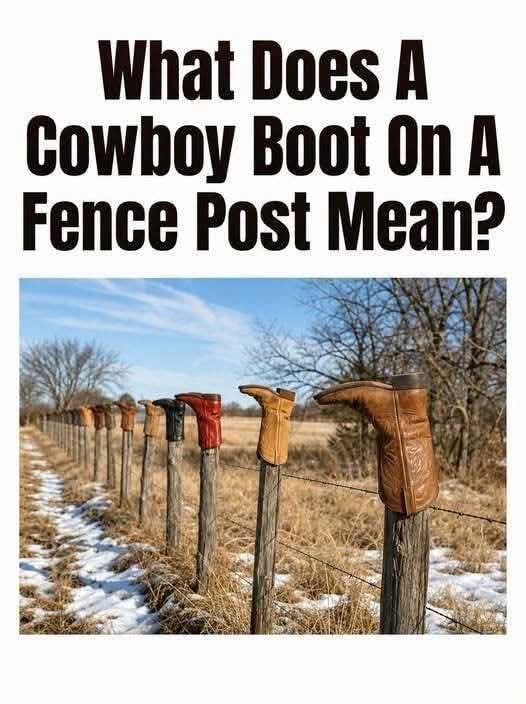
The image shows something particularly interesting: multiple fence posts carrying boots.
That can make the tradition look like a carefully organized system.
But there does not appear to be one universal rule saying that a certain number of boots represents a specific message.
A fence lined with boots could develop gradually.
One person places an old boot on a post.
Another follows.
Over the years, more worn-out boots are added.
Eventually, the fence itself becomes part of the local character of the property.
In other cases, several boots may have been deliberately placed there as decoration, a memorial, or a way of preserving a family tradition.
Some ranchers have described collections of old boots accumulating on fence posts simply because workers kept adding their discarded footwear.
7. It Is Not Necessarily a “Secret Cowboy Code”
This is one of the most important points to understand.
You may find claims online saying that every cowboy boot on every fence has a precise meaning.
The reality is much less certain.
Researchers, ranchers, writers, and people familiar with Western culture have offered several explanations, but there is no universally accepted interpretation.
Even the National Cowboy and Western Heritage Museum’s ethnology curator has noted that the exact origins of the custom are uncertain, with possibilities ranging from memorials to jokes and practical uses.
That uncertainty actually makes the tradition more interesting.
The boot does not have to have one fixed meaning.
Its meaning may belong to the person who placed it there.
8. A Tradition That Changes From Place to Place
The practice has been reported in parts of Texas and throughout other areas of the western and central United States, including places such as Wyoming, Nebraska, Oklahoma, South Dakota, and surrounding ranching regions.
But rural traditions rarely follow state borders perfectly.
One ranch may use boots as memorials.
Another may simply place worn-out footwear on fence posts.
Someone else may use them as decoration.
Another person may have heard an old family story about using a boot to indicate whether someone was home.
Two fences can look almost identical while carrying completely different stories.
9. The Boot as a Symbol of Hard Work
Perhaps the most beautiful interpretation is also the simplest.
A cowboy boot represents the person who wore it.
Think about everything a working boot can experience.
It walks through dust.
It crosses muddy ground.
It stands in freezing temperatures.
It spends hours in the saddle.
It gets scratched by branches, soaked by rain, covered in dirt, and worn down by thousands of steps.
Eventually, it becomes too damaged to continue doing the job for which it was made.
Placing it on a fence post can therefore feel like giving that boot a final place of honor.
It has finished working.
But it remains part of the landscape.
10. Why the Tradition Still Fascinates People Today
Modern technology has changed rural life dramatically.
People no longer need to rely on a boot pointing toward a pasture to know where someone is working. A phone can answer that question instantly.
Yet traditions do not always disappear simply because the original practical reason disappears.
They can become symbols.
They can become family habits.
They can become local landmarks.
And sometimes they simply become part of the scenery.
That is why an old boot on a fence post can still catch the attention of someone driving past decades later.
It looks like a message.
And perhaps it is.
Just not necessarily one that everyone can decode.
What Should You Do If You See One?
If you encounter a boot on a fence post while traveling through rural country, the safest assumption is that it belongs to someone and may have sentimental value.
Don’t remove it simply because it looks old.
Don’t assume that it has been abandoned.
And don’t automatically interpret it as a universal signal.
It could be someone’s memorial, a family tradition, a piece of folk art, or simply an old boot that found a new purpose.
As with many rural customs, the person who placed it there may be the only person who knows the complete story.
The Quiet Language of the Fence
There is something wonderfully human about the tradition.
A boot is an ordinary object. It is made to protect someone’s feet.
A fence post is an ordinary piece of wood. It is made to mark a boundary or keep animals where they belong.
Put the two together, however, and they can become something much more meaningful.
The boot might remember a cowboy.
It might honor a horse.
It might represent years of hard work.
It might simply protect a fence post.
Or it might have been placed there because someone thought an old boot deserved one last place in the countryside.
There is no single answer.
And perhaps that is precisely why the sight remains so memorable.
The next time you see an old cowboy boot standing upside down on a fence post, don’t immediately think of it as discarded footwear.
It may be a tiny piece of rural history standing quietly beside the road.
And sometimes, the quietest objects tell the most interesting stories.
