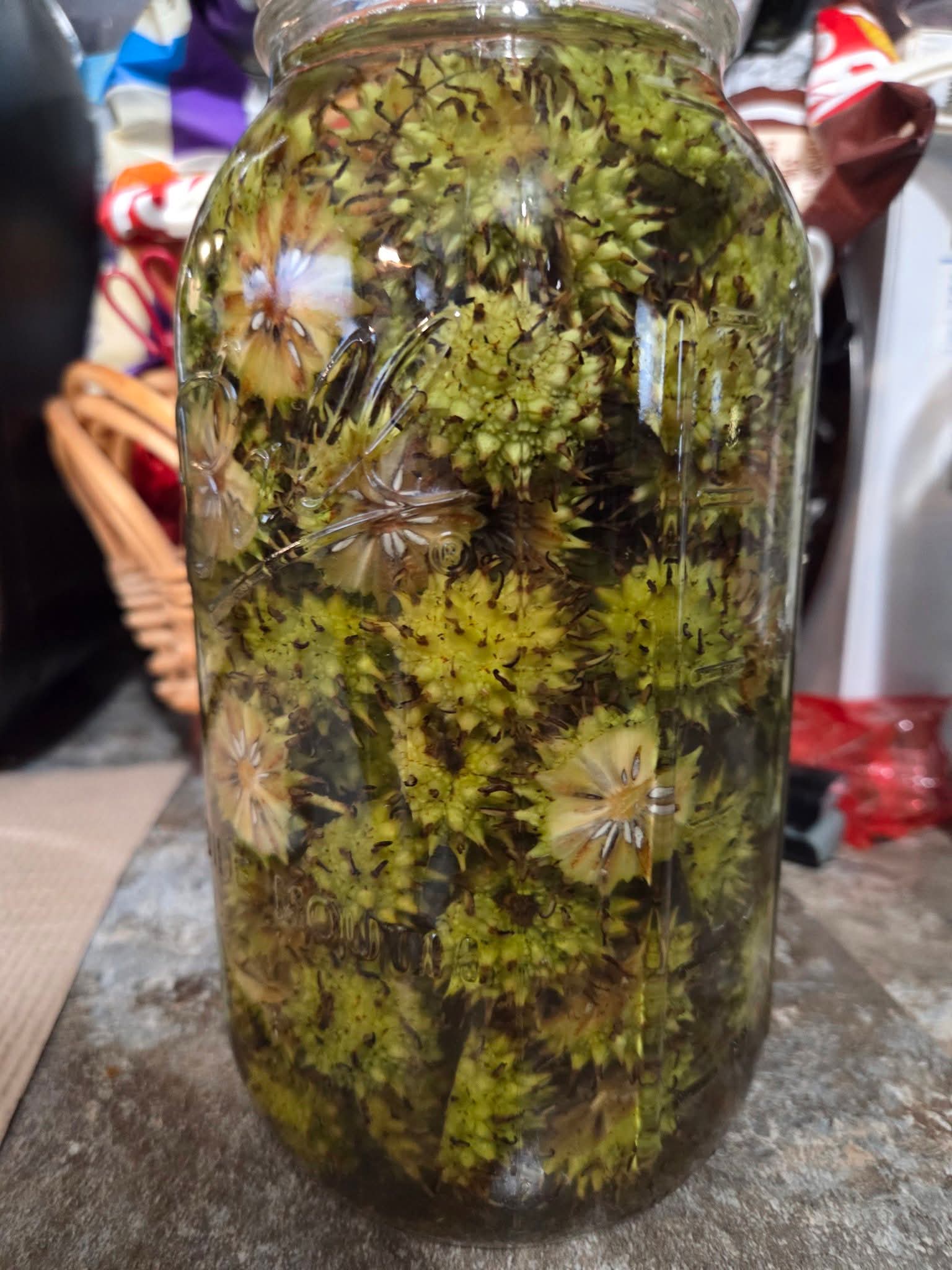
traditional herbal tincture rather than a natural version of Tamiflu. Sweet gum (Liquidambar styraciflua) does contain shikimic acid, a precursor used in making oseltamivir (Tamiflu), but that does not mean a sweet-gum tincture works like oseltamivir. Evidence for treating influenza with sweet gum itself is lacking.
Here’s a publishable recipe with that distinction made clear:
Homemade Sweet Gum Tincture 🌿✨
If you have a sweet gum tree nearby, you may already have noticed its unusual little green, spiky seed balls scattered around the ground.
These familiar “gumballs” have a long history of traditional use, and sweet gum (Liquidambar styraciflua) has been studied for a variety of plant compounds, including shikimic acid. Shikimic acid is an important starting material in the production of oseltamivir, the active ingredient in Tamiflu.
That connection has made sweet gum especially interesting to herbal enthusiasts. However, having shikimic acid in the plant does not make a homemade tincture equivalent to Tamiflu, and there isn’t good clinical evidence showing that sweet gum tincture treats or prevents influenza.
Still, if you’re interested in making a traditional herbal preparation, here’s a simple method.
🌿 Sweet Gum Tincture
Ingredients
- Fresh green sweet gum balls from Liquidambar styraciflua
- 80-proof vodka or another food-grade alcohol around 40% ABV
- A clean glass jar with a tight-fitting lid
You’ll Also Need
- A knife or sturdy kitchen shears
- Cutting board
- Fine-mesh strainer or cheesecloth
- Dark glass bottles or small jars for storage
- Label and marker
Step 1: Gather the Green Gumballs
Choose firm, green sweet gum seed balls from a tree you have positively identified as Liquidambar styraciflua.
Avoid anything that has been exposed to lawn chemicals, pesticides, herbicides, or other contaminants.
Give the gumballs a good rinse and allow them to dry completely.
Important: Sweet gum balls are extremely hard and covered with sharp points, so use care when cutting them.
Step 2: Chop Them
Cut the green gumballs into smaller pieces.
You don’t need to pulverize them. Smaller pieces simply give the alcohol more surface area to work with during the extraction.
Because they’re very tough, use a sturdy knife and work slowly.
Step 3: Fill the Jar
Place the chopped green sweet gum balls into a clean glass jar.
Fill the jar loosely rather than packing everything down tightly.
Pour vodka over the plant material until it is completely covered.
Leave about an inch of liquid above the plant material.
Step 4: Seal and Shake
Close the jar tightly and give it a good shake.
Place the jar somewhere cool and dark.
Shake it gently once a day, making sure the plant material remains submerged.
Step 5: Let It Infuse
Allow the tincture to infuse for approximately 4–6 weeks.
Keep it away from direct sunlight and heat.
As the alcohol extracts compounds from the plant material, the liquid will gradually take on a deeper color and aromatic scent.
Step 6: Strain
When you’re ready to finish the tincture, pour the contents through cheesecloth or a fine-mesh strainer.
Press the plant material gently to recover as much liquid as practical.
Discard the spent plant material.
Step 7: Bottle and Label
Transfer the strained tincture into clean dark glass bottles.
Label the bottle with:
Sweet Gum Tincture
Date Made: __________
Plant: Liquidambar styraciflua
Store it tightly closed in a cool, dark place.
🌿 Why Are Green Sweet Gum Balls Interesting?
Sweet gum has been used traditionally for coughs, colds, wounds, and other ailments. Modern research has identified numerous compounds in different parts of the tree, including shikimic acid in the seeds.
The interesting part is that sweet gum is one of the plant sources that contains shikimic acid, which is used as a precursor in producing oseltamivir.
But there’s an important difference between containing a chemical compound used to manufacture a medication and being clinically equivalent to that medication.
A homemade tincture hasn’t been shown to have the same antiviral activity, concentration, purity, dosage, or safety profile as prescription oseltamivir.
⚠️ A Few Important Safety Notes
This is a traditional herbal preparation, not a proven treatment for influenza or other viral infections.
There isn’t an established medical dose for sweet gum preparations, and clinical evidence is limited.
Don’t use a homemade tincture in place of medical treatment for influenza, particularly for someone at higher risk of complications.
Pregnant or breastfeeding people should avoid medicinal use unless advised by a qualified healthcare professional, because safety information is insufficient.
Also, make absolutely certain you’ve correctly identified the tree before harvesting. Never use plant material collected from areas that may have been chemically treated.
🌱 A Simple Herbal Tradition
There is something wonderfully old-fashioned about being able to walk outside, collect something that most people consider yard debris, and turn it into a traditional herbal preparation.
Those prickly little green gumballs may not be a substitute for modern antiviral medicine, but their chemistry certainly makes sweet gum an interesting plant to learn about.
And if you have a sweet gum tree producing more gumballs than you know what to do with, this is certainly a fascinating way to explore one of its traditional uses.
Have you ever made a sweet gum tincture? 🌿
Would you try it, or do you simply leave those prickly gumballs where they fall?
