🧠🔄 Turn Your Phone Upside Down and Blink Once… Can You See It?
Have you ever looked at a picture and suddenly thought, “Wait… that can’t possibly be right!” 👀
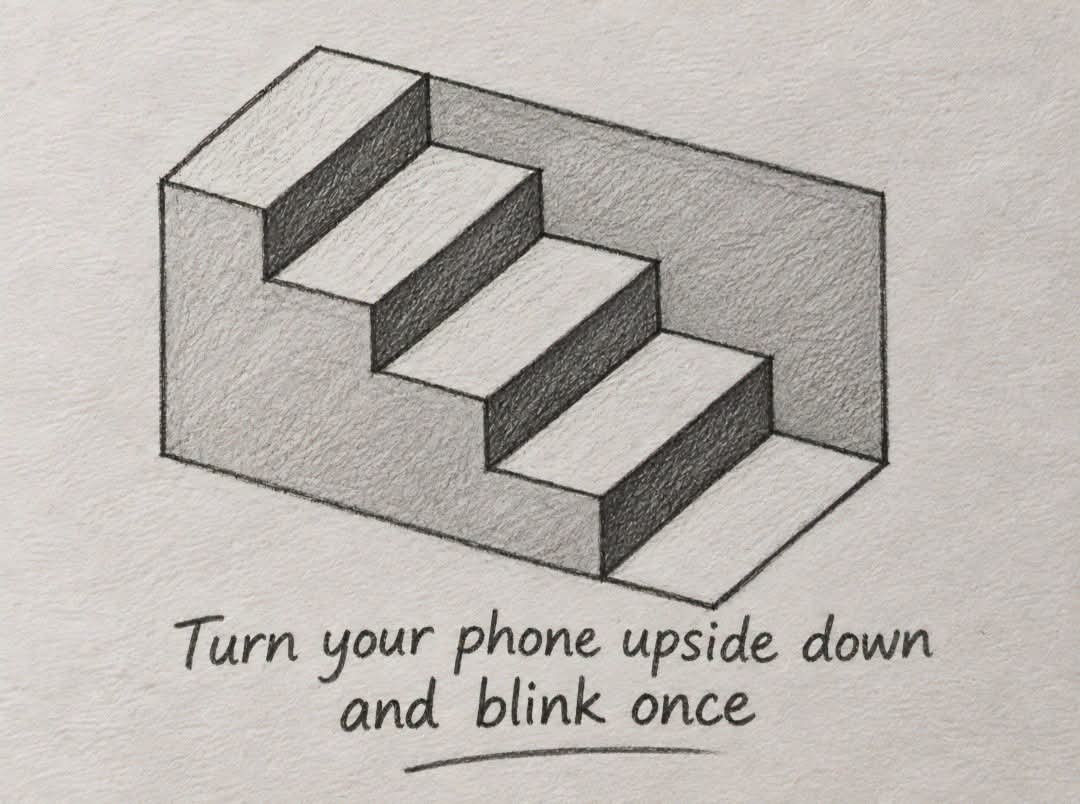
This staircase is one of those wonderfully frustrating optical illusions that makes your brain question something as simple as up and down.
The instruction in the image says:
“Turn your phone upside down and blink once.”
And suddenly, the staircase may seem to change direction or become even more confusing.
But what’s really happening?
🪜 The Staircase That Doesn’t Quite Make Sense
At first glance, the drawing looks like an ordinary staircase.
You can clearly see individual steps. Each step has a tread, a vertical face, and edges that appear to connect naturally with the surrounding walls.
Your brain is extremely good at taking those visual clues and building a three-dimensional interpretation of the picture.
The problem is that the whole arrangement doesn’t obey the rules of a real staircase.
This type of impossible staircase is closely related to the famous Penrose stairs, an optical illusion in which the steps appear to continually rise—or fall—while somehow returning to where they started. (PubMed Central (PMC))
And that’s where your brain gets trapped.
👀 Why Does Your Brain Fall for It?
Your visual system doesn’t analyze every part of an image as if it were a mathematical blueprint.
Instead, it rapidly interprets things like:
- angles
- shadows
- edges
- perspective
- overlapping surfaces
- relative size
- familiar shapes
A single section of this staircase looks perfectly reasonable.
The next section does too.
And the next one.
Your brain keeps connecting those locally sensible pieces into one continuous three-dimensional object.
But when you consider the entire structure at once, the geometry doesn’t work.
Research and explanations of impossible figures describe this as a conflict between locally convincing visual information and the global impossibility of the object. (Scientific American)
Basically, your eyes aren’t necessarily “wrong.”
They’re interpreting the information they’re being given.
The drawing is the trick.
🔄 So Why Turn Your Phone Upside Down?
That’s the fun part.
Rotating an ambiguous image can change which visual relationships your brain emphasizes.
Suddenly, surfaces that seemed to have one orientation may appear to have another. Your brain can reinterpret the staircase from a different perspective, making the illusion feel completely different.
Similar effects occur with other ambiguous staircase illusions. For example, Scientific American has described staircase images in which flipping the image changes which wall appears closer to the viewer. (Scientific American)
So when the image tells you to turn your phone upside down, it’s essentially asking you to force your visual system to reconsider the picture.
And then comes the blink.
👀 Blink.
For a split second, your visual input disappears.
When your eyes open again, your brain reconstructs the scene—and that tiny interruption can make the illusion feel surprisingly dramatic.
🧠 Your Brain Wants the Staircase to Be Real
Here’s what makes these illusions so fascinating.
You already know that a staircase has to follow certain physical rules.
If you’re standing at the bottom, climbing upward should eventually take you higher.
You can’t continuously climb upward around a closed loop and somehow arrive back at your original height.
Yet the picture can make each individual section appear to do exactly that.
Scientific American notes that with impossible staircases, the visual system can make a local interpretation such as “ascending stairs” even though our reasoning tells us that the complete structure can’t exist physically. (Scientific American)
It’s almost like your eyes and your logic are having a tiny argument.
Your eyes: “Looks like stairs.”
Your brain: “Absolutely.”
Your logic: “Those stairs cannot possibly work.”
Your brain: “…Don’t worry about it.” 😂
📐 It’s a 2D Trick
One of the most important things to remember is that this isn’t a normal staircase photographed from a strange angle.
It’s a two-dimensional representation designed to suggest three-dimensional space.
That’s why the illusion works so well.
A real staircase has to occupy actual physical space. A drawing doesn’t have that limitation. Lines can be positioned so that they individually suggest realistic surfaces while the overall object violates three-dimensional geometry.
The University of Reading has discussed impossible-staircase illusions as examples of how our internal visual representation of space can differ from a physically realizable 3D structure. (Archive de l’Université de Reading)
In other words:
The picture doesn’t have to obey reality.
It only has to convince your visual system that it does.
🤯 Why Does It Feel So Strange?
Stairs are particularly effective subjects for optical illusions because they’re extremely familiar.
You’ve probably seen thousands of staircases throughout your life.
Your brain already knows what a step is supposed to look like.
So when it sees:
tread → riser → tread → riser → tread
it immediately starts constructing a staircase in your mind.
You don’t consciously calculate every angle.
You simply recognize it.
That’s exactly what the illusion takes advantage of.
Impossible objects can exploit the brain’s tendency to interpret familiar shapes and spatial relationships quickly rather than stopping to mathematically verify the entire structure. (PubMed Central (PMC))
🪜 The Famous Penrose Connection
The classic Penrose staircase was developed by Lionel Penrose and Roger Penrose and became one of the best-known examples of an impossible object.
Its defining trick is simple:
The staircase appears to continually rise in one direction, yet following it around eventually brings you back to where you began.
That’s obviously impossible in ordinary three-dimensional space.
Yet the drawing can make it look completely convincing.
The illusion became particularly famous through the work of artist M. C. Escher, whose artwork explored impossible architecture, endless staircases, and other contradictions involving perspective and space. (Scientific American)
📱 Try the Challenge Yourself
Now that you’ve read the explanation, try the image again.
1️⃣ Look at it normally.
Follow the stairs slowly from one end to the other.
2️⃣ Turn your phone upside down.
Don’t immediately analyze it.
Just look.
3️⃣ Blink once.
👀
4️⃣ Follow the staircase again.
Does it suddenly feel different?
5️⃣ Try tracing the edges with your eyes.
This is where things can get really weird.
You’ll probably reach a point where you think:
“Wait… where is this staircase actually going?”
😂
🧩 Why Optical Illusions Are So Addictive
There’s something incredibly satisfying about discovering that your own perception can be fooled.
Optical illusions aren’t simply about having “bad eyesight.”
They’re demonstrations of how perception works.
Your brain has to make extremely fast decisions about the world around you. Usually, those shortcuts are useful. You don’t want to spend five minutes calculating the geometry of every chair before sitting down.
But when someone deliberately designs an image to exploit those shortcuts, the same system can produce a bizarre result.
Impossible staircases are particularly good examples because every small piece can look reasonable while the entire object is impossible.
😂 The Best Part?
Even after you understand the trick, you can’t necessarily stop seeing it.
That’s what makes these images so fun.
You can tell yourself:
“It’s impossible.”
You can study the lines.
You can rotate the phone.
You can explain the geometry to someone else.
And yet your brain still wants to see a staircase.
That’s the strange relationship between what we know and what we perceive.
Sometimes knowing the answer doesn’t completely erase the illusion.
👀 Final Challenge
Now send this image to someone without explaining anything.
Just tell them:
“Turn your phone upside down and blink once.”
Then wait. 😂
When they start staring at the staircase like they’ve just discovered a glitch in reality, you’ll know exactly what’s happening.
🪜🧠 So… did the staircase look different when you turned your phone upside down?
Did you see the illusion immediately, or did you have to stare at it for a while? 👀🔄
